When I heard that Harper was going to introduce a motion recognizing "Quebec" (for so it was reported on CBC Radio news last night) as a nation, I have to admit my first reaction was about the politics of it. "Why would Harper want to save Iggy's political bacon like this?" But bigger issues are in play.
Whether the motion is true depends, of course, on what you mean by the "Québécois" and by "a nation". I have no trouble recognizing that the descendents of the habitants represent an ethnic nation, or, as we used to say, a "race".
However, this nation is not coincident with the residents of the province of Quebec. It is a majority in Quebec, and nowhere else, but that isn't the same thing.
If we give in to history, and call this nation/race the Québécois, then the resolution is true. I would even be happy to go further and say that one of the reasons we insist on strong provinces is so that the one jurisdiction in which this nation is the majority has the power it needs to ensure the future of this nation/race.
Trudeau objected to this, because Trudeau was a principled liberal. He didn't think states should be in the business of ensuring futures to nations/races. I admire the way Trudeau insisted on his principles, but I don't share them. Whatever the later excesses of their nationalisms, I am pleased the Canadian Indians and the "Queébécois" told him to buzz off. I am less pleased that my people bought Truedau's principles as a way of fighting separatism. In the end, redrawing the borders of your country is a better thing than teaching your children to be embarrassed at their own identity.
Update: Andrew Coyne has an entire aviary in opposition to the Commons motion recognizing the Québécois as a nation.
Thursday, November 23, 2006

Tuesday, November 21, 2006
Bad Style and Bad Law
Via Larry Solum's excellent Legal Theory Blog, I found Paul Horwitz's 2000 article in the Osgood Hall Law Review entitled, "Law's Expression: The Promise and Perils of Judicial Opinion Writing in Canadian Constitutional Law".
Horwitz's argument is that the style of judical writing makes a difference for the quality of law, particularly constitutional law. The typical judicial "opinion" (note to PH: in Canada, they are referred to as "reasons for judgment") takes an omniscient and dogmatic tone, states the obvious and irrelvant at length and sets out lots of "tests" and "hurdles" that rarely do much of the work of deciding the case. Horwitz not only thinks that this style is boring, but that it is also bad for the law, and although he doesn't make much of a case for his position, I tend to agree.
Instead, Horwitz would like to see a style of "open-textured minimalism." The Pithlord likes the minimalism part, but to the extent I understand what "open-textured" means (Socrates meets Solon, I suppose), I doubt that most judges are really up to the task. Judges are successful lawyers who have avoided creating powerful enemies-- intelligent and hard-working, usually, but not prophets. A few of them -- like Oliver Wendell Holmes or Richard Posner -- have original minds, but even these people are only acceptable as judges to the extetnt they suppress their most original ideas when on the bench.
Horwitz doesn't care for the Oakes test, and presumably would decry the Delgamuukw decision in which Lamer goes on and on at Russian novel length setting out impractical and many-stage tests, while never deciding any issue actually between the parties. So far, the Pithlord can add little more than "Amen" and "Hallelujah".
The Pithlord gets crankier when Horwitz reveals what he thinks of as skookum judicializing. Horwitz is a big fan of the Secession Reference, in which the Court held that Quebec couldn't unilaterally separate, but that a "clear majority on a clear question" would trigger a duty to negotiate the terms of secession. By Lamer-era standards, the decision is a model of clarity and pith. And the underlying political tradeoff is defensible. However, it seems to me that this case shows a bit of a weakness in the Horwitz approach, since the style cannot hide the substantive trickery of the decision. Our Constitution has a detailed set of provisions for its own amendment. Referenda, whether clear or opaque, have no role in those provisions. Legally, the question the Court was asked in 1997 wasn't hard at all: Quebec couldn't secede (except through revolution) unless at least the federal Parliament and six other provinces agreed, and there is no legal requirement for those other entities to consider a Quebec referendum at all.
Whatever its stylistic merits, then, the Secession Reference was lawless. That strikes me as the bigger point.
Technical note: The University of Montreal website with Supreme Court of Canada decisions seems a bit wacky right now, so I haven't tried to hyperlink the decisions referred to. I may get around to it someday.
Horwitz's argument is that the style of judical writing makes a difference for the quality of law, particularly constitutional law. The typical judicial "opinion" (note to PH: in Canada, they are referred to as "reasons for judgment") takes an omniscient and dogmatic tone, states the obvious and irrelvant at length and sets out lots of "tests" and "hurdles" that rarely do much of the work of deciding the case. Horwitz not only thinks that this style is boring, but that it is also bad for the law, and although he doesn't make much of a case for his position, I tend to agree.
Instead, Horwitz would like to see a style of "open-textured minimalism." The Pithlord likes the minimalism part, but to the extent I understand what "open-textured" means (Socrates meets Solon, I suppose), I doubt that most judges are really up to the task. Judges are successful lawyers who have avoided creating powerful enemies-- intelligent and hard-working, usually, but not prophets. A few of them -- like Oliver Wendell Holmes or Richard Posner -- have original minds, but even these people are only acceptable as judges to the extetnt they suppress their most original ideas when on the bench.
Horwitz doesn't care for the Oakes test, and presumably would decry the Delgamuukw decision in which Lamer goes on and on at Russian novel length setting out impractical and many-stage tests, while never deciding any issue actually between the parties. So far, the Pithlord can add little more than "Amen" and "Hallelujah".
The Pithlord gets crankier when Horwitz reveals what he thinks of as skookum judicializing. Horwitz is a big fan of the Secession Reference, in which the Court held that Quebec couldn't unilaterally separate, but that a "clear majority on a clear question" would trigger a duty to negotiate the terms of secession. By Lamer-era standards, the decision is a model of clarity and pith. And the underlying political tradeoff is defensible. However, it seems to me that this case shows a bit of a weakness in the Horwitz approach, since the style cannot hide the substantive trickery of the decision. Our Constitution has a detailed set of provisions for its own amendment. Referenda, whether clear or opaque, have no role in those provisions. Legally, the question the Court was asked in 1997 wasn't hard at all: Quebec couldn't secede (except through revolution) unless at least the federal Parliament and six other provinces agreed, and there is no legal requirement for those other entities to consider a Quebec referendum at all.
Whatever its stylistic merits, then, the Secession Reference was lawless. That strikes me as the bigger point.
Technical note: The University of Montreal website with Supreme Court of Canada decisions seems a bit wacky right now, so I haven't tried to hyperlink the decisions referred to. I may get around to it someday.
Monday, November 20, 2006
Pro Swing -- Thumbs Up
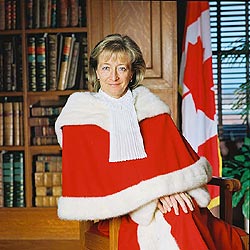
On Friday, the SCC ruled 4-3 that a non-money judgment by a US federal court should not automatically be enforced in Ontario. The Pithlord gives the majority decision in Pro Swing Inc. v. Elta Golf Inc., 2006 SCC 52 the "thumbs up", but that really means I think it is the lesser evil compared to the Chief Justice's dissent. I see no reason that to depart from the long-established rule that only final money judgments of foreign courts should be enforced domestically, as all seven justices did. Blather about "globalization" is not a reason. And, in any event, even if we accept that globalization has changed the policy calculus here, it ought to be up to the legislatures, not the courts, to enact this kind of law reform.
Two things can happen when you win a civil lawsuit: you can be awarded a sum of money ("liquidated damages") or you can get some qualitative order telling the other party it has to do a bunch of stuff. Historically, the common law courts only gave awards of damages. This led the courts of equity to try to increase their market share by providing qulitative remedies -- injunctions, accountings, declarations of trust and other goodies.
Because qualitative judgments are trickier to administer and more intrusive, the courts of equity always retained large amounts of discretion about how and when to grant these remedies. The common law courts purported to provide more clear-cut justice. The combination of discretion and qualitative remedies made the Courts of Equity rather procedurally convoluted places: it is not for nothing that Bleak House satirizes the Courts of Chancery.
Globalization is actually a very old story, and the English courts long ago recognized that if a halfway honest foreign court found that A owed B a certain sum of money, then A should generally be allowed to enforce that judgment in England without having to prove A's case all over again. But there was a lot of suspicion of qualitative judgments in other countries. The question of when they would be available would differ, they might be unjust and the common law courts thought such things were for those bozos in Chancery anyway.
In the Pithlord's respectful view, this distinction was always a good one. To this day, qualitative remedies are exceptional in common law jurisdictions. Whether to extend such things is an important part of sovereignty. If ABC Ltd. entered into a transaction in some foreign spot, and ended up owing XYZ Inc. a sum of dinars, then we can normally say that said sum is owing everywhere, including here, and other courts usually take the same view. But telling people what they can and cannot do if they want to avoid jail is a different thing.
Pro Swing was a trademark case (the underlying sin of the defendant was to market its golf clubs under a name that could be confused with Pro Swing's clubs). Trademark law involves a difficult trade off between allowing companies to retain investments in their brand with free speech and free commerce. One policy decision is whether to permit judicial silencing of brand invaders or only to allow compensation. It should be recognized that the silencing remedy has a much greater potential impact on free expression. At minimum, each jurisdiction must decide for itself when and whether to allow judicial silencing as a response.
When it came to light that Elta Golf was marketing dubiously-named golf clubs on the Internet, Pro Swing and Elta Golf agreed to a consent order, which was entered in a federal court in Ohio. (It is worth noting that nothing in the order suggests it was intended to have application outside the United States.) Elta apparently violated the consent order, and Pro Swing was awarded a civil contempt order -- which included injunctions and the requirement of an accounting (Elta had to provide evidence of its profits, and hand the money over to Pro Swing, but a specific sum was not yet determined). Elta is based in Toronto, and that is presumably where most of its records are kept.
On a traditional view of the law, Pro Swing would have to invoke Ontario's civil rules to obtain letters rogatory to get the info it needed to quantify the wrongfully-obtained profits. Only the Federal Court could give Pro Swing an injunction in Canada, and only for violation of Canada's trademark legislation. Once there was a judgment in Yankee dollars, then Ontario courts would help Pro Swing enforce, but that would be it. Contempt orders could not possibly be applied cross-border.
The result from the majority judgment is in keeping with traditional law. Unfortunately, Justice Deschamps' "on the one hand" does not always let her "on the other hand" know what it is doing. This means the law will be unsettled, and someone with clearer ideas will ultimately have to sort it out.
The Chief Justice's decision shows greater clarity of thought, but it would basically allow the application of qualitative orders from foreign jurisdictions apply here, unless the same narrow tests that apply to money judgments are met.
There are a couple annoying things about the Chief Justice's decision. First, she refers to Law Reform Commission recommendations (which, I understand, are actually limited to inter-provincial application of qualitative judgments) as reasons for judges to change the law. On the contrary, if an issue is the subject of potential legislative reform, and the legislatures have not acted, that suggests there are policy reasons not to act, and the whole thing should be left with the political process. McLachlin's discussion here reminds me of how she used class action legislation in some provinces to force class actions on the provinces that had deliberately refrained from enacting them.
The other annoying thing is the assertion that constitutional values of privacy (and, in this case, freedom of speech) don't matter in civil actions, since the coerced disclosure is to sworn private enemies, rather than the state. It strikes me that this makes things worse, not better. I might be worried about what some bureaucrat will do with my personal information, but I can probably rely on the reality that he or she will probably be more interested in coffee breaks and Solitaire. Giving my personal information to profit-maximizing corporations, particularly ones I have a dispute with, is more problematic, and should only happen when there has been a clear legislative judgment to require me to do it.
Finally, it is extremely odd that both justices take the principle of "comity" as the dominant one in private international law, but fail to give any weight to the fact that American courts would never domestically enforce a non-money judgment of a Canadian court.
Anyway, the private international law revolution stalled a bit on Friday, which is good, but will probably be temporary relief.
Case Comment of Pro Swing Inc. v. Elta Golf Inc.
Photo of Madam Justice Deschamps credited to Phillipe Landreville, Supreme Court of Canada collection
Update: An ectomorphic take on Pro Swing can be found here. Andy makes the point that the civil law judges voted against bringing the common law into line with their own.
Sunday, November 19, 2006
The Chief Justice as Superstar
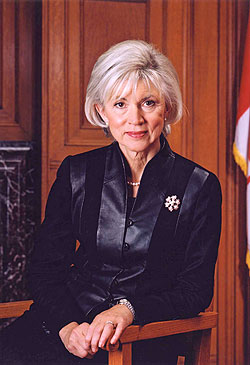
Andy the Ectomorph observes (I think correctly) the much-enhanced public role of Chief Justice Beverly McLachlin in comparison with her predecessor Antonio Lamer, and asks what it all means.
Its superempowered constitutional role has created an institutional need for a politically-savvy and media-conscious figure to do public relations for the Court. The need has existed for a while, but Uncle Tony was just not equipped to provide it: when he spoke extra-judicially and publicly, the result was always embarrassing for the Court Party. Brian Dickson wasn't as bad as Lamer, but he had the same corporate lawyer's incapacity for political communication that we saw in John Turner. Going back even further, Bora Laskin was more successful as a public figure than on his own court, where he was in a permanent minority with Spence and Dickson (L-S-D): in those days, it was really Ronald Martland, as leader of the conservative-Quebec alliance, who was the Chief Justice.
The current Chief Justice, though, is completely and utterly suited to be a public advocate for the court's role. In her own jurisprudence, she combines substantive caution and moderation with a consistent support for expanding the court's role. And she clearly has political skills. Maurice Vellacot was substantively in the right in his conflict with her last spring, but there can be no doubt that he had his political butt handed to him.
I agree with Andy that the Beverley McLachlin is, in many ways, an admirable judge. She is open-minded and pragmatic. And she has a superhuman work ethic. Unfortunately, though, her advocacy skills are put to the benefit of the institutional interests of the court and of the legal profession. That's perhaps what you would expect, given her role, but it could work against the interests of the country. The Harper government would be ill-advised to underestimate her.
Tuesday, November 14, 2006
Radical Tories A Generation On
At my local bookstore, I noticed that Radical Tories by Charles Taylor (the journalist son-of-E.P. Taylor, not the philosopher or Liberian dictator) has been re-released.
Taylor has chapter-length sketches of a number of Canadian intellectuals and politicians he lumps together as, in some sense, “red Tories”: Conservative historian Donald Creighton, Liberal historian W.L. Morton, Liberal senator Eugene Forsey, nationalist poet Al Purdy, federal Conservative leader and underwear heir Robert Stanfield, dimunitive Toronto mayor and Conservative cabinet minister David Crombie and pessimistic political philosopher George Grant. Only Crombie is still alive.
The tendency Taylor was trying to define is a bit vague: nationalistic, anti-libertarian and supportive of British North American traditions, but not particularly programmatic. Taylor writes biographical and journalistic profiles, not manifestoes, and he says little about the issues of that day or this. There is not much about Quebec separatism, concrete economic policies or the Cold War.
My favourite bit is when Taylor takes George Grant to Woodbine race track, where he says something incredibly pompous, much to the disgust of Purdy.
“Red Tory” was never a well-defined term, and it never described a particularly influential trend in our political life. It has come to mean the opposite of what Grant or Taylor intended. Today it is commonly used to refer to someone who has no trouble either with the global market or Trudeau’s attempted erasure of traditional English Canada, someone pleased both with Trudeau’s Charter of Rights and Mulroney’s free trade agreements, a libertarian lite. Crombie fits in with this more contemporary meaning of red Tory, but there is little evidence that he (or Stanfield) ever wanted to take some doomed Grantian stand on behalf of “our own” against the twin evils of corporate capitalism and post-ethnic post-Christian “rights-talk” liberalism.
The one "practical" politician clearly inspired by Taylor’s book was the Quixotic David Orchard. Orchard took seriously the idea of an economically nationalist progressive conservatism, and he and his followers briefly had significant influence in the post-Kim Campbell pre-fusion Progressive Conservative party. Orchard will be remembered, of course, for agreeing to support the egregious Peter Mackay in return for his signed promise not to liquidate the PC party, a contract cynically negotiated with the connivance of Brian Mulroney and as cynically breached.
I found Taylor’s book interesting as a teenager, before falling under the spell of doctrinaire Marxism. I no longer find economic nationalism and statism particularly appealing. But I recognize something of value in what Taylor was trying to do.
As Grant recognized and bemoaned, we British North Americans always had a profoundly liberal, as well as monarchical and Christian, tradition. We cannot counterpose to the religion of progress – in either its libertarian or egalitarian guises – with the Syllabus of Errors, or some idealized, reactionary medievalism. Our tradition – like it or not – is one of commercial and personal liberty, of technological progress and of relative social egalitarianism.
But our tradition was not one of economic determinism, on the one hand, or a belief in the infinite malleability of human nature on the other. Our founders recognized that economic issues (best handled, they thought, with a mixture of internal laissez-faire and government-subsidised infrastructure development) could never be as destructive or as important as religious and ethnic ones. They did not believe that people would forego their particularistic loyalties, but they did think that those differences could be managed within a framework of British institutions.
Since Taylor wrote, what he loved has been bashed both from the left (in the form of multiculturalism and the Charter) and from the right (in the form of the Free Trade Agreement and the Washington Consensus). All of these can point to some roots in the English Canadian tradition. But the true believers in both versions of progress are united in their embarrassment at the remnants of that tradition.
It is pretty easy for what Taylor was sketching to fall into the traps of nostalgia, racial-exclusivity, retrograde gender politics and economic illiteracy. Equally, there are domesticated Canada Council/CBC versions of "Tory" nationalism that are virtually indistinguishable from Annex bien-pensant socialism. And the literalist political example of David Orchard is not encouraging. But I think there's something worth rescuing.
Taylor has chapter-length sketches of a number of Canadian intellectuals and politicians he lumps together as, in some sense, “red Tories”: Conservative historian Donald Creighton, Liberal historian W.L. Morton, Liberal senator Eugene Forsey, nationalist poet Al Purdy, federal Conservative leader and underwear heir Robert Stanfield, dimunitive Toronto mayor and Conservative cabinet minister David Crombie and pessimistic political philosopher George Grant. Only Crombie is still alive.
The tendency Taylor was trying to define is a bit vague: nationalistic, anti-libertarian and supportive of British North American traditions, but not particularly programmatic. Taylor writes biographical and journalistic profiles, not manifestoes, and he says little about the issues of that day or this. There is not much about Quebec separatism, concrete economic policies or the Cold War.
My favourite bit is when Taylor takes George Grant to Woodbine race track, where he says something incredibly pompous, much to the disgust of Purdy.
“Red Tory” was never a well-defined term, and it never described a particularly influential trend in our political life. It has come to mean the opposite of what Grant or Taylor intended. Today it is commonly used to refer to someone who has no trouble either with the global market or Trudeau’s attempted erasure of traditional English Canada, someone pleased both with Trudeau’s Charter of Rights and Mulroney’s free trade agreements, a libertarian lite. Crombie fits in with this more contemporary meaning of red Tory, but there is little evidence that he (or Stanfield) ever wanted to take some doomed Grantian stand on behalf of “our own” against the twin evils of corporate capitalism and post-ethnic post-Christian “rights-talk” liberalism.
The one "practical" politician clearly inspired by Taylor’s book was the Quixotic David Orchard. Orchard took seriously the idea of an economically nationalist progressive conservatism, and he and his followers briefly had significant influence in the post-Kim Campbell pre-fusion Progressive Conservative party. Orchard will be remembered, of course, for agreeing to support the egregious Peter Mackay in return for his signed promise not to liquidate the PC party, a contract cynically negotiated with the connivance of Brian Mulroney and as cynically breached.
I found Taylor’s book interesting as a teenager, before falling under the spell of doctrinaire Marxism. I no longer find economic nationalism and statism particularly appealing. But I recognize something of value in what Taylor was trying to do.
As Grant recognized and bemoaned, we British North Americans always had a profoundly liberal, as well as monarchical and Christian, tradition. We cannot counterpose to the religion of progress – in either its libertarian or egalitarian guises – with the Syllabus of Errors, or some idealized, reactionary medievalism. Our tradition – like it or not – is one of commercial and personal liberty, of technological progress and of relative social egalitarianism.
But our tradition was not one of economic determinism, on the one hand, or a belief in the infinite malleability of human nature on the other. Our founders recognized that economic issues (best handled, they thought, with a mixture of internal laissez-faire and government-subsidised infrastructure development) could never be as destructive or as important as religious and ethnic ones. They did not believe that people would forego their particularistic loyalties, but they did think that those differences could be managed within a framework of British institutions.
Since Taylor wrote, what he loved has been bashed both from the left (in the form of multiculturalism and the Charter) and from the right (in the form of the Free Trade Agreement and the Washington Consensus). All of these can point to some roots in the English Canadian tradition. But the true believers in both versions of progress are united in their embarrassment at the remnants of that tradition.
It is pretty easy for what Taylor was sketching to fall into the traps of nostalgia, racial-exclusivity, retrograde gender politics and economic illiteracy. Equally, there are domesticated Canada Council/CBC versions of "Tory" nationalism that are virtually indistinguishable from Annex bien-pensant socialism. And the literalist political example of David Orchard is not encouraging. But I think there's something worth rescuing.
Friday, November 10, 2006
How Canadian Are You?
Find out here.
The Pithlord got 97%, which is pretty good (or "not too bad" in Canadian). I probably lost the 3% because I refused to say I'd buy my sister a dress at Canadian Tire.
Inevitable Regionalist Bitching Update: I lived in Toronto for six years, so I knew the answer to the "Pizza Pizza" question, but the damn chain doesn't exist in Western Canada! Once again, as in the dark days of the NEP, we have been shunted aside by the damn Easterners and their ...[blah...blah...blah, etc.. you know the drill]
The Pithlord got 97%, which is pretty good (or "not too bad" in Canadian). I probably lost the 3% because I refused to say I'd buy my sister a dress at Canadian Tire.
Inevitable Regionalist Bitching Update: I lived in Toronto for six years, so I knew the answer to the "Pizza Pizza" question, but the damn chain doesn't exist in Western Canada! Once again, as in the dark days of the NEP, we have been shunted aside by the damn Easterners and their ...[blah...blah...blah, etc.. you know the drill]
Ardent for some desperate glory
Every year, the ritual was the same.
The Headmaster read the lists of the school's dead from each world war, and the shorter list for Korea. WASP name after WASP name -- in the Great War, it must have been half the graduates. The letter from the school founder to the "boys," the cheery and sentimental Edwardian voice framed by the easy irony of his death in the trenches a month later. And then the poems: always two, always the same. Wilfred Owen's Dulce et Decorum Est and John McCrae's In Flanders Fields.
I can't remember which year I realized that the two poems were saying exactly the opposite thing, that the two poets would have despised each other. No doubt I was pleased with myself for noticing the first time, and then self-righteously indignant the next times. But at middle age, I suppose my elders were right. Many of them were still of the generation that fought. It really is ambiguous how we break faith with those who die -- whether by failing to take up their quarrel with the foe or by colonizing a gruesome death with noble words.
Owen was the better poet, and had the more lasting impact on his culture. Even in my generation, there are people to whom that old Edwardian idealism speaks. Forty two Canadians younger than me have died in combat since 2002. To them, honour and valour still mean something other than the con game Owen perceived. And I am glad they exist, since we are probably burning up our stores of those virtues, with God knows what consequences when we come to the end of them.
Owen doesn't say anything about why so many men have loved war, why it is so liberating. Freud may not have been a scientist, but how well he understood that feeling, that joy in destruction and in the overthrow of civilization.
But what he gets right is the contrast between the technology and bureaucracy of war -- and the ugliness of death -- with the adolescent notions that get us there.
I have no real idea what my elders thought they were doing with that ritual, whether they were shaming us for our peaceful bourgeois lives or warning us against militaristic folly. They probably didn't know either, and they seemed uninterested in the effect of these things on us.
A surprisingly large number of my class did join the armed forces, especially considering how low prestige and ill-paid it was in those days. They were definitely among the most square. It seemed unlikely that there would be much glory in it then: if a real war came, we assumed we'd all -- civilian or otherwise -- be dead virtually instantly. In the meantime, there didn't seem to be much other than policing duties in Cyprus. Canadian offensive military power was a joke. Still is, I suppose, but the one guy I know from those days who is still in the Armed Forces seems to have seen a lot of violence in a lot of places.
Another group of us spent the next decade marching, getting into fights with obscure far right cranks, workers in resource industries and occasionally the police. When we opposed logging, we learned defence in depth -- when we opposed overseas wars, we seemed to do a lot of marching. Since we all smoked, we had to get our exercise somehow. John McRae would have hated us, and maybe Wilfred Owen would have too. No doubt we avoided taking real risks. But our cowardice mixed with an ardour for desperate glory. And we didn't lack for lies.
For the first time in my lifetime, Remembrance Day comes with a Canadian people aware that we are in a serious war. The old generation of vets that were such a dominating presence in my childhood thins out. Another, much smaller, one is being forged, and may have a lot to say in my middle age.
Even a conservative Anglo-Canadian private school in the 80s could not quite get away with incorporating Kipling into its ritual. But the old bastard managed to combine commitment to his to us misguided loyalties with awareness of how insignificant what he was loyal to ultimately was. So I'll end this year with him and Joe Strummer.
The Headmaster read the lists of the school's dead from each world war, and the shorter list for Korea. WASP name after WASP name -- in the Great War, it must have been half the graduates. The letter from the school founder to the "boys," the cheery and sentimental Edwardian voice framed by the easy irony of his death in the trenches a month later. And then the poems: always two, always the same. Wilfred Owen's Dulce et Decorum Est and John McCrae's In Flanders Fields.
I can't remember which year I realized that the two poems were saying exactly the opposite thing, that the two poets would have despised each other. No doubt I was pleased with myself for noticing the first time, and then self-righteously indignant the next times. But at middle age, I suppose my elders were right. Many of them were still of the generation that fought. It really is ambiguous how we break faith with those who die -- whether by failing to take up their quarrel with the foe or by colonizing a gruesome death with noble words.
Owen was the better poet, and had the more lasting impact on his culture. Even in my generation, there are people to whom that old Edwardian idealism speaks. Forty two Canadians younger than me have died in combat since 2002. To them, honour and valour still mean something other than the con game Owen perceived. And I am glad they exist, since we are probably burning up our stores of those virtues, with God knows what consequences when we come to the end of them.
Owen doesn't say anything about why so many men have loved war, why it is so liberating. Freud may not have been a scientist, but how well he understood that feeling, that joy in destruction and in the overthrow of civilization.
But what he gets right is the contrast between the technology and bureaucracy of war -- and the ugliness of death -- with the adolescent notions that get us there.
I have no real idea what my elders thought they were doing with that ritual, whether they were shaming us for our peaceful bourgeois lives or warning us against militaristic folly. They probably didn't know either, and they seemed uninterested in the effect of these things on us.
A surprisingly large number of my class did join the armed forces, especially considering how low prestige and ill-paid it was in those days. They were definitely among the most square. It seemed unlikely that there would be much glory in it then: if a real war came, we assumed we'd all -- civilian or otherwise -- be dead virtually instantly. In the meantime, there didn't seem to be much other than policing duties in Cyprus. Canadian offensive military power was a joke. Still is, I suppose, but the one guy I know from those days who is still in the Armed Forces seems to have seen a lot of violence in a lot of places.
Another group of us spent the next decade marching, getting into fights with obscure far right cranks, workers in resource industries and occasionally the police. When we opposed logging, we learned defence in depth -- when we opposed overseas wars, we seemed to do a lot of marching. Since we all smoked, we had to get our exercise somehow. John McRae would have hated us, and maybe Wilfred Owen would have too. No doubt we avoided taking real risks. But our cowardice mixed with an ardour for desperate glory. And we didn't lack for lies.
For the first time in my lifetime, Remembrance Day comes with a Canadian people aware that we are in a serious war. The old generation of vets that were such a dominating presence in my childhood thins out. Another, much smaller, one is being forged, and may have a lot to say in my middle age.
Even a conservative Anglo-Canadian private school in the 80s could not quite get away with incorporating Kipling into its ritual. But the old bastard managed to combine commitment to his to us misguided loyalties with awareness of how insignificant what he was loyal to ultimately was. So I'll end this year with him and Joe Strummer.
Far-called our navies melt away;
On dune and headland sinks the fire;
Lo, all our pomp of yesterday
Is one with Nineveh and Tyre!
Judge of the Nations spare us yet,
Lest we forget -- lest we forget!
If drunk with sight of power, we loose
Wild tongues that have not thee in awe--
Such boasting as the Gentiles use
Of lesser breeds without the law--
Lord God of Hosts, be with us yet
Lest we forget -- lest we forget.
From the Hundred Years War to the Crimea
With a lance and a musket and a roman spear
To all of the men who stood without fear
In the service of the King
Before you meet your fate be sure you did not forsake
Your lover may not be around any more.
Thursday, November 09, 2006
What will the Roberts Court do about partial-birth abortion? And about federalism?
The Supreme Court of the United States has been hearing oral arguments in the Gonzales v. Carhart and Gonzales v. Planned Parenthood cases this week. (All the links you could want are here). The case is about the constitutionality of the federal partial birth abortion ban.
The key 14th Amendment issue seems to be whether Congress can come to its own judgment on the issue of whether a particular abortion procedure is medically necessary, and what review the courts should apply. My prediction there is that Roberts-Alito-Scalia-Thomas will agree that a very wide deference is owed to legislative judgments, that Stevens-Ginsburg-Breyer-Souter will say that Congressional judgment is owed little deference, and was wrong here, and that Kennedy will write the opinion of the court saying little deference is owed, but Congress got it right this time. We will see if the crystal ball holds up.
What would I do? Well, unlike people on the left of the abortion issue, I think the conflict-of-interest inherent in a doctor who performs abortions deciding what is medically necessary is a legitimate and important legislative concern. I think this is something the political process should decide.
But which political process? The state or the federal? This strikes me as precisely the sort of divisive cultural/moral issue that should be in the hands of individual states: there is just no need for a single, federally-mandated solution.
It should be noted that the federal partial birth abortion ban is based on the "Interstate Commerce" clause of Article 1, a clause which has been bent out of all recognition by post-New Deal "progressive" jurisprudence, into a pretty much all-encompassing grant of federal power. The Rehnquist court made some baby steps in cutting back on this theory when it comes to non-economic regulation, but except for Clarence Thomas,* there were at best fairweather federalists on that court. It will therefore be interesting to see what Alito and Roberts do.
According to Marty Lederman, John Paul Stevens, the leader of the liberal bloc, was the one to raise the federalism issue in oral argument. He asked how Interstate Commerce could apply to an abortion clinic that does not charge for its services. The Solicitor General cleverly suggested that this issue could only be dealt with in an "as-applied" challenge, since it might be that the federal statute, properly interpreted, would not apply for non-constitutional reasons.
A more fundamental question -- it seems to me -- is whether the federal government should be allowed to regulate something for patently non-economic reasons, just because it might be bought and sold. That strikes me as the punchline to a reductio ad absurdum, but sensible Americans tell me that even the wild-eyed federalists on the court believe it.
Interestingly, though, Justice Scalia is on record (non-judicially) saying the federal government has no jurisdiction over abortion:
I would hope that all of Thomas, Kennedy, Alito and Roberts would agree with this, in which case the federal law ought to be considered unconstitutional by everybody.
*Thomas is apparently not present for the oral hearing because he is sick, but will rule in the case. This is a bit shocking to my own lawyerly sensibilities, so I wonder if my American readers can tell me whether this is common in American courts.
The key 14th Amendment issue seems to be whether Congress can come to its own judgment on the issue of whether a particular abortion procedure is medically necessary, and what review the courts should apply. My prediction there is that Roberts-Alito-Scalia-Thomas will agree that a very wide deference is owed to legislative judgments, that Stevens-Ginsburg-Breyer-Souter will say that Congressional judgment is owed little deference, and was wrong here, and that Kennedy will write the opinion of the court saying little deference is owed, but Congress got it right this time. We will see if the crystal ball holds up.
What would I do? Well, unlike people on the left of the abortion issue, I think the conflict-of-interest inherent in a doctor who performs abortions deciding what is medically necessary is a legitimate and important legislative concern. I think this is something the political process should decide.
But which political process? The state or the federal? This strikes me as precisely the sort of divisive cultural/moral issue that should be in the hands of individual states: there is just no need for a single, federally-mandated solution.
It should be noted that the federal partial birth abortion ban is based on the "Interstate Commerce" clause of Article 1, a clause which has been bent out of all recognition by post-New Deal "progressive" jurisprudence, into a pretty much all-encompassing grant of federal power. The Rehnquist court made some baby steps in cutting back on this theory when it comes to non-economic regulation, but except for Clarence Thomas,* there were at best fairweather federalists on that court. It will therefore be interesting to see what Alito and Roberts do.
According to Marty Lederman, John Paul Stevens, the leader of the liberal bloc, was the one to raise the federalism issue in oral argument. He asked how Interstate Commerce could apply to an abortion clinic that does not charge for its services. The Solicitor General cleverly suggested that this issue could only be dealt with in an "as-applied" challenge, since it might be that the federal statute, properly interpreted, would not apply for non-constitutional reasons.
A more fundamental question -- it seems to me -- is whether the federal government should be allowed to regulate something for patently non-economic reasons, just because it might be bought and sold. That strikes me as the punchline to a reductio ad absurdum, but sensible Americans tell me that even the wild-eyed federalists on the court believe it.
Interestingly, though, Justice Scalia is on record (non-judicially) saying the federal government has no jurisdiction over abortion:
[I]f a state were to permit abortion on demand, I would -- and could in good conscience -- vote against an attempt to invalidate that law for the same reason that I vote against the invalidation of laws that forbid abortion on demand: because the Constitution gives the federal government (and hence me) no power over the matter.
I would hope that all of Thomas, Kennedy, Alito and Roberts would agree with this, in which case the federal law ought to be considered unconstitutional by everybody.
*Thomas is apparently not present for the oral hearing because he is sick, but will rule in the case. This is a bit shocking to my own lawyerly sensibilities, so I wonder if my American readers can tell me whether this is common in American courts.
Wednesday, November 08, 2006
Dems take House and probably Senate; I become more insufferable than ever
Well, I'm going to go to bed without knowing George Allen's litigation strategy, but Webb is up by 12,000 and it appears that Montana and Missouri are in the bag. Result will be 50 Democrats (including Lieberman), 49 Republicans and one Vermont socialist. Advantage Pithlord.
+30 for the Democrats in the House looks about right too.
Yes, yes, I know that I'm creating bad karma here. But it's a great night. The American people have rejected the Peronist politics of jingoism and fiscal incontinence. I agree with the commentators who are saying that the US electorate has not embraced "liberalism." Just as there was nothing particularly conservative about the party of imperialism and insolvency, there is nothing particularly progressive about the desire to be rid of them. But it's good to see all the same.
+30 for the Democrats in the House looks about right too.
Yes, yes, I know that I'm creating bad karma here. But it's a great night. The American people have rejected the Peronist politics of jingoism and fiscal incontinence. I agree with the commentators who are saying that the US electorate has not embraced "liberalism." Just as there was nothing particularly conservative about the party of imperialism and insolvency, there is nothing particularly progressive about the desire to be rid of them. But it's good to see all the same.
Sunday, November 05, 2006
AstraZeneca -- Thumbs Up
Can a patent drug manufacturer prevent generic drug manufacturers from producing a drug based on an expired patent by taking out "related" patents?
On Friday, the SCC answered this question with a big "no."
That was the right call. The alternative would have been to eviscerate the time-limited nature of the patent, which would be a very bad idea indeed.
On Friday, the SCC answered this question with a big "no."
That was the right call. The alternative would have been to eviscerate the time-limited nature of the patent, which would be a very bad idea indeed.
Case Comment of AstraZeneca Canada Inc. v. Canada (Minister of Health), 2006 SCC 49
Friday, November 03, 2006
Flaherty Kills the Income Trust: Right Thing to Do, But No Good Deed Goes Unpunished
The big political/economic story in Canada, of course, is the Minister of Finance's announcement on Halloween that the Government is going to eliminate the favourable tax treatment of income trusts relative to corporations. The general corporate tax rate is to drop by half a percentage point to make the change (statically) revenue-neutral.
The predictable reaction of the markets was a $25 billion selloff. If your a Canadian and have any investments at all, you almost certainly lost money this week. To make matters worse for the Tories, they specifically promised not to do this in their election platform.
From a policy perspective, this was the right thing to do. Under existing law, the income trusts are tax-efficient, but they are inefficient corporate governance vehicles. The alternative to doing this would be to abandon corporate income tax altogether, and just tax income in the hands of individuals. That wouldn't be an entirely awful idea. There is much that is economically illiterate in the NDP call to faire payer les corporations -- since corporations are fundamentally legal fictions, they can't ultimately bear the tax burden. Only individuals can. But a corporate tax does effectively tax foreign investors in Canadian enterprises and prevents a simple form of tax deferment and tax splitting.
But if the Tories have done the right thing, they are going to pay a political price for it. John Ibbitson's claim to the contrary is not convincing.
First of all, it is hard to imagine a change in government policy with such a direct, immediate effect on the finances of millions of potentially Conservative voters. A good or bad economy may or may not be the work of the party in power. The loss of value in the markets on Tuesday clearly was.
Second, it is easy to point out that the Tories went back on a promise, just as Chrétien did with the GST. From a policy perspective, Chrétien was absolutely right not to eliminate the GST, but a promise is still a promise, and it did him some harm. This will probably be worse, since there is no deficit to point to in explanation, and since the effect is so immediate.
Ibbitson's response is that by getting this out of the way now, Harper can recover later. This analysis misses two points. First, a quick election, before the Grits have their act together, might have been a good deal for the Tories. They don't have that option now.
More subtly, this changes the whole dynamic of a minority Parliament. Harper could act as if he had a majority only because the opposition didn't really want to defeat him and go to the polls. We'll see what Angus Reid has to say, but if it's bad news for the government, then the opposition has the upper hand in the game of chicken that a minority Parliament inevitably is.
Politically, it surely would have been better to tie this announcement to much broader tax relief than Finance is proposing now. But the Government still doesn't know what kind of deal it might make on the diséquilibre fiscale. So it is stuck.
Update: The early empirical evidence isn't kind to my instant political analysis. It appears the Tories are up in the Ipsos Reid poll taken immediately after the Income Trusts decision.
The predictable reaction of the markets was a $25 billion selloff. If your a Canadian and have any investments at all, you almost certainly lost money this week. To make matters worse for the Tories, they specifically promised not to do this in their election platform.
From a policy perspective, this was the right thing to do. Under existing law, the income trusts are tax-efficient, but they are inefficient corporate governance vehicles. The alternative to doing this would be to abandon corporate income tax altogether, and just tax income in the hands of individuals. That wouldn't be an entirely awful idea. There is much that is economically illiterate in the NDP call to faire payer les corporations -- since corporations are fundamentally legal fictions, they can't ultimately bear the tax burden. Only individuals can. But a corporate tax does effectively tax foreign investors in Canadian enterprises and prevents a simple form of tax deferment and tax splitting.
But if the Tories have done the right thing, they are going to pay a political price for it. John Ibbitson's claim to the contrary is not convincing.
First of all, it is hard to imagine a change in government policy with such a direct, immediate effect on the finances of millions of potentially Conservative voters. A good or bad economy may or may not be the work of the party in power. The loss of value in the markets on Tuesday clearly was.
Second, it is easy to point out that the Tories went back on a promise, just as Chrétien did with the GST. From a policy perspective, Chrétien was absolutely right not to eliminate the GST, but a promise is still a promise, and it did him some harm. This will probably be worse, since there is no deficit to point to in explanation, and since the effect is so immediate.
Ibbitson's response is that by getting this out of the way now, Harper can recover later. This analysis misses two points. First, a quick election, before the Grits have their act together, might have been a good deal for the Tories. They don't have that option now.
More subtly, this changes the whole dynamic of a minority Parliament. Harper could act as if he had a majority only because the opposition didn't really want to defeat him and go to the polls. We'll see what Angus Reid has to say, but if it's bad news for the government, then the opposition has the upper hand in the game of chicken that a minority Parliament inevitably is.
Politically, it surely would have been better to tie this announcement to much broader tax relief than Finance is proposing now. But the Government still doesn't know what kind of deal it might make on the diséquilibre fiscale. So it is stuck.
Update: The early empirical evidence isn't kind to my instant political analysis. It appears the Tories are up in the Ipsos Reid poll taken immediately after the Income Trusts decision.
Tower Hamlets Council Sees a Reason that Gunpowder Treason Should Be Forgot
Via Andrew Sullivan, I see that a London council wants to replace Guy Fawkes day with a Bengali celebration about a Moghul emperor.
Interestingly, unreconstructed Stalinist and Saddam-apologist George Galloway is leading the fight for this august English tradition.
Interestingly, unreconstructed Stalinist and Saddam-apologist George Galloway is leading the fight for this august English tradition.
Thursday, November 02, 2006
Enough with the whining, already!
Andrew Cunningham has responded to my pinko-endomorph taunting of people unwilling to make election predictions, and promises that he will have some thing up on the US midterms shortly.
He notes something I have observed as well: the preponderance of pro-Democrats with pessimistic takes on what looks to be a blowout in their favour. Few pollsters think the Republicans will pick up a single Democratic seat in either the House or the Senate. The number of seats the Democrats will win is obviously subject to reasonable dispute, and I admit I'm going out on a limb to think the Dems will actually take the Senate, but you have to be a lily-livered liberal to seriously doubt that Nancy Pelosi will be the next Speaker.
Humans have their cognitive biases, of course. Generally, people tend to wishful thinking (I want it to be the case that X -> X). If your team loses too many times though, you get the opposite form of bias, which doesn't seem to have a name (I don't want it to be the case that X ->X). Logically, for events that you can do little to change, there is no relationship between your wanting them and their happening, but we're all superstitous.
What is interesting is whether the tendency on the left (at least in the US) to counter-wishful thinking is something that hurts them. Karl Rove obviously thinks that looking like a winner increases your chances of being a winner, and I suspect he's on to something.
This must partiuclarly be the case among Americans. America is the most optimistic place on earth. Russia, by contrast, is the land of the hard luck story. If Russia ever had genuinely competitive elections, maybe there would be some electoral advantage in thinking you were going to lose all the time. But who has met a normal American who thinks that way in business or any other non-political endeavour? No, Americans tend to think that if you believe in your dream, you can accomplish anything.
The overwhelming lesson of human history, and the second law of thermodynamics, is that Russians are right and Americans are wrong. And Iraq is a good example of how American can-do spirit can go horribly wrong. Still, optimism does seem to be the secret of American greatness, and whatever else you think of American civilization, it surely is great, indees super-great. You surely can't win a country by being untrue to the secret of its success.
So knock it off, Dems, and stop being such whiners!
Update: I realize that BKN will be able to totally ridicule me if the Dems don't at least take the House. My shame will be eternal!
He notes something I have observed as well: the preponderance of pro-Democrats with pessimistic takes on what looks to be a blowout in their favour. Few pollsters think the Republicans will pick up a single Democratic seat in either the House or the Senate. The number of seats the Democrats will win is obviously subject to reasonable dispute, and I admit I'm going out on a limb to think the Dems will actually take the Senate, but you have to be a lily-livered liberal to seriously doubt that Nancy Pelosi will be the next Speaker.
Humans have their cognitive biases, of course. Generally, people tend to wishful thinking (I want it to be the case that X -> X). If your team loses too many times though, you get the opposite form of bias, which doesn't seem to have a name (I don't want it to be the case that X ->X). Logically, for events that you can do little to change, there is no relationship between your wanting them and their happening, but we're all superstitous.
What is interesting is whether the tendency on the left (at least in the US) to counter-wishful thinking is something that hurts them. Karl Rove obviously thinks that looking like a winner increases your chances of being a winner, and I suspect he's on to something.
This must partiuclarly be the case among Americans. America is the most optimistic place on earth. Russia, by contrast, is the land of the hard luck story. If Russia ever had genuinely competitive elections, maybe there would be some electoral advantage in thinking you were going to lose all the time. But who has met a normal American who thinks that way in business or any other non-political endeavour? No, Americans tend to think that if you believe in your dream, you can accomplish anything.
The overwhelming lesson of human history, and the second law of thermodynamics, is that Russians are right and Americans are wrong. And Iraq is a good example of how American can-do spirit can go horribly wrong. Still, optimism does seem to be the secret of American greatness, and whatever else you think of American civilization, it surely is great, indees super-great. You surely can't win a country by being untrue to the secret of its success.
So knock it off, Dems, and stop being such whiners!
Update: I realize that BKN will be able to totally ridicule me if the Dems don't at least take the House. My shame will be eternal!
Wednesday, November 01, 2006
Habermas on whether we can have genuine religious pluralism
Long-time readers of this site will recall my fascination with George Grant's conviction that there could be only one public religion in any state. Grant thereby opposed Rawls's optimism that deep religious pluralism could co-exist in a liberal society. Grant thought it perfectly possible that the "religion of progress" could conquer Christianity and turn it in to a more-or-less tolerated private hobby, but not that the two could live together.
Rawls thought everyone could live happily, just so long as the religious always justified their political ideas in secular terms. As Atrios put it, "[A]s long as it stays away from policy I really don't care what people believe or choose to worship."
The trouble is that no believer is going to accept this proviso. In effect, Rawls is either asking the religious not to be motivated by their most fundamental convictions, or to put up justifications that are disingenuous. If that's what's necessary to allow for deep religious pluralism, then it doesn't seem to have much of a shot.
Jurgen Habermas recognizes this criticism of Rawls. According to the German, for religion to co-exist with secularism requires something of a transformation of both religion and secularism.
The first transformation is to religion. As it ceases to be the unquestioned background belief of everyone, and is challenged by science and liberalism, believers are forced to undergo a critical, reflective attitude towards their own traditions. That is, in effect, what theology is, although Habermas further requires that theology somehow diffuse down to the ordinary believer.
However, Habermas argues that the secular must undergo a similar process. This is not merely a question of being respectful to other people's convictions. Rather, it is a realization of how contingent the secular liberal's own ground is:
But this Dawkinsian state of secularist innocence cannot survive confrontation with the stubbornness of religious belief.
Both these exacting cognitive processes can be refused. The believer can retreat into fundamentalism. We know about that.
The secularist who refuses the exacting cognitive process Habermas demands? What does he or she do?
Well, one response is extreme Islamophobia, the "liberalism of fools". Of course, while there, common cause ends up being made with fundamentalist of the other Abrahamic religions. It all gets messy, as Christopher Hitchens will no doubt inform us all when he finally sobers up.
Another response is that of the Eschaton commenter. There are many good reasons to dislike the Bush administration, but part of the rage -- it must be admitted -- comes from the fact that Bush's electoral victories make it impossible to imagine America trending blissfully towards European levels of secularism. Not that the Europeans are really that secular, as opposed to post-Christian.
Habermas concludes with the thought that the co-existence of a religious and a secular tradition is not a matter of normative argument, but of the actual history of particular religious and particular secular traditions. There is no great optimism there that all religious traditions (or even any of them) will find a workable accommodation, or that all secular traditions are capable of responding to the religions that will try.
Update: This Brad De Long thread shows that even highly intelligent and thoughtful liberals can be absurd when it comes to religion. De Long links to a dumb post by P.Z. Meyers in response to Terry Eagleton's evisceration of Richard Dawkins, in which Meyers claims that theologians are dishonest. A fellow by the name of Kent argues agains De Long, earning himself a disenvowellment, the label "troll" and the question "What makes you think you know something about theology?" Turns out "Kent" has a Ph.D. in the subject. Oops.
I'd note that this is from one of the most thoughtful and academic voices in the left blogosphere.
Rawls thought everyone could live happily, just so long as the religious always justified their political ideas in secular terms. As Atrios put it, "[A]s long as it stays away from policy I really don't care what people believe or choose to worship."
The trouble is that no believer is going to accept this proviso. In effect, Rawls is either asking the religious not to be motivated by their most fundamental convictions, or to put up justifications that are disingenuous. If that's what's necessary to allow for deep religious pluralism, then it doesn't seem to have much of a shot.
Jurgen Habermas recognizes this criticism of Rawls. According to the German, for religion to co-exist with secularism requires something of a transformation of both religion and secularism.
The first transformation is to religion. As it ceases to be the unquestioned background belief of everyone, and is challenged by science and liberalism, believers are forced to undergo a critical, reflective attitude towards their own traditions. That is, in effect, what theology is, although Habermas further requires that theology somehow diffuse down to the ordinary believer.
However, Habermas argues that the secular must undergo a similar process. This is not merely a question of being respectful to other people's convictions. Rather, it is a realization of how contingent the secular liberal's own ground is:
"As long as secular citizens are convinced that religious traditions and religious communities are to a certain extent archaic relics of pre-modern societies that continue to exist in the present, they will understand freedom of religion as the cultural version of the conservation of a species in danger of becoming extinct. From their viewpoint, religion no longer has any intrinsic justification to exist. And the principle of the separation of state and church can for them only have the lacist meaning of sparing indifference. In the secularist reading, we can envisage that, in the long run, religious views will inevitably melt under the sun of scientific criticism and that religious communities will not be able to withstand the pressures of some unstoppable cultural and social modernization. Citizens who adopt such an epistemic stance toward religion can obviously no longer be expected to take religious contributions to contentious political issues seriously ..."
But this Dawkinsian state of secularist innocence cannot survive confrontation with the stubbornness of religious belief.
[T]he insight by secular citizens that they live in a post-secular society that is epistemically adjusted to the continued existence of religious communities first requires a change in mentality that is no less cognitively exacting than the adaptation of religious awareness to the challenges of an ever more secularized environment.
Both these exacting cognitive processes can be refused. The believer can retreat into fundamentalism. We know about that.
The secularist who refuses the exacting cognitive process Habermas demands? What does he or she do?
Well, one response is extreme Islamophobia, the "liberalism of fools". Of course, while there, common cause ends up being made with fundamentalist of the other Abrahamic religions. It all gets messy, as Christopher Hitchens will no doubt inform us all when he finally sobers up.
Another response is that of the Eschaton commenter. There are many good reasons to dislike the Bush administration, but part of the rage -- it must be admitted -- comes from the fact that Bush's electoral victories make it impossible to imagine America trending blissfully towards European levels of secularism. Not that the Europeans are really that secular, as opposed to post-Christian.
Habermas concludes with the thought that the co-existence of a religious and a secular tradition is not a matter of normative argument, but of the actual history of particular religious and particular secular traditions. There is no great optimism there that all religious traditions (or even any of them) will find a workable accommodation, or that all secular traditions are capable of responding to the religions that will try.
Update: This Brad De Long thread shows that even highly intelligent and thoughtful liberals can be absurd when it comes to religion. De Long links to a dumb post by P.Z. Meyers in response to Terry Eagleton's evisceration of Richard Dawkins, in which Meyers claims that theologians are dishonest. A fellow by the name of Kent argues agains De Long, earning himself a disenvowellment, the label "troll" and the question "What makes you think you know something about theology?" Turns out "Kent" has a Ph.D. in the subject. Oops.
I'd note that this is from one of the most thoughtful and academic voices in the left blogosphere.
Tuesday, October 31, 2006
No Guts, No Glory
OK, I'm going to go out on the limb and make a "Democrats are going to kick butt" prediction for the midterms next week. My thinking is that the "Likely Voter" models are based on previous elections, and this isn't going to be like them.
So I see the Senate with 50 Dems (including Lieberman) with 49 Republicans and 1 independent.
The Dems will pick up 30 seats in the House, which would roughly reverse the current standings.
(Comments ridiculing my prognostication skills are welcomed. But if you don't put something down yourself before next Tuesday, expect to be met with chicken noises.)
So I see the Senate with 50 Dems (including Lieberman) with 49 Republicans and 1 independent.
The Dems will pick up 30 seats in the House, which would roughly reverse the current standings.
(Comments ridiculing my prognostication skills are welcomed. But if you don't put something down yourself before next Tuesday, expect to be met with chicken noises.)
Sunday, October 29, 2006
Iggy's Popped
Much as we amateurs and commentators would like to pretend otherwise, professional politics is skilled work. It takes years of practice.
It was therefore always rather arrogant of Michael Ignatieff to imagine he could start right at the top, particularly in a country he has not lived in for three decades.
The mess he has made of recognizing Quebec as a "nation" is evidence enough.
First, his supporters in the Quebec branch of the federal Liberal party make a big show of a resolution calling for recognition of Quebec as a nation in the Constitution. His people claim this as a big victory over Dion and Rae.
But once English Canadian Liberals react to this affront to the fundamental principles of Trudeauism, Iggy claims he is saying nothing different from the others. He now says he doesn't want quick constitutional change. So he has raised expectations among nationalists, and then said he will not meet them.
I want to return to the substantive issue later, but the man clearly is not a reasonable alternative Prime Minister. IQ and looks are no substitute for experience.
It was therefore always rather arrogant of Michael Ignatieff to imagine he could start right at the top, particularly in a country he has not lived in for three decades.
The mess he has made of recognizing Quebec as a "nation" is evidence enough.
First, his supporters in the Quebec branch of the federal Liberal party make a big show of a resolution calling for recognition of Quebec as a nation in the Constitution. His people claim this as a big victory over Dion and Rae.
But once English Canadian Liberals react to this affront to the fundamental principles of Trudeauism, Iggy claims he is saying nothing different from the others. He now says he doesn't want quick constitutional change. So he has raised expectations among nationalists, and then said he will not meet them.
I want to return to the substantive issue later, but the man clearly is not a reasonable alternative Prime Minister. IQ and looks are no substitute for experience.
Saturday, October 28, 2006
Khawaja and the dangers of ideology
Last week, Mr. Justice Rutherford of the Ontario Superior Court of Justice, as a result of a constitutional application by an accused terrorist, severed clause 83.01(1)(b)(i)(A) from the Criminal Code.
What does that mean, you ask? Before last Wednesday, there were two ways to prove that an act or failure to act was a "terrorist activity" -- the first was to show that it was one of a number of offences under international law. The second involved proving that it was "in whole or in part, for a political, religious or ideological purpose, objective or cause." That wasn't enough, of course. Lots of perfectly lawful things -- arguably including Pith & Substance -- are in whole or in part for political, religious or ideological purposes. A terrorist activity has to kill somebody, or endanger their life, or cause serious risk to public health or safety or -- at bare minimum -- cause serious property damage or disrupt an essential service in a way that might do one of those things. But, before Wednesday, if you did one of those bad things just for kicks, or for love or money, it wasn't terrorism. Now it is.
The first thing I noticed in reading Justice Rutherford's decision was how lackadaisical the process of constitutional litigation has become in this country. No expert witnesses were called on the critical subject of the policy reasons for distinguishing religious and political violence form other forms of violence. Instead, the judge was just given large amounts of undigested reading material -- without objection from either side. None of the assertions in the academic literature (which is largely unsympathetic to national security concerns in this country) were subject to cross-examination. We wouldn't run a significant personal injury case this way, but the government appears willing to let a major part of its anti-terrorism policy be shot down on the basis of garbage evidence. The judge rightly complained about this. Heads ought to roll at DOJ.
Traditionally, the Anglo-Canadian criminal law has ignored motive in deciding whether a particular crime has been made out, although it is often important in sentencing. Personally, I am unable to see much of constitutional significance in this distinction. The law has never thought that motive was irrelevant to the seriousness of criminal activity, and I can't see why the state should be prevented from defining certain crimes in terms of motive.
On the other hand, I can't dismiss the idea that inquiry into the motives of people committing what are admitted to be criminal acts creates some risks to freedom of expression and religion. This is a problem libertarians have pointed out -- with little effect -- in relation to hate crimes. Assault is already illegal, but if it is a bigger deal because it is motivated by discriminatory beliefs, then it is, of course, relevant to ask people about their beliefs during trial. This may well be unfair to people with nasty -- but legal -- opinions.
On the other hand, it is -- I think correctly -- argued that racial violence has the unique potential to dissolve civil society in a multiethnic state. If it isn't ruthlessly crushed, and subject to specific sanction, Toronto or Vancouver could look like Sarajevo or Beirut.
I suspect the same thing is true of terrorism. It has an effect on social order that random violence does not. As Solzhenistyn remarked, without an ideology, Shakespeare's villains all stop at about a dozen corpses. Human nature doesn't need religion or politics to generate violence -- greed, lust for power or jealousy will do -- but without religion or politics, it is just retail violence.
Surely, an expert could have told Mr. Justice Rutherford as much. But he couldn't see it on his own.
What does that mean, you ask? Before last Wednesday, there were two ways to prove that an act or failure to act was a "terrorist activity" -- the first was to show that it was one of a number of offences under international law. The second involved proving that it was "in whole or in part, for a political, religious or ideological purpose, objective or cause." That wasn't enough, of course. Lots of perfectly lawful things -- arguably including Pith & Substance -- are in whole or in part for political, religious or ideological purposes. A terrorist activity has to kill somebody, or endanger their life, or cause serious risk to public health or safety or -- at bare minimum -- cause serious property damage or disrupt an essential service in a way that might do one of those things. But, before Wednesday, if you did one of those bad things just for kicks, or for love or money, it wasn't terrorism. Now it is.
The first thing I noticed in reading Justice Rutherford's decision was how lackadaisical the process of constitutional litigation has become in this country. No expert witnesses were called on the critical subject of the policy reasons for distinguishing religious and political violence form other forms of violence. Instead, the judge was just given large amounts of undigested reading material -- without objection from either side. None of the assertions in the academic literature (which is largely unsympathetic to national security concerns in this country) were subject to cross-examination. We wouldn't run a significant personal injury case this way, but the government appears willing to let a major part of its anti-terrorism policy be shot down on the basis of garbage evidence. The judge rightly complained about this. Heads ought to roll at DOJ.
Traditionally, the Anglo-Canadian criminal law has ignored motive in deciding whether a particular crime has been made out, although it is often important in sentencing. Personally, I am unable to see much of constitutional significance in this distinction. The law has never thought that motive was irrelevant to the seriousness of criminal activity, and I can't see why the state should be prevented from defining certain crimes in terms of motive.
On the other hand, I can't dismiss the idea that inquiry into the motives of people committing what are admitted to be criminal acts creates some risks to freedom of expression and religion. This is a problem libertarians have pointed out -- with little effect -- in relation to hate crimes. Assault is already illegal, but if it is a bigger deal because it is motivated by discriminatory beliefs, then it is, of course, relevant to ask people about their beliefs during trial. This may well be unfair to people with nasty -- but legal -- opinions.
On the other hand, it is -- I think correctly -- argued that racial violence has the unique potential to dissolve civil society in a multiethnic state. If it isn't ruthlessly crushed, and subject to specific sanction, Toronto or Vancouver could look like Sarajevo or Beirut.
I suspect the same thing is true of terrorism. It has an effect on social order that random violence does not. As Solzhenistyn remarked, without an ideology, Shakespeare's villains all stop at about a dozen corpses. Human nature doesn't need religion or politics to generate violence -- greed, lust for power or jealousy will do -- but without religion or politics, it is just retail violence.
Surely, an expert could have told Mr. Justice Rutherford as much. But he couldn't see it on his own.
Friday, October 27, 2006
Pharmascience Inc. v. Binet, 2006 SCC 48 -- Who's in charge of handing out leave here?
In Pharmascience, the Supreme Court of Canada decided whether the word "on" in s. 122 of Quebec's Professional Code means every governed professional or everybody. If it's the former, then syndics (officials in charge of professional discipline) can order the production of documents from anyone, whether they are part of the profession the syndic has jurisdiction over or not.
The Quebec Court of Appeal thought the grammatical meaning of "on" in context was ambiguous, and invoked the principle that legislated search power must be clear to prefer the more restrictive interpretation. Justice LeBel, with a majority of the Supreme Court of Canada, disagreed.
The Pithlord speaks what can be gently referred to as "Western Canadian High School Francais." I can follow Stephen Harper in full oratorical flight, and could tell you the score in a game carried only by Radio-Canada. But I am not going to pronounce on the proper reference of the pronoun "on", especially since I suspect it is a Gallic plot to confuse Anglos in revenge for Agincourt. If the Quebec Court of Appeal think the linguistic issue is murky, I have no reason to disbelieve them. But it's LeBel's native language too, so what do I know?
But you don't get to be a contender in the "Best New Canadian Blog"* category by being shy to offer an opinion on a subject just because you don't know anything about it. And, after some reflection, I found I did have an opinion after all: this decision should never have existed in the first place because leave shouldn't have been given.
As the Canadian legal blogosphere's most prominent ectomorph has pointed out, all is not well with the mix of cases the Supremes take. Bar association meetings and Continuing Legal Education events across the country are filled with moaning about how the Nine don't resolve the pressing issues of somebody's practice, except when they are about how the Nine screwed everything up in their latest unfathomable pronouncement.
Now, to be fair, the time of the Nine is a scarce thing. They have to refuse to hear more cases than they can hear. So if we are going to be constructive critics, we have to bitch about what they are hearing, as well as what they're not.
And that is one of the things that makes Pharmascience so mystifying. If there is one type of litigation that can safely be left to provincial appellate courts, it is litigation that turns on the interpretation of ambiguous provisions in provincial statutes. No one else cares, and if the court has really screwed it up, the legislature can fix it relatively easily.
So no thumbs this time, but a blank stare of incomprehension.
Case Comment of Pharmascience Inc. v. Binet, 2006 SCC 48
Photo of Mr. Justice LeBel from Supreme Court of Canada collection. Credit Phillipe Landreville
*By the way, how's that going, L? You remember the deal...
Thursday, October 26, 2006
R. v. Krieger -- Thumbs Up
The right to trial by jury is one of those things that Anglos can be insufferable about. The English developed it, and it became a bulwark against tyranny, so we like to bring it up when we are mocked about our spotty complexions.
One implication of a jury trial is that ordinary citizens can occasionally refuse to convict because they disapprove of the law the accused is charged with violating. In the seventies, Henry Morgentaler took advantage of this possibility and was acquitted of violating the provisions restricting abortion then in the Criminal Code, even though he was obviously violating them. The Supreme Court of Canada reversed the acquittal, and found Morgentaler guilty. In effect, the 70s-era Nine found him guilty, even though no jury of his peers would.
Interestingly, Trudeau reacted by abolishing the power of appellate courts to overturn acquittals, as opposed to order new trials. The right to a jury trial for matters where there could be a sentence in excess of five years was put in the Charter. Canada during that era reaffirmed the old English principle of trial-by-jury.
Fast forward to our current controversies. Grant Krieger grew his own marijuana for allegedly medicinal purposes. He was charged, and elected a jury trial. His defence, like Morgentaler's, was the murky common law defence of necessity.
Rather outrageously, at the end of the evidence, the judge told the jury that they had no choice but to find the man guilty. As the Supreme Court quotes the trial judge referring to some jury members asking to be excused:
This is clearly inappropriate for a judge in a jury trial. Many long-winded speeches of dead English jurists could be cited on the subject, but it is unnecessary, since the Crown conceded as much.
The Alberta Court of Appeal -- rather oddly, I think -- thought matters were improved by the fact that the jury deliberated quite a while, notwithstanding the judge's clear instruction that they find a verdict of guilty. The Supremes couldn't see what that makes things any better -- it might make things worse, since it suggests the jury had a lot of doubts about what the judge ordered them to do.
A good day for an ancient right.
Here are Alex's thoughts on the case. He discusses the jury nullification angle, which I might do something on sometime.
One implication of a jury trial is that ordinary citizens can occasionally refuse to convict because they disapprove of the law the accused is charged with violating. In the seventies, Henry Morgentaler took advantage of this possibility and was acquitted of violating the provisions restricting abortion then in the Criminal Code, even though he was obviously violating them. The Supreme Court of Canada reversed the acquittal, and found Morgentaler guilty. In effect, the 70s-era Nine found him guilty, even though no jury of his peers would.
Interestingly, Trudeau reacted by abolishing the power of appellate courts to overturn acquittals, as opposed to order new trials. The right to a jury trial for matters where there could be a sentence in excess of five years was put in the Charter. Canada during that era reaffirmed the old English principle of trial-by-jury.
Fast forward to our current controversies. Grant Krieger grew his own marijuana for allegedly medicinal purposes. He was charged, and elected a jury trial. His defence, like Morgentaler's, was the murky common law defence of necessity.
Rather outrageously, at the end of the evidence, the judge told the jury that they had no choice but to find the man guilty. As the Supreme Court quotes the trial judge referring to some jury members asking to be excused:
It is apparent that some of the members either didn’t understand my direction this morning, that is that they were to return a verdict of guilty [Emphasis in Supreme Court of Canada decision]
This is clearly inappropriate for a judge in a jury trial. Many long-winded speeches of dead English jurists could be cited on the subject, but it is unnecessary, since the Crown conceded as much.
The Alberta Court of Appeal -- rather oddly, I think -- thought matters were improved by the fact that the jury deliberated quite a while, notwithstanding the judge's clear instruction that they find a verdict of guilty. The Supremes couldn't see what that makes things any better -- it might make things worse, since it suggests the jury had a lot of doubts about what the judge ordered them to do.
A good day for an ancient right.
Case Comment of R. v. Krieger, 2006 SCC 47
Here are Alex's thoughts on the case. He discusses the jury nullification angle, which I might do something on sometime.
Wednesday, October 25, 2006
Prince Myshkin reviews Richard Dawkins' new book
"I came home in the morning by the new railway and talked for four hours with a man in the train; we made friends on the spot. I had heard a great deal about him beforehand and had heard he was an atheist, among other things. He really is a very learned man, and I was delighted at the prospect of talking to a really learned man. What's more, he is a most unusally well-bred man, so that he talked to me quite as if I were his equal in ideas and attainment. He doesn't believe in God. Only, one thing struck me: that he seemed not to be talking about that at all, the whole time; and it sruck me just because whenever I have met unbelievers before, or read their books, it always seemed that they were speaking and writing in their books about something quite different, although it seemed to be about that on the surface. I said so to him at the time, but I suppose I didn't say so clearly, or did not know how to express it, for he didn't understand."
--The Idiot>, as translated by Constance Garnett
I am quite sure that the God in which Dawkins disbelieves does not exist. I am not as sure -- although it may be true -- that someone believes in that God, and so Dawkins is doing something useful.
But then it is inevitable that our conceptions of the Absolute will fail to actually be the Absolute. The commandment against idolatry is a stern reminder of that. We do not -- cannot -- know as we are "known". Nor are we "known" by a knower like us, or a big invisible all-powerful version of us. I'm not sure how far Dawkins has advance the argument beyond that.
Update: Terry Eagleton makes some of the same points as Dostoyevsky/Myshkin, but in the style of a man trained in Trotskyist and academic-lit-crit polemic.
Imperial Oil Ltd v. Canada -- Thumbs Down
Nothing quite stiffens up the sinews and summons up the blood like a decision on when foreign exchange losses are fully deductible from income for tax purposes.
The Alpha and Omega of the Pithlord's approach to tax policy is Kenneth Carter's* line that "a buck is a buck is a buck." In other words, I am a believer in the Haig-Symons doctrine that income just is increase in wealth plus consumption. Any attempt to distinguish between increases or decreases in the value of assets (capital gains/losses) from other forms of income is doomed to be arbitrary and ad hoc.
But whatever its merits, the distinction is with us. And so, every taxpayer wants to portray good news as a capital gain, but bad news as an income loss. The Man feels exactly the opposite, of course. Since the distinction is actually bogus, this gives a lot of opportunities to tax lawyers to feed their families. If I were a better person (or a tax lawyer), I wouldn't resent this, but I'm not, so I do.
One issue that comes up from time-to-time is whether the foreign exchange gains/losses of transactions conducted in non-Canadian currencies are capital or income losses/gains. The governing principle, I am lead to understand, is that the same characterization that applies to the non-currency part of the transaction, applies to the whole of it. If I buy stock in a Malaysian company, then the whole of my loss--whether attributable to undisclosed financial irregularities by senior management or a tanking Canadian dollar -- is a capital loss. If I buy and sell widgets in Kazakhstani dinars (or whatever), then it's a business loss/gain and is taxable (or deductible) as ordinary income.
Along with this principle (and necessary to make sense of it) is the principle that the only currency for the purposes of Canadian law is the Canadian dollar -- every element of a statutory formula must be translated into loonies.
The Imperial Oil case turned on a type of transaction that is a capital one, but is specifically designated as deductible from income by the Income Tax Act -- the redemption of debt obligations. There's a long and boring story about why that is, but that need not concern us here. Imperial lost some US money buying back some debentures, but because the Canadian dollar fell between issuance and redemption, it lost even more Canadian money. The Rev allowed the non-currency related loss as deductible from ordinary income, but said the exchange loss was a capital loss. In other words, it said the first principle didn't apply.
If those were the rules, the Pithlord would be unconcerned. We could maybe say that the foreign exchange aspects of all transactions are always capital gain/losses. But we don't and never have, so the Rev was wrong, as the Federal Court of Appeal found.
Bad as the Rev's argument was, though, it wasn't as bad as the one that the majority of the Supremes came up with. Instead of abandoning the principle that the characterization of the foreign exchange aspects of a transaction follows the nature of the transaction, they abandoned the principle that Canadian law always uses Canadian dollars. So now the amount of the loss is calculated in US dollars, even though it is defined in terms of two different magnitudes (roughly, the amount the debentures were issued for and the amount they were redeemed for).
The majority quotes one charmingly innumerate House of Lords decision to abandon a rather basic principle and thereby cause reams of confusion. The Court remarks that the principle that all magnitudes must be measured in Canadian dollars isn't in the Income Tax Act, but it is in section 14 of the Currency Act, as both parties apparently pointed out. The majority mentions this, without reasoned response. The principle that "all magnitudes must be translated into Canadian dollars" has been abandoned for "most magnitudes must be translated into Canadian dollars" without any guidance on the appropriate exceptions and without any reason for muddying everything up. In addition to patriotism, as your Grade 7 Science teacher ought to have told you, it is just darn important when measuring things to use the same measure all the time.
*Someone really should put the Carter Commission report online.
The Alpha and Omega of the Pithlord's approach to tax policy is Kenneth Carter's* line that "a buck is a buck is a buck." In other words, I am a believer in the Haig-Symons doctrine that income just is increase in wealth plus consumption. Any attempt to distinguish between increases or decreases in the value of assets (capital gains/losses) from other forms of income is doomed to be arbitrary and ad hoc.
But whatever its merits, the distinction is with us. And so, every taxpayer wants to portray good news as a capital gain, but bad news as an income loss. The Man feels exactly the opposite, of course. Since the distinction is actually bogus, this gives a lot of opportunities to tax lawyers to feed their families. If I were a better person (or a tax lawyer), I wouldn't resent this, but I'm not, so I do.
One issue that comes up from time-to-time is whether the foreign exchange gains/losses of transactions conducted in non-Canadian currencies are capital or income losses/gains. The governing principle, I am lead to understand, is that the same characterization that applies to the non-currency part of the transaction, applies to the whole of it. If I buy stock in a Malaysian company, then the whole of my loss--whether attributable to undisclosed financial irregularities by senior management or a tanking Canadian dollar -- is a capital loss. If I buy and sell widgets in Kazakhstani dinars (or whatever), then it's a business loss/gain and is taxable (or deductible) as ordinary income.
Along with this principle (and necessary to make sense of it) is the principle that the only currency for the purposes of Canadian law is the Canadian dollar -- every element of a statutory formula must be translated into loonies.
The Imperial Oil case turned on a type of transaction that is a capital one, but is specifically designated as deductible from income by the Income Tax Act -- the redemption of debt obligations. There's a long and boring story about why that is, but that need not concern us here. Imperial lost some US money buying back some debentures, but because the Canadian dollar fell between issuance and redemption, it lost even more Canadian money. The Rev allowed the non-currency related loss as deductible from ordinary income, but said the exchange loss was a capital loss. In other words, it said the first principle didn't apply.
If those were the rules, the Pithlord would be unconcerned. We could maybe say that the foreign exchange aspects of all transactions are always capital gain/losses. But we don't and never have, so the Rev was wrong, as the Federal Court of Appeal found.
Bad as the Rev's argument was, though, it wasn't as bad as the one that the majority of the Supremes came up with. Instead of abandoning the principle that the characterization of the foreign exchange aspects of a transaction follows the nature of the transaction, they abandoned the principle that Canadian law always uses Canadian dollars. So now the amount of the loss is calculated in US dollars, even though it is defined in terms of two different magnitudes (roughly, the amount the debentures were issued for and the amount they were redeemed for).
The majority quotes one charmingly innumerate House of Lords decision to abandon a rather basic principle and thereby cause reams of confusion. The Court remarks that the principle that all magnitudes must be measured in Canadian dollars isn't in the Income Tax Act, but it is in section 14 of the Currency Act, as both parties apparently pointed out. The majority mentions this, without reasoned response. The principle that "all magnitudes must be translated into Canadian dollars" has been abandoned for "most magnitudes must be translated into Canadian dollars" without any guidance on the appropriate exceptions and without any reason for muddying everything up. In addition to patriotism, as your Grade 7 Science teacher ought to have told you, it is just darn important when measuring things to use the same measure all the time.
Case Comment of Imperial Oil Ltd. v. Canada; Inco Ltd. v. Canada, 2006 SCC 46
*Someone really should put the Carter Commission report online.
Monday, October 23, 2006
The Fantasy Foreign Policy
Matthew Yglesias makes the sound point that, however bad Bush's foreign policy may have been, it is sanity itself compared to the fevered dreams of the neoliberals and neocons. If the Weekly Standard and the New Republic had their way, the US wouldn't just be in an unwinnable war in Iraq, but in Syria, Iran, Sudan and God knows where else as well. With fantasy troops. However reckless Bush is, he does have to actually implement his policies.
Interestingly, the foreign policy of Tory Canada resembles more closely the fantasy foreign policy of the neoliberal/neocon axis. Who cares if we don't have enough soldiers to meet our commitments in Afghanistan? We can always send sailors instead! No thought is taken for the fate of our navy, because this is Canada where left and right alike view the armed forces as ideological fantasms. We share an illusion of not having any security needs, and therefore treat foreign policy as simply vicarious identity politics.
Naturally, the big foreign policy debate in Canada today -- just as our biggest commitment since Korea has been exposed as a clear overcommitment -- is whether the (dim) foreign minister called his ex-girlfriend a dog. We haven't been a serious country about these matters for almost half a century, but this is a new low.
Update: The Minister of National Defence has announced that the navy will not be used for operations in Afghanistan. No resolution yet on the canine controversy.
Interestingly, the foreign policy of Tory Canada resembles more closely the fantasy foreign policy of the neoliberal/neocon axis. Who cares if we don't have enough soldiers to meet our commitments in Afghanistan? We can always send sailors instead! No thought is taken for the fate of our navy, because this is Canada where left and right alike view the armed forces as ideological fantasms. We share an illusion of not having any security needs, and therefore treat foreign policy as simply vicarious identity politics.
Naturally, the big foreign policy debate in Canada today -- just as our biggest commitment since Korea has been exposed as a clear overcommitment -- is whether the (dim) foreign minister called his ex-girlfriend a dog. We haven't been a serious country about these matters for almost half a century, but this is a new low.
Update: The Minister of National Defence has announced that the navy will not be used for operations in Afghanistan. No resolution yet on the canine controversy.
Silly Country
Apparently, there are no people in the United States named "Pith Lord". No one with my real name either.
Thursday, October 19, 2006
Riverbend on whether 600,000 really died
I try to avoid mere link blogging, but everybody should read Riverbend's latest. A secular Iraqi cries for what has happened to her country.
(Via Lawyers, Guns and Money)
(Via Lawyers, Guns and Money)
The Gitlin-Ackerman Manifesto
Todd Gitlin and Bruce Ackerman have put together a manifesto for American liberals in answer to Tony Judt's charge that their tribe has acquiesced in Bush's foreign policy.
The manifesto rightly assails Bush for his violations of international law and the American constitution in how he has prosecuted the "Global War on Terror" and the invasion/occupation of Iraq. Good stuff, but it sits uneasily with the signatories support for the Bosnian and Kosovo wars, neither of which fit in nicely with the UN Charter or Article I, Section 8 of the US Constitution.
I also can't endorse the following statement of vulgar Rawlsianism:
I doubt this stricture is applied solely to governments. After all, it isn't so much governments that debate policy in the public square, as politicians and citizens, and it would be an inappropriate limitation on democracy to prohibit the latter from bringing their religious commitments to the public sphere. I'm not sure there even are "grounds that can be accepted by people regardless of their religious beliefs," and dispute that it is acceptable to keep people from asserting religious values in the public square. I doubt the signatories have Buddhists for a Free Tibet or Quakers Against the Death Penalty in mind. But what they ask is basically impossible: in Canada, political scientists have long found that religious affiliation is a better predictor of voting behaviour than almost anything else. You might as well have a manifesto denouncing the tendency of the tides to get your feet wet.
Which brings me to the Manifesto's embrace of reason. I'm big on science, and I agree that Bushian Republicans have a bad record in regard to it, but the insistence by American liberals and like-minded progressives in other countries that equality is an empirical fact, rather than a normative guide, is a significant hassle for scientists. Left-of-centre types have also had non-reason-based objections to economic science in my lifetime.
Don't get me wrong. Bush has been a lawless President, and one unusually impervious to empirical disconfirmation, and most of these criticisms hit home. I intend no moral equivalence. As Daniel Larison -- no liberal by any definition -- puts it, "You can vote for the Republic, or you can vote for the Republicans." But even in a short piece, American liberals show some of their own limitations.
The manifesto rightly assails Bush for his violations of international law and the American constitution in how he has prosecuted the "Global War on Terror" and the invasion/occupation of Iraq. Good stuff, but it sits uneasily with the signatories support for the Bosnian and Kosovo wars, neither of which fit in nicely with the UN Charter or Article I, Section 8 of the US Constitution.
I also can't endorse the following statement of vulgar Rawlsianism:
When debating policy in the public square, our government should base its laws on grounds that can be accepted by people regardless of their religious beliefs
I doubt this stricture is applied solely to governments. After all, it isn't so much governments that debate policy in the public square, as politicians and citizens, and it would be an inappropriate limitation on democracy to prohibit the latter from bringing their religious commitments to the public sphere. I'm not sure there even are "grounds that can be accepted by people regardless of their religious beliefs," and dispute that it is acceptable to keep people from asserting religious values in the public square. I doubt the signatories have Buddhists for a Free Tibet or Quakers Against the Death Penalty in mind. But what they ask is basically impossible: in Canada, political scientists have long found that religious affiliation is a better predictor of voting behaviour than almost anything else. You might as well have a manifesto denouncing the tendency of the tides to get your feet wet.
Which brings me to the Manifesto's embrace of reason. I'm big on science, and I agree that Bushian Republicans have a bad record in regard to it, but the insistence by American liberals and like-minded progressives in other countries that equality is an empirical fact, rather than a normative guide, is a significant hassle for scientists. Left-of-centre types have also had non-reason-based objections to economic science in my lifetime.
Don't get me wrong. Bush has been a lawless President, and one unusually impervious to empirical disconfirmation, and most of these criticisms hit home. I intend no moral equivalence. As Daniel Larison -- no liberal by any definition -- puts it, "You can vote for the Republic, or you can vote for the Republicans." But even in a short piece, American liberals show some of their own limitations.
Wednesday, October 18, 2006
Comments
Up to the present, the Pithlord has moderated all his comments. For the benefit of the literatus, I will explain that this means that I saw each of them and had to approve them before the general public could read them in Haloscan.
I am going to experiment with unmoderated comments. For now, you can just open up the Haloscan box, type away and press Post. I may have to take further anti-spam measures in the future, but here's hoping that this will work.
This will not be an exercise in free speech absolutism. Contrary to popular belief, when Al Gore invented the Internet, he did not thereby repeal the laws of defamation, uttering threats, advertising non-FDA-approved pharmaceuticals or spreading seditious libels against our sovereign. The right to comment will be subject to such reasonable limits prescribed by the Pithlord as would be demonstrably justified in a police state with me as sole despot.
I won't delete something just because I disagree with it, or it is politically incorrect, but I also won't provide for any right of appeal.
I should note that all my commenters so far have been persons of great taste and discernment. I particularly welcome Fred S.'s objections to my politics and sense of personal self-esteem. Of course, I also enjoy the more like-minded commenters too. Please keep it up!
I am going to experiment with unmoderated comments. For now, you can just open up the Haloscan box, type away and press Post. I may have to take further anti-spam measures in the future, but here's hoping that this will work.
This will not be an exercise in free speech absolutism. Contrary to popular belief, when Al Gore invented the Internet, he did not thereby repeal the laws of defamation, uttering threats, advertising non-FDA-approved pharmaceuticals or spreading seditious libels against our sovereign. The right to comment will be subject to such reasonable limits prescribed by the Pithlord as would be demonstrably justified in a police state with me as sole despot.
I won't delete something just because I disagree with it, or it is politically incorrect, but I also won't provide for any right of appeal.
I should note that all my commenters so far have been persons of great taste and discernment. I particularly welcome Fred S.'s objections to my politics and sense of personal self-esteem. Of course, I also enjoy the more like-minded commenters too. Please keep it up!
Tuesday, October 17, 2006
We're Doomed
I always doubted the reports that Bush, just prior to the Iraq War, was unaware that there was a sectarian division between Shi'ites and Sunnis in the country he was planning to invade. Don't get me wrong: I don't like the guy, and am generally willing to believe bad things about him. But it apparently derived from some emigrés he met with at that time. And I have heard from second-order hearsay that Bush in person is actually quite different from the amiable doofus he likes to appear as on TV screens.
But now Jeff Stein reports that a large number of senior American policy makers and national security officials still don't know the difference.
Here's Terry Everett, vice-chair of the House subcommittee on technical and intelligence issues, and apparently a nice guy, with an epiphany he ought to have had a while ago:
But now Jeff Stein reports that a large number of senior American policy makers and national security officials still don't know the difference.
Here's Terry Everett, vice-chair of the House subcommittee on technical and intelligence issues, and apparently a nice guy, with an epiphany he ought to have had a while ago:
“One’s in one location, another’s in another location. No, to be honest with you, I don’t know. I thought it was differences in their religion, different families or something.”
To his credit, he asked me to explain the differences. I told him briefly about the schism that developed after the death of the Prophet Muhammad, and how Iraq and Iran are majority Shiite nations while the rest of the Muslim world is mostly Sunni. “Now that you’ve explained it to me,” he replied, “what occurs to me is that it makes what we’re doing over there extremely difficult, not only in Iraq but that whole area.”
Urban Bias in the John Hopkins/Lancet Iraq Mortality Study
At Mike Dunford's science blog, I asked whether the streets/intersections method of selecting a sample in fact led to an urban bias in the John Hopkins mortality study. A Kevin Donoghue made the following response, which I pass along to you:
Update Via Deltoid, here is an interesting take from UK Polling Report.
Pithlord, the clusters were assigned in such a way that, at the outset, as far as possible every household in Iraq had an equal probability of inclusion. Admittedly an isolated farm or village might have had no chance, but no survey really lives up to the textbook ideal of a random sample. I can't see that a household in a small town containing a hundred homes or so would have been any less likely to get included than a household in Baghdad.
If isolated farms and small groups of houses are very safe/(unsafe) that would bias the mortality estimate upward/(downward), by an amount which depends on the proportion of Iraq's population living in such places. AFAIK that proportion is very small.
I suspect Mike's main reason for de-emphasising that concern is he doesn't know which way the bias (if any) goes. Most likely nobody does.
Update Via Deltoid, here is an interesting take from UK Polling Report.
Monday, October 16, 2006
Innumerate vs. Non-innumerate criticisms of the John Hopkins Mortality Study
There's been some confusion about this in the comment threads. So let me set this out:
*Criticism that the sampling exhibited various biases. (NOT INNUMERATE)
*Asking where all the bodies are. (INNUMERATE).
*Making reference to the wide confidence interval. (NOT INNUMERATE)
*Referring to Iraq Body Count or other media-report-based sample as disproof (INNUMERATE)
*Questioning whether the Sampling Protocols could have been executed flawlessly in the circumstances of Iraq (NOT INNUMERATE).
*Refusing to believe the number because it just seems too high or because there is a midterm election in the US next month, or because the Iraqi and American governments don't like it or because snooty leftists have referred to it. (INNUMERATE)
You're welcome.
Pithlord approved links:
Andrew Gelman
Tim Lambert (any of last ten posts)
The BBC (includes Iraq Body Count criticsms and responses by study authors to other criticisms)
Iraq Body Count's own press release
Mike Dunford, Take 1 (critical of the John Hopkins study) and Mike Dunford, Take 2 (reconsidering some of his criticisms
Dunford Take 2 walks back from his original criticism that the sample was biased to urban areas, although he doesn't say why.
*Criticism that the sampling exhibited various biases. (NOT INNUMERATE)
*Asking where all the bodies are. (INNUMERATE).
*Making reference to the wide confidence interval. (NOT INNUMERATE)
*Referring to Iraq Body Count or other media-report-based sample as disproof (INNUMERATE)
*Questioning whether the Sampling Protocols could have been executed flawlessly in the circumstances of Iraq (NOT INNUMERATE).
*Refusing to believe the number because it just seems too high or because there is a midterm election in the US next month, or because the Iraqi and American governments don't like it or because snooty leftists have referred to it. (INNUMERATE)
You're welcome.
Pithlord approved links:
Andrew Gelman
Tim Lambert (any of last ten posts)
The BBC (includes Iraq Body Count criticsms and responses by study authors to other criticisms)
Iraq Body Count's own press release
Mike Dunford, Take 1 (critical of the John Hopkins study) and Mike Dunford, Take 2 (reconsidering some of his criticisms
Dunford Take 2 walks back from his original criticism that the sample was biased to urban areas, although he doesn't say why.
Benedict's Regensburg address and "Radical Orthodoxy"
I am far from learned in the ways of theology, but one thing that struck me in reading Benedict's Regensburg address was the similarity between his themes and those of the "Radical Orthodoxy" theological movement. (The latter is a mostly Anglo-Catholic trend in academic theology with connections to the current Archbishop of Canterbury. Its leading lights are John Milbank and Catherine Pickstock).
This is an interesting fact in part because Radical Orthodoxy is politically leftist, not rightist, and hostile to the "Global War on Terror" (as, of course, Benedict has been).
Milbank:
Benedict:
Milbank:
Benedict:
The common narrative is the following:
*Patristic and meideval Christianity was characterized by a beneficial synthesis of faith and reason. The critical concept was Platonic "participation" as the link between the created and the creator.
*This synthesis was first disrupted in Islamic thought, where Platonic and Aristotlean conceptions of divine rationality were thought to limit God's freedom.
*The Islamic emphasis on God's freedom as against God's rationality migrated to Europe through Duns Scotus and the nominalist late scholastics (boo!)
*Duns had a huge impact on the Reformation and on modern philosophy and, through it, the scientific idea of rationality and the liberal concept of justice.
*The whole thing leads to a dangerous choice between nihilism and fundamentalism.
*Islam and Western secularism are not opposed -- they are variants of the same heresy.
*We need to somehow get back to the Patristic/medieval way of thinking about faith and reason.
I'm not learned enough to know if Benedict and Milbank are theologically related by common descent or mutual influence. Milbank thinks the counter-Reformation, with its emphasis on the authority of the hierarchy and ultimately the Pope was also part of the unfortunate development of modernity; not surprisingly, that theme is absent from Benedict's lecture.
Much of Milbank's political analysis has the weakness of a lot of Chomskyan critiques -- the West is damned if it does and damned if it doesn't. UNOCAL seeking pipeline opportunities in Afghanistan and American toleration of Saudi norms in the interests of making a buck are denounced in neocon terms, but neoconservatism is denounced as imperialist. Milbank makes some sensible points (terrorists are not like medieval pirates) and some not-sensible ones (" Detailed and objective analyses by Le Monde and many other reliable sources show that what is currently being played out in Afghanistan is not a war against terrorism nor a response to the attack on the Twin Towers, but le nouveau grand jeu de Kipling. Multiple interests are trying to seize control of one of the largest pools of natural resources in the world in the former Soviet and largely Islamic territories to the north. " Dude, there are cheaper ways to get natural resources.) Benedict is a bit more worldly.
But the critical point, which few of my bretheren and sisteren on the secular left have grasped, is that we cannot begin to understand the issues of the day without learning some medieval theology.
This is an interesting fact in part because Radical Orthodoxy is politically leftist, not rightist, and hostile to the "Global War on Terror" (as, of course, Benedict has been).
Milbank:
Luther entertained no such project [as "knowledge by faith alone"]: on the contrary, he broadly accepted the framework of late medieval nominalist philosophy. Now this philsophy was itself the legatee of the greatest of all disruptions carried out in the history of European thought, namely that of Duns Scotus, who for the first time established a radical separation of philosophy from theology by declaring that it was possible to consider being in abstraction from the question of whether one is considering created or creating being. Eventually this generated the notion of ontology and an epistemology unconstrained by, and transcendentally prior to, theology itsef. .. The very notion of a reason-revelation duality, far from being an authentic Christian legacy, itself results only from the rise of a questionably secular mode of knowledge. By contrast, in the Church Fathers or the early scholastics, both faith and reason are included within the more generic framework of participation in the mind of God [...]
"The Theological Critique of philosophy" in ed. J. Milbank et al., Radical Orthodoxy
Benedict:
In all honesty, one must observe that in the late Middle Ages we find trends in theology which would sunder this synthesis between the Greek spirit and the Christian spirit. In contrast with the so-called intellectualism of Augustine and Thomas, there arose with Duns Scotus a voluntarism which, in its later developments, led to the claim that we can only know God's voluntas ordinata. Beyond this is the realm of God's freedom, in virtue of which he could have done the opposite of everything he has actually done. This gives rise to positions which clearly approach those of Ibn Hazm and might even lead to the image of a capricious God, who is not even bound to truth and goodness.
Milbank:
In the year 1277, the Christian West reached its crisis: certain drastic edicts issued by the archbishops of Paris and Canterbury meant that it decided more or less to outlaw the common Hellenistic legacy of Aristotle fused with Neoplatonism, and blended with allegorical readings of the Hebrew Bible, which it shared with Islam, Judaism, and Byzantium. A common culture of mystical philosophy and theology, focused around analogy and ontological participation--—which has also tended to favor social participation--was rendered impossible. The West went in one direction and Islam in another, since Islam, too, inclined in this period to outlaw this perspective. Islam became a doctrinally orthodox, scriptural, and legalistic civilization to the exclusion of dialectics and mystical theology (apart from newly enhanced Sufistic tendencies).
The conventional view is that from that point forward, the West became secular and Islam became theocratic. But that seems to me to be a half-truth. In fact, by abandoning the shared mystical outlook, Western Christian theology started to look more and more itself like Islamic orthodoxy; it started to read the Bible more like the Qur'an, allowing only the literal meaning and construing that meaning more narrowly than it had. The new stress in the fourteenth century, that only God's will makes things true and right, echoed earlier Islamic Kalam theology and some of the ideas of Al-Ghazali.
Benedict:
Dehellenization first emerges in connection with the postulates of the Reformation in the sixteenth century. Looking at the tradition of scholastic theology, the Reformers thought they were confronted with a faith system totally conditioned by philosophy, that is to say an articulation of the faith based on an alien system of thought. As a result, faith no longer appeared as a living historical Word but as one element of an overarching philosophical system. The principle of sola scriptura, on the other hand, sought faith in its pure, primordial form, as originally found in the biblical Word.
The common narrative is the following:
*Patristic and meideval Christianity was characterized by a beneficial synthesis of faith and reason. The critical concept was Platonic "participation" as the link between the created and the creator.
*This synthesis was first disrupted in Islamic thought, where Platonic and Aristotlean conceptions of divine rationality were thought to limit God's freedom.
*The Islamic emphasis on God's freedom as against God's rationality migrated to Europe through Duns Scotus and the nominalist late scholastics (boo!)
*Duns had a huge impact on the Reformation and on modern philosophy and, through it, the scientific idea of rationality and the liberal concept of justice.
*The whole thing leads to a dangerous choice between nihilism and fundamentalism.
*Islam and Western secularism are not opposed -- they are variants of the same heresy.
*We need to somehow get back to the Patristic/medieval way of thinking about faith and reason.
I'm not learned enough to know if Benedict and Milbank are theologically related by common descent or mutual influence. Milbank thinks the counter-Reformation, with its emphasis on the authority of the hierarchy and ultimately the Pope was also part of the unfortunate development of modernity; not surprisingly, that theme is absent from Benedict's lecture.
Much of Milbank's political analysis has the weakness of a lot of Chomskyan critiques -- the West is damned if it does and damned if it doesn't. UNOCAL seeking pipeline opportunities in Afghanistan and American toleration of Saudi norms in the interests of making a buck are denounced in neocon terms, but neoconservatism is denounced as imperialist. Milbank makes some sensible points (terrorists are not like medieval pirates) and some not-sensible ones (" Detailed and objective analyses by Le Monde and many other reliable sources show that what is currently being played out in Afghanistan is not a war against terrorism nor a response to the attack on the Twin Towers, but le nouveau grand jeu de Kipling. Multiple interests are trying to seize control of one of the largest pools of natural resources in the world in the former Soviet and largely Islamic territories to the north. " Dude, there are cheaper ways to get natural resources.) Benedict is a bit more worldly.
But the critical point, which few of my bretheren and sisteren on the secular left have grasped, is that we cannot begin to understand the issues of the day without learning some medieval theology.
Will Kim Jong Il Live to See the New Year?: Kremlinology Today
I still think that if China's loss of patience with the Korean dictator is genuine, he isn't long for the world.
A data point comes from Mr. Spog, who notices this article in the Korea Times. It seems the Chinese media is full of articles about how ancient northern Korean kingdoms were really part of China.
Apparently, this bold new direction in historical scholarship really got underway in 2003. Andrei Lankov, the Russian expert quoted in the Korea Times piece, thinks there are parts of the NK elite who would welcome some attention to their internal politics from their elder brother in socialism.
A data point comes from Mr. Spog, who notices this article in the Korea Times. It seems the Chinese media is full of articles about how ancient northern Korean kingdoms were really part of China.
Apparently, this bold new direction in historical scholarship really got underway in 2003. Andrei Lankov, the Russian expert quoted in the Korea Times piece, thinks there are parts of the NK elite who would welcome some attention to their internal politics from their elder brother in socialism.
Saturday, October 14, 2006
One Bad Argument on Abortion
Well, there are a lot of them. But the one I want to take on is Scott Lemieux's. He says that those who would make abortion illegal but do not support serious criminal sanctions against the woman seeking the abortion are in a contradiction, at least if they accept that women have the same moral agency as men.
In one of his comments threads, I argued that this didn't work against abortion opponents who think of abortion as morally wrong, but not as wrong as infanticide, as most do. Other commenters made similar points at greater length.
In fact, most of us combine the following views about something:
*X is wrong.
*X should be legally suppressed.
*Not everyone involved in X should be subject to criminal sanction.
For example, I suspect most Democrats believe that American employers hiring illegal aliens are doing something wrong, and that there should be some legal consequences, while opposing criminal sanctions against the illegal aliens. They are hardly thereby denying moral agency to undocumented Hispanic workers.
There are a lot of prudential and moral reasons that a person might oppose criminal sanctions against women seeking abortions, even if they thought the law should step in more often (my own position) or even all the time (not my position).
Update: Scott responds here.
It's tricky defending views you don't hold, especially on issues it is possible to lose friends over. I'm not a pro-lifer, but I don't think the position of wanting to suppress abortion without criminalizing women who seek them is inconsistent. In addition to the relatively abstract issue of whether a particular argument is a good one or not, there is the problem that seeking to furhter polarize people's opinions on abortion on the grounds of "logic" may not have good consequences.
To address Scott's challenge, I can think of a couple of reasons that a pro-lifer might think criminal sanctions inappropriate:
*Criminalizing something much of a society thinks is permissible is often a mistake, even if that part of society is mistaken about the moral issue. That's basically my view of spanking. I might support criminalizing it if there was a social consensus against it, but I hardly want to drag ordinary parents away to jail when such a consensus doesn't exist.
*Many women seeking abortions do so under conditions of economic or social duress. This would be even more true if abortion was legally unavailable. A person opposed to the legality of abortion could regard this as mitigative, even if not justificatory.
In one of his comments threads, I argued that this didn't work against abortion opponents who think of abortion as morally wrong, but not as wrong as infanticide, as most do. Other commenters made similar points at greater length.
In fact, most of us combine the following views about something:
*X is wrong.
*X should be legally suppressed.
*Not everyone involved in X should be subject to criminal sanction.
For example, I suspect most Democrats believe that American employers hiring illegal aliens are doing something wrong, and that there should be some legal consequences, while opposing criminal sanctions against the illegal aliens. They are hardly thereby denying moral agency to undocumented Hispanic workers.
There are a lot of prudential and moral reasons that a person might oppose criminal sanctions against women seeking abortions, even if they thought the law should step in more often (my own position) or even all the time (not my position).
Update: Scott responds here.
It's tricky defending views you don't hold, especially on issues it is possible to lose friends over. I'm not a pro-lifer, but I don't think the position of wanting to suppress abortion without criminalizing women who seek them is inconsistent. In addition to the relatively abstract issue of whether a particular argument is a good one or not, there is the problem that seeking to furhter polarize people's opinions on abortion on the grounds of "logic" may not have good consequences.
To address Scott's challenge, I can think of a couple of reasons that a pro-lifer might think criminal sanctions inappropriate:
*Criminalizing something much of a society thinks is permissible is often a mistake, even if that part of society is mistaken about the moral issue. That's basically my view of spanking. I might support criminalizing it if there was a social consensus against it, but I hardly want to drag ordinary parents away to jail when such a consensus doesn't exist.
*Many women seeking abortions do so under conditions of economic or social duress. This would be even more true if abortion was legally unavailable. A person opposed to the legality of abortion could regard this as mitigative, even if not justificatory.
Is (Genuine) Papism Consistent With Liberal Democracy?
Noah at Gideon's Blog notices that this is the interesting question arising out of the Linker-Douthat debate at The New Republic.
Since JFK, no one doubts that operationally secular or operationally Protestant Catholics can be good liberal democrats. But what about those who take seriously the magesterium's authority over matters of faith and morals? Did the problem exist? Did Vatican II solve it?
This was a central issue in Canadian history: the dominant view from Durham to Trudeau was "no." Quebec had to drop its traditional Catholicism (as it did in the mid-sixties) to be properly liberal-democratic. What Durham failed to realize was that French Quebec was not going to peacefully give way to the self-evidently superior Anglo-Saxon way of life. What Trudeau failed to realize was that the only possible replacement for the old Catholic Quebec was ethnic nationalism.
One striking fact about traditional Catholic societies (e.g., Quebec, Ireland, Spain) is how sudden the process of liberalization is, and how quickly those societies settle into an indifferentism about the issues of sex and death the Church is clear about. They seem to pretty clearly vindicate Grant's suspicion that only one of the "religion of progress" and traditional religion could inhabit the public sphere. In principle, perhaps liberalism or libertarianism could be neutral between comprehensive conceptions of the good, but it never seems to work out that way in practice, particularly outside the traditionally Protestant world.
Since JFK, no one doubts that operationally secular or operationally Protestant Catholics can be good liberal democrats. But what about those who take seriously the magesterium's authority over matters of faith and morals? Did the problem exist? Did Vatican II solve it?
This was a central issue in Canadian history: the dominant view from Durham to Trudeau was "no." Quebec had to drop its traditional Catholicism (as it did in the mid-sixties) to be properly liberal-democratic. What Durham failed to realize was that French Quebec was not going to peacefully give way to the self-evidently superior Anglo-Saxon way of life. What Trudeau failed to realize was that the only possible replacement for the old Catholic Quebec was ethnic nationalism.
One striking fact about traditional Catholic societies (e.g., Quebec, Ireland, Spain) is how sudden the process of liberalization is, and how quickly those societies settle into an indifferentism about the issues of sex and death the Church is clear about. They seem to pretty clearly vindicate Grant's suspicion that only one of the "religion of progress" and traditional religion could inhabit the public sphere. In principle, perhaps liberalism or libertarianism could be neutral between comprehensive conceptions of the good, but it never seems to work out that way in practice, particularly outside the traditionally Protestant world.
Another Grand Unified Theory of Bushism
The brouhaha over the Lancet mortality study, and the rightist position that the results discredit the fields of statistics and public health, makes me wonder if there is not another grand unified theory of Bushism. It is the democratic revolt against knowledge. The 2000 election was aimed at math, while the 2004 election was more directed against history and the knowledge of foreign languages.
Stephen Harper: Ethnic Demagogue/ Michael Ignatieff: Not Ready for Political Prime Time
So now we have the absurd spectacle of our politics revolving around whether the Israeli air strike on Qana last summer was a war crime. It was, but the matter is hardly central to the appropriate concerns of a Canadian Prime Minister.
But first Harper claims the Liberal party (long the recipient of the support of the majority of Canadian Jews) is "anti-Israel" because Ignatieff criticized the Qana bombing after saying he would "lose little sleep" over civilian deaths in Lebanon last summer (that, at least, is certainly true).
Harper's Tories are building a dubious record of ethnic divisiveness over matters outside the core concerns of the Canadian federal government. First we get the apology to the payors of the Chinese head tax, posturing over the Armenian genocide and a clear attempt to play on Jewish international ethnic loyalties as a wedge in the Liberal party. This is dangerous, even irresponsible, stuff in a leader of a multi-ethnic country. You wouldn't think he, of all people, would take Joe Clark as a role model.
As for Ignatieff, he is just proof that political experience is necessary in a political leader. He lost a number of opportunities to shut up about things that don't concern him. This latest stunt about going to Israel is just going to make things worse.
Pith & Substance endorses Trudeau's insight that a multi-ethnic society can only hope to be just "in our own time" (an insight Chrétien very much followed, which, to my mind, suggests we should overlook the odd dubious transaction). The Pithlord would only add that we can only hope to be just in our own space, as well.
Update: On a related note, Matthew Yglesias questions how the Jewish people could have survived at all what with all the "anti-Semites" like Tony Judt (Jewish intellectual) and George Soros (Holocaust survivor and financier).
Update 2: Andy at I Ectomorph, from the opposite perspective on the Israel attack on Lebanon, independently came up with the "not ready for prime time" verdict about Ignatieff.
But first Harper claims the Liberal party (long the recipient of the support of the majority of Canadian Jews) is "anti-Israel" because Ignatieff criticized the Qana bombing after saying he would "lose little sleep" over civilian deaths in Lebanon last summer (that, at least, is certainly true).
Harper's Tories are building a dubious record of ethnic divisiveness over matters outside the core concerns of the Canadian federal government. First we get the apology to the payors of the Chinese head tax, posturing over the Armenian genocide and a clear attempt to play on Jewish international ethnic loyalties as a wedge in the Liberal party. This is dangerous, even irresponsible, stuff in a leader of a multi-ethnic country. You wouldn't think he, of all people, would take Joe Clark as a role model.
As for Ignatieff, he is just proof that political experience is necessary in a political leader. He lost a number of opportunities to shut up about things that don't concern him. This latest stunt about going to Israel is just going to make things worse.
Pith & Substance endorses Trudeau's insight that a multi-ethnic society can only hope to be just "in our own time" (an insight Chrétien very much followed, which, to my mind, suggests we should overlook the odd dubious transaction). The Pithlord would only add that we can only hope to be just in our own space, as well.
Update: On a related note, Matthew Yglesias questions how the Jewish people could have survived at all what with all the "anti-Semites" like Tony Judt (Jewish intellectual) and George Soros (Holocaust survivor and financier).
Update 2: Andy at I Ectomorph, from the opposite perspective on the Israel attack on Lebanon, independently came up with the "not ready for prime time" verdict about Ignatieff.
Friday, October 13, 2006
R. v. Shoker -- Case Comment -- Thumbs Up
Mojo Nixon famously told the world, "I ain't going to peepee in no cup/ Unless Nancy Reagan's gonna drink it up." The question is whether he would be able to maintain this position in Canada if convicted of a crime and otherwise ordered by a sentencing judge as a probation term.
The court today said that sentencing judges cannot order urine, blood or breath samples as part of a probation order, unless Parliament more specifically gives them that power. As it stands, the Criminal Code allows a court to prescribe such "reasonable conditions as the court considers desirable ... for protecting society and for facilitating the offender's successful reintigration into the community."
Harjit Singh Shoker broke into a woman's bedroom and, naked, tried to get into her bed. When she called the police, he apparently made no attempt to escape. Charged with breaking and entering a dwelling-house with intent to commit sexual assualt, he blamed the drugs and the booze.
The sentencing judge told him that once he completed his jailtime, he had to abstain from alcohol and non-prescription narcotics. Sensibly enough, the judge thought random testing would be necessary to ensure compliance with this condition, and ordered it.
The Pithlord has no problem with the judge's order. Shoker was convicted of an offence, and if you can deprive him of all his liberty by putting him in jail, you should also be able to subject him to more limited indignities non-criminals are secure from. But he agrees with the majority that, given that such orders are obviously "search and seizure", they need more specific legislative language. Courts are doing what they are supposed to in forcing the politicos to be clear when intruding on personal liberty, however justifiably.
A good day for democracy-forcing.
Case Comment of R. v. Shoker, 2006 SCC 44
Update: I also give a thumbs up to Justice Rothstein's decision in Ritchie v. Walker (defendants do not have to pay increased costs because plaintiffs could not afford to pay their lawyer), but it's too boring for me to blog on a Friday. Complaints are directed to Haloscan.
Update 2: David Fraser, the Privacy Lawyer, blogs about Shoker here.
Thursday, October 12, 2006
My Name is Bush, Devourer of Worlds
The Lancet has published a mortality study of excess deaths in Iraq since the invasion (lead author Gilbert Burnham). The excess violent death toll is around 600,000. This in a country smaller than Canada.
Any humour here will be grim, but Lindsay Beyerstein has a rundown of innumerate right-wing commentary here. Bush himself claims to be an expert epidemiologist.
The takehome points:
*The fact that you do not want to believe something is not an argument against it.
*It is equally likely that the sample size led to an understatement of the actual number of deaths in the population as an overstatement.
*In particular, there is a 2.5% chance that the actual number of deaths exceeds the confidence interval, just as there is a 2.5% chance that it is beneath the confidence interval.
There is no such thing as the perfect study, and all empirical work is subject to reasonable criticism. So far, the right-wing blogosphere has yet to exceed the level of the Holocaust deniers.
Update: More important than the right-blogosphere is the American national media. Tim Lambert has been covering its reaction (or lack thereof). Basically, the New York Times and the Washington Post have been burying it, while Associate Press claims the study is "controversial" on the basis of the word of a "national security analyst" with no apparent expertise in statistics or epidemiology.
Update 2: Steve Sailer points out that most of the methodological difficulties with a study like this derive from the fact that Iraq is "hideously dangerous", which is hardly a point in favour of the Iraq optimists. He also has an interesting calculation of 1 million American bullets fired in anger per day in Iraq. A lot of those bullets had somebody's name on them.
Update 3: Daniel Davies (D-squared) has the definitive take here.
Update 4Seyad at Healing Iraq provides an Iraqi perspective on the Lancet study here.
Any humour here will be grim, but Lindsay Beyerstein has a rundown of innumerate right-wing commentary here. Bush himself claims to be an expert epidemiologist.
The takehome points:
*The fact that you do not want to believe something is not an argument against it.
*It is equally likely that the sample size led to an understatement of the actual number of deaths in the population as an overstatement.
*In particular, there is a 2.5% chance that the actual number of deaths exceeds the confidence interval, just as there is a 2.5% chance that it is beneath the confidence interval.
There is no such thing as the perfect study, and all empirical work is subject to reasonable criticism. So far, the right-wing blogosphere has yet to exceed the level of the Holocaust deniers.
Update: More important than the right-blogosphere is the American national media. Tim Lambert has been covering its reaction (or lack thereof). Basically, the New York Times and the Washington Post have been burying it, while Associate Press claims the study is "controversial" on the basis of the word of a "national security analyst" with no apparent expertise in statistics or epidemiology.
Update 2: Steve Sailer points out that most of the methodological difficulties with a study like this derive from the fact that Iraq is "hideously dangerous", which is hardly a point in favour of the Iraq optimists. He also has an interesting calculation of 1 million American bullets fired in anger per day in Iraq. A lot of those bullets had somebody's name on them.
Update 3: Daniel Davies (D-squared) has the definitive take here.
Update 4Seyad at Healing Iraq provides an Iraqi perspective on the Lancet study here.
Two things you can't say in America
1. There should be a binational state in Israel/Palestine.
2. There is an organized effort to stop people saying there should be a binational state in Israel/Palestine.
2. There is an organized effort to stop people saying there should be a binational state in Israel/Palestine.
The Pithlord, for one, welcomes our new Bakerite overlords
Apparently, Daddy's men have decided to tell the President the bad news that his dream democracy in Iraq is not going to happen and it's time to cut US losses.
The Pithlord has been burned on his hopes of a Baker/Scowcroft coup before. But the whipping the Republicans are going to get next month might just do it.
The Pithlord has been burned on his hopes of a Baker/Scowcroft coup before. But the whipping the Republicans are going to get next month might just do it.
Robertson v. Thompson Corp. -- Thumbs Down
Today, the Supremes split 5-4 on whether a newspaper publisher can make freelance articles available on a searchable database without obtaining a license from the writer. The majority, like that of the Supreme Court of the United States in Tasini v. New York Times, said "no," except for CD-ROMs. The dissenters said "yes."
There is no doubt that the dissenters end up with the more sensible policy result. Newspaper publishers are not going to pay freelancers money to exhibit their ancient articles. So the result will just be that they won't be available. No one benefits, and when no one benefits from something, it is usually a bad idea. This is particularly clear in Canada, since we have the experience of the SCOTUS's Tasini decision to tell us what basic economics would have predicted.
The legal argument comes down to the question of whether putting articles in a database is republishing the articles (which only the author has a right to do) or republishing the newspaper (which the publisher has a right to do). The overriding principle (but one that points both ways) is "media neutrality" - if you own copyright in one medium, you own it in all.
The majority thinks that a searchable database of articles is not the same as a newspaper, because the articles are "decontextualized" and therefore lose the originality involved in turning individual articles into a newspaper, the original effort of the publisher that copyright protects. I don't buy this, since I would think that the acts of selecting articles and editing them would still be present.
Staff articles will still be found, since the publishers automatically own them by virtue of the employment relationship.
There is no doubt that the dissenters end up with the more sensible policy result. Newspaper publishers are not going to pay freelancers money to exhibit their ancient articles. So the result will just be that they won't be available. No one benefits, and when no one benefits from something, it is usually a bad idea. This is particularly clear in Canada, since we have the experience of the SCOTUS's Tasini decision to tell us what basic economics would have predicted.
The legal argument comes down to the question of whether putting articles in a database is republishing the articles (which only the author has a right to do) or republishing the newspaper (which the publisher has a right to do). The overriding principle (but one that points both ways) is "media neutrality" - if you own copyright in one medium, you own it in all.
The majority thinks that a searchable database of articles is not the same as a newspaper, because the articles are "decontextualized" and therefore lose the originality involved in turning individual articles into a newspaper, the original effort of the publisher that copyright protects. I don't buy this, since I would think that the acts of selecting articles and editing them would still be present.
Staff articles will still be found, since the publishers automatically own them by virtue of the employment relationship.
Case Comment of Robertson v. Thompson Corporation, 2006 SCC 43
Wednesday, October 11, 2006
For the love of God, nooooo!

Via Larison, the new Toronto Coat of Arms.
What's with the bear?
Don and Humber "rivers" are actual size.
Wild Thoughts on North Korea
Everyone's a bit troubled by Kim Jong Il's decision to test a nuclear weapon. The South Koreans are unsurprisingly worried. The Japanese might get back in the military game after a sixty year absence.
According to Dan Drezner, the Chinese are pissed, possibly because of the last-noted prospect.
I know nothing, of course, but it seems plausible to me that the Chinese government has a few friends around the Central Committee table with ambitions of starting their own Leninist-jucheist dynasty of Communist tyrants. If China is annoyed enough, I figure Kim Jong Il may be sleeping with the fishes.
According to Dan Drezner, the Chinese are pissed, possibly because of the last-noted prospect.
I know nothing, of course, but it seems plausible to me that the Chinese government has a few friends around the Central Committee table with ambitions of starting their own Leninist-jucheist dynasty of Communist tyrants. If China is annoyed enough, I figure Kim Jong Il may be sleeping with the fishes.
Subscribe to:
Posts (Atom)
