Showing posts with label Criminal Law. Show all posts
Showing posts with label Criminal Law. Show all posts
Thursday, June 26, 2008

Tuesday, June 10, 2008
Things Look Grim for Lord Black
If Posner hammers his lordship on the appeal, it will be pretty difficult to claim he was done in by anti-capitalist extremism.
Sunday, June 01, 2008
Supremes Reverse Onus, Claim Societal Consensus
The Pithlord is two weeks behind in reacting to R. v. D.B.. When seventeen, D.B. got in a fight with another adolescent male, and left him for dead. He was charged with manslaughter. Five of the Red Nine struck down the presumption that young offenders will face certain serious violent offences in adult court. The rule now is that the Crown carries the burden of persuading a judge that adult court is the appropriate place.
My excuse, if any, is that the argument seems predestined to follow a very familiar series of steps. Populist critics will point out that the electorate views the current structure as too lenient on young offenders. The Court Party will respond by saying that the rule of law and individual rights are too important to be left to the hoi polloi. We seem to have an unresolvable dispute between government by experts and government by public opinion. All too familiar for any country that has judicial review of legislation. The tendency is just to move along, like you would when you see some hip hop kid in a mall simulatenously answering his cellphone and yelling at his girlfriend.
Except if you read the majority judgment, you come upon a paradox. The Court itself claims to be acting on the basis of a "societal consensus" -- in other words, public opinion. We are told that it is the social belief that youth and inexperience is a mitigating factor in criminal culpability that justifies what the Court is doing. The Charter itself is silent on the matter.
It is probably true that the weakest form of the principle of youth-as-mitigating-factor would get a large amount of support. The difficulty with this move is that the recognition of youth as a sometimes-mitigating factor is compatible not only with the system of presumptive offences, but even with abolishing the separate youth system altogether. A person could coherently think that youth is mitigating for minor crimes, but not for major violent ones. And since manslaughter has no minimum sentence, even a judge in adult criminal court would be entitled to take into account D.B.'s tender years and raging hormones.
What we (including Supreme Court of Canada justices) disagree about is not the principle, but the weight that should be given to that principle. On that question, the empirical evidence is that the people think too much weight is given to that principle, relative to the competing considerations of retribution, deterrence and so on.
More generally, the fact that there is a consensus that X (pateint autonomy, youth-as-mitigation) is an important consideration is never evidence that there is a consensus that X is the only consideration. And the courts themselves never treat X as the only consideration: they always end up "balancing" it against something else. But if they are "balancing" and the politicians are "balancing", why are the unstable political coalitions of nine lawyers in Ottawa entitled to greater respect than the unstable political coalitions of ... elected politicians?
That's not just a rhetorical question. In some cases, there is an answer -- democratic political processes may be inferior to oligarchic forensic processes on certain important questions.
The trouble is that the judiciary tends to intervene precisely where it is their own work that is being reviewed. The public is unhappy with criminal sentencing, particularly of juveniles, because it is done badly and erratically.
My excuse, if any, is that the argument seems predestined to follow a very familiar series of steps. Populist critics will point out that the electorate views the current structure as too lenient on young offenders. The Court Party will respond by saying that the rule of law and individual rights are too important to be left to the hoi polloi. We seem to have an unresolvable dispute between government by experts and government by public opinion. All too familiar for any country that has judicial review of legislation. The tendency is just to move along, like you would when you see some hip hop kid in a mall simulatenously answering his cellphone and yelling at his girlfriend.
Except if you read the majority judgment, you come upon a paradox. The Court itself claims to be acting on the basis of a "societal consensus" -- in other words, public opinion. We are told that it is the social belief that youth and inexperience is a mitigating factor in criminal culpability that justifies what the Court is doing. The Charter itself is silent on the matter.
It is probably true that the weakest form of the principle of youth-as-mitigating-factor would get a large amount of support. The difficulty with this move is that the recognition of youth as a sometimes-mitigating factor is compatible not only with the system of presumptive offences, but even with abolishing the separate youth system altogether. A person could coherently think that youth is mitigating for minor crimes, but not for major violent ones. And since manslaughter has no minimum sentence, even a judge in adult criminal court would be entitled to take into account D.B.'s tender years and raging hormones.
What we (including Supreme Court of Canada justices) disagree about is not the principle, but the weight that should be given to that principle. On that question, the empirical evidence is that the people think too much weight is given to that principle, relative to the competing considerations of retribution, deterrence and so on.
More generally, the fact that there is a consensus that X (pateint autonomy, youth-as-mitigation) is an important consideration is never evidence that there is a consensus that X is the only consideration. And the courts themselves never treat X as the only consideration: they always end up "balancing" it against something else. But if they are "balancing" and the politicians are "balancing", why are the unstable political coalitions of nine lawyers in Ottawa entitled to greater respect than the unstable political coalitions of ... elected politicians?
That's not just a rhetorical question. In some cases, there is an answer -- democratic political processes may be inferior to oligarchic forensic processes on certain important questions.
The trouble is that the judiciary tends to intervene precisely where it is their own work that is being reviewed. The public is unhappy with criminal sentencing, particularly of juveniles, because it is done badly and erratically.
Friday, January 18, 2008
Exclusion of Unconstitutionally Obtained Evidence
The US Supreme Court appears to be rethinking the automatic exclusion of unconstitutionally obtained evidence.
Under s. 24(2) of the Charter, Canada has a "balancing test", although the Lamer Court (wrongly) imposed a strict exclusion rule for so-called "conscriptive evidence." In other words, if the police search your house with an improper warrant, the evidence will only be excluded if the breach is bad enough, but if they don't give you a warning about your right to counsel that conforms exactly with twenty five years of convoluted jurisprudence, any confession, no matter how damning and reliable, is out. The conscriptive evidence rule is completely inconsistent with the plain language of the Charter, as well as everything we know about its history, but it reflects the frustration of former defence counsel like Lamer in having idiots as clients.
I see two problems with exclusion of otherwise-reliable evidence as a remedy for constitutional violations:
1. It is no remedy at all for someone whose rights are violated, but who couldn’t be criminally convicted if the evidence was admitted. In other words, it provides no remedy for the (factually or legally) innocent.
2. It effectively punishes the past and future victims of the person who would have been convicted if the evidence had been admitted for the mistakes of the police. Ironically, that can only be justified on the most heartless kind of utilitarianism.
What there should be is a system of strict civil liability for constitutional breaches, where the damages are set high enough to make pursuing these cases economical for plaintiff lawyers.
Under s. 24(2) of the Charter, Canada has a "balancing test", although the Lamer Court (wrongly) imposed a strict exclusion rule for so-called "conscriptive evidence." In other words, if the police search your house with an improper warrant, the evidence will only be excluded if the breach is bad enough, but if they don't give you a warning about your right to counsel that conforms exactly with twenty five years of convoluted jurisprudence, any confession, no matter how damning and reliable, is out. The conscriptive evidence rule is completely inconsistent with the plain language of the Charter, as well as everything we know about its history, but it reflects the frustration of former defence counsel like Lamer in having idiots as clients.
I see two problems with exclusion of otherwise-reliable evidence as a remedy for constitutional violations:
1. It is no remedy at all for someone whose rights are violated, but who couldn’t be criminally convicted if the evidence was admitted. In other words, it provides no remedy for the (factually or legally) innocent.
2. It effectively punishes the past and future victims of the person who would have been convicted if the evidence had been admitted for the mistakes of the police. Ironically, that can only be justified on the most heartless kind of utilitarianism.
What there should be is a system of strict civil liability for constitutional breaches, where the damages are set high enough to make pursuing these cases economical for plaintiff lawyers.
Thursday, August 02, 2007
Conrad Black: "Worst Kind of Imperial CEO"
So concludes conservative corporate law prof Stephen Bainbridge. Bainbridge isn't quite sure that this was an appropriate case for the criminal law, but he observes (a) that Deleware Vice Chancellor Leo Strine listened to his testimony in a civil trial; (b) Strine concluded he was a liar; and (c) the reputation of the Delaware courts has been proven in the marketplace.
Thursday, March 08, 2007
Spencer -- Thumbs Up

There is a fundamental contradiction embedded in Canadian criminal law. Even before the Charter, a confession was supposed to be excluded from evidence unless the Crown could prove it was voluntary. And, at least in theory, a statement was only voluntary if it was made without any threat or inducement.
However, the dirty truth is that the whole criminal justice system is premised on getting admissions of guilt in return for stuff. The vast majority of charges never go to trial, and the only reason is because a guilty verdict after trial is worse news than a plea. If it weren't for this theoretically illegitimate expected risk/reward structure, the system would collapse.
So criminal law doctrine prohibits precisely what the crime control system is structured around.
In R. v. Spencer, the Supreme Court had to deal with this contradiction in the context of a confession provided by the accused with the hope of getting someone else out of trouble. Spencer and (perhaps) his lady friend were allegedly involved in a number of robberies on the West Coast. Spencer said he would confess if his inamorata was spared. The investigating officer promised nothing. Spencer confessed anyway. The trial judge let the confession in, resulting in a conviction. This was overturned on intermediate appeal.
The majority comes to the sensible conclusion that the confession should be allowed. I can't say they improve the doctrinal muddle, though.
Case Comment for R. v. Spencer, 2006 SCC 11
Photo credit Phillip Landreville, Supreme Court of Canada collection
Monday, December 04, 2006
Best Federal Program Ever -- Axed
BKN opines:
I'm a bit of a law-and-order type myself, and I think populist complaints of an erratic and overly-lenient sentencing system are vindicated by sound empirical work. But I have to raise an objection to the cancellation of a program giving federal inmates free tatoos. Personally, I can't think of a better investment of public money than providing some easy feature for shaky prosectuion visual ID witnesses.
Seriously though, I'm provisionally impressed by the fact that Dion, unlike his fellow policy-wonk counterpart on the other side of the aisle, seems to believe (as I do) that the state has functions beyond spewing jeep exhaust at brown-skinned foreigners and devising ways to wring a few more drops of vengeance from convicts.
I'm a bit of a law-and-order type myself, and I think populist complaints of an erratic and overly-lenient sentencing system are vindicated by sound empirical work. But I have to raise an objection to the cancellation of a program giving federal inmates free tatoos. Personally, I can't think of a better investment of public money than providing some easy feature for shaky prosectuion visual ID witnesses.
Thursday, November 23, 2006
R. v. Déry
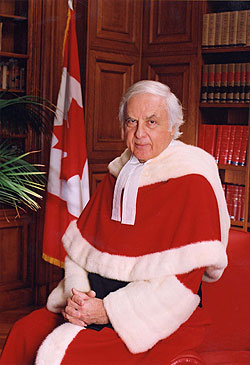
The Supreme Court of Canada ruled today that you can't attempt to conspire to commit a crime. It takes more work than that.
Apparently, the accused in this case thought about stealing some booze, discussed it with another member of the lumpenproletariat, but never actually got to the point of agreeing on a positive course of action. Everyone's been at meetings like that.
Justice Fish noted that no one has ever been convicted of attempting to conspire before, and didn't see any reason to start now.
From a crime control perspective, the major downside with this case will likely be the free pass it gives persons who think they are conspiring with a confederate who is in fact in the employ of Her Majesty. Parliament might want to fix that one.
Case Comment of R. v. Déry, 2006 SCC 53
Subscribe to:
Posts (Atom)
