I get a lot of grief about how negative Pith & Substance is all the time. (Well, I think I would get a lot of grief if I could get the daily view stats reliably into the double digits -- for now, let me just argue with my imaginary critics.) So let me set out my constructive views on a matter of public note that I have thought about, if not resolved: judicial review.
I don't share Paul Martin's view that the words of the SCC on questions of public policy should have greater authority than the Pope speaking ex cathedra on a matter of faith and morals. Mr. Martin was against gay marriage and two-tier healthcare until the courts said the opposite. I was for both, but doubted the reasoning by which they were judicially introduced. And we are equally not Prime Minister right now.
Also, as I will explain when I finally get around to finishing that damn Singh blogathon, I don't really believe that the determination of whether a particular law violates somebody's rights is a legal or interpretative judgment. It is always a matter of balancing policy outcomes, and judges and lawyers know this, even though we are not supposed to let the laity in on it.
On the other hand, I don't really have a bee in my bonnet about judicial review as such. I accept Aristotle's view that democracy needs to be tempered by aristocracy (and vice versa). Back in the day, the British tradition of democracy had plenty of aristocratic elements, but they have given way to modernity. No one really thinks the Senate can play the role Macdonald envisioned for it.
The aristocratic elements today are the bureaucracy, the policy academy (basically economists and epidemiologists with the odd IR type), the professions and the judiciary. All are capable of self-interested behaviour. I think all need to give way to the firmly-held opinion of the people. But the people want contradictory things, do not know much, and can act unwisely as a result of passing emotions (so too can the aristocratic types, of course). So mediating popular will is a good thing.
So where does this lead us? It looks as though we can't trust anybody, and we should give way to consistently held popular opinion.
The solution is the notwithstanding clause. Where traditional rights or vulnerable minorities are concerned, let the judges make it difficult, but not impossible, for the majority to get its way. Let them change who plays defence.
The problem with our s. 33 is that it applies only to some rights, but it allows the legislature to overrule with a simple majority. The result is the unstable equilibrium we have now where the Charter can only be maintained as effective if we regard the use of s. 33 as totally unacceptable. But it shouldn't be totally unacceptable, because judges are often wrong and the populace right.
Ideally, we would have s. 33 apply to all the rights in the Constitution, but only allow it to be exercised with a super-majority in the relevant legislature (say 2/3). The legitimacy of the overruling would cease to be in doubt, but would obviously be harder to get. If no one worried that the use of s. 33 once would destroy the Charter forever, then it would be a lot simpler to overrule boneheaded decisions that the whole political spectrum could regard as dumb.
Paradoxically, the existence of the political safety valve of s. 33 actually permits the courts to be more active in the protection of rights. If s. 33 had existed down South, then the pro-life movement would have been less focused on changing the composition of the SCOTUS, and more on getting politicians to commit to using the non obstante. They probably would have failed, which would be fine, because it would still be a political process, rather than a dictated one.
If Harper wants to introduce property rights into the Constitution, I would say fine to that as well, as long as section 33 was available. Some crazy libertarian judge decides to follow Lochner and the people's representatives can use the "notwithstanding" clause. (In fact, Harper could do this without changing the constitution by amending the sadly-neglected Diefenbaker Bill of Rights to give substantive protection to property rights).
I'd like to see a super-majoritarian non obstante introduced into federalism disputes as well. Actually, I think the Federal Parliament should be able to validate provincial legislation struck down on a simple majority. But when federal legislation is struck down, it should require the 2/3 (with some special protections for Quebec, TBA).
Thursday, April 20, 2006

Wednesday, April 19, 2006
No more M'Lud
In India at least. From now on, Indian judges are to be called "Your Honour".
English judges were known as Your Lordship because they actually were Lords.
Canadians awkwardly adopted "My Lord" and "My Lady". Ontario abolished them a while back, and the Supreme Court of Canada have now taken on the less fawning "Justice."
A few provinces, including British Columbia, still get their lawyers to request their Lordships and Ladyships to take notice of their submissions. I'm not quite enough of an old fart yet to approve.
English judges were known as Your Lordship because they actually were Lords.
Canadians awkwardly adopted "My Lord" and "My Lady". Ontario abolished them a while back, and the Supreme Court of Canada have now taken on the less fawning "Justice."
A few provinces, including British Columbia, still get their lawyers to request their Lordships and Ladyships to take notice of their submissions. I'm not quite enough of an old fart yet to approve.
"Buster"! thou shouldst be living at this hour
Some on the right have denied that a nuclear option is being considered for Iran. The more ambitious Jonah Goldberg defended it by claiming the Pentagon has plans to invade Canada. Those nationalists among our readers should be aware that these plans were developed by the War department in the 1930s.
More importantly, we had a plan to invade them back. As the journalist Charles Taylor related in the 1980s, Defence Scheme No. 1 was developed by the slightly loopy Brigadier James Sutherland "Buster" Brown, but kiboshed by King. According to Wikipedia, Buster did his own reconnaissance in plain clothes, and even predicted that we would be greeted as liberators during Prohibition.
Update: Steve Sailer points out that Goldberg called for an attack on the CN Tower a few moons ago, when anti-Canadianism was the flavour of the month in the crazy neocon set. I recall much panic among our own local bourgeoisie at this development. Our clients were advised not to worry too much, given the advanced stage of Attention Deficit Disorder attained by the angry American right.
More importantly, we had a plan to invade them back. As the journalist Charles Taylor related in the 1980s, Defence Scheme No. 1 was developed by the slightly loopy Brigadier James Sutherland "Buster" Brown, but kiboshed by King. According to Wikipedia, Buster did his own reconnaissance in plain clothes, and even predicted that we would be greeted as liberators during Prohibition.
Update: Steve Sailer points out that Goldberg called for an attack on the CN Tower a few moons ago, when anti-Canadianism was the flavour of the month in the crazy neocon set. I recall much panic among our own local bourgeoisie at this development. Our clients were advised not to worry too much, given the advanced stage of Attention Deficit Disorder attained by the angry American right.
Tuesday, April 18, 2006
Technology Advances
I have been getting a lot of bitching about my copyright-compliant image blogging policy. Some people are tired of pictures of Supreme Court of Canada Justices! Well, at Pith and Substance, we aim to please. Inspired by Lindsay Beyerstein, I decided to see if I can get more interesting public domain images by getting a flickr account.
This was uploaded by Catherine Jamieson on April 18, 2005. Thanks, Catherine, for your contribution to cyberfreedom!

This was uploaded by Catherine Jamieson on April 18, 2005. Thanks, Catherine, for your contribution to cyberfreedom!
Monday, April 17, 2006
The Rebel Sell: A Mini-Review
Over the long weekend, a friend gave me Joseph Heath and Andrew Potter's 2004 book The Rebel Sell.
Basically, I agreed with the authors' points, laughed as they ridiculed the ridiculous and nodded throughout. But it still left me a bit unsatisfied.
I can't argue with the main points the book makes. All societies require rules of conduct, and being anti-social is not the same as being a political dissident. Counter-culture is not anti-capitalist, since capitalism is just as happy to sell authentic experiences and cultural change as pork bellies. Cool is indeed just a post-sixties word for status (within a certain class: more people continue to seek status the old-fashioned way, by having successful children and numerous grandchildren).
The problem is the genre of The Rebel Sell, the dialectical polemic. Dialectical polemics are big on tracing out the logic of the Idea the polemicist is against, from précis of Big Theorist to pop cultural avatar. Heath and Potter take on a Zeitgeist of counter-culture, of anti-consumerist consumption, which somehow stretches from Rousseau, Freud and Gramsci to the most annoying rock snob and ditsiest hippie chick you ever met at an E party. The Pithlord is not entirely against this genre. It is often the case that the fundamental reason to reject the Frankfurt School professor is the shame you feel for pretending to take the hippy chick's contention that the Body Shop will save the world or the rage that the superior record store clerk inspires. So the Pithlord isn't against the genre altogether.
The problem is that a dialectical polemic doesn't take the time to distinguish between ideas worth doing a sociological analysis of, and those really worth arguing with. Heath and Potter can be quite annoying when they throw off policy ideas (35 hour week, school uniforms, elimination of full deductibility of advertising expenses) without bothering to seriously motivate them. At one point, they introduce quite an interesting issue: is there an aggressive instinct in humans, as Freud thought, or is aggression simply the meeting of pure instrumental rationality with a prisoner's dilemma, as Hobbes said? Heath and Potter assure us that there is nothing in human nature that well-regulated markets can't fix. Personally, I suspect they miss that it is our genes that are rational maximizers, not us, and they certainly don't discuss the recent work to show how "irrational" aggression might have evolved. In effect, they dismiss the idea that civilization must repress dangerous human energies with the lightness of touch more appropriately used when discussing Adbusters' new shoe brand.
Sometimes this tendency opens them up to ethical criticism. At one point, they criticize Theodore Roszak for describing Playboy as on a continuum with Auschwitz, but later they treat those who buy free-range eggs as siblings in spirit with the Unabomber. The critics of "moral equivalence" describe the difference between violent and non-violent environmentalists as "more tactical than substantive" (p. 136).
If the counter-culture was really libertarian-capitalist all along -- if the hippies were always yuppies -- then the question still arises whether it was good or bad. Tyler Cowen or Virginia Postrel happily point out the delusion of leftist avant-garde types, but they celebrate what the competitive process Heath and Potter describes has wrought. And they are on to something: maybe the hippies that brought North America better bread were misguided political analysts, but we do now have better bread. Sure, the bobos abandon openly racist expression in part because it reeks of commonness, but don't we end up a little more civilized, a little more restrained? Heath and Potter's analysis of the counter-culture's essential libertarianness doesn't answer the evaluative question of whether and to what extent it has been good for us. They are entitled not to be interested in this question, but would the polemical force remain if they confronted it?
Even Naomi Klein could be seen simply as someone trying to make development and trade union politics cool, to rebrand it. This might not be as foolish a political move as Heath and Potter say.
Fundamentally, the boys are right that the impulse to turn away from "the system" is not a political impulse. No practical politics can afford to oppose the system as such -- it must always have a concrete object of change: a war, segregation, daycare. The impulse of disgust at the system is, at bottom, a religious impulse. It is the impulse to ask the question posed by our free finitude. Ridiculing the impulse doesn't really make it go away. And the boys don't seem to get religion, even though religious journeys of various sorts (Buddhist, Gnostic, Kabbalistic) are a big part of their story. The boys tell us that "The primary functions of Western religions are to teach morality, sanctify marriage and family, and anchor social stability through shared beliefs, rituals and institutions." An odd thing to say about Christianity, for example, whose founder had little time for bourgeois morality, family or social stability.
Ultimately, the boys refuse to understand why anyone would efficiency and instrumental rationality lacking. They invoke Rawls to say that they don't need to embark on the deeper questions -- that liberalism requires only shallow agreement -- but then they are never going to really understand either the counter-culture, which strained for a deeper-than-bourgeois way of living, nor the limits of it.
Update: The literatus wonders whether "ditsiest" should be "ditziest." My spell checker knows neither, but it has the vocabulary of a six-year-old with a reading disability. Five minutes of exhaustive Internet research reveals that both usages are acceptable.
The literatus also complains that I failed in the basic task of the reviewer, which is to tell people whether they should buy the damn book. I was about to invoke the authority of Northrop Frye, and get all snooty about "mere evaluation", when I remembered some pundit (whose name I have forgot/forgotten) who suggested Frye's aversion to evaluating reflected the general unwillingness of the Canadian literary community to piss off somebody who might be in the position to a rule on a Canada Council grant someday. Whether this is fair or not, it stuck with me, and I feel guilty for not pointing my thumbs solidly in a particular direction.
The Rebel Sell is indeed a good book, summarizing complicated ideas effectively and ridiculing stupid ones mercilessly. For a North American born between 1965 and 1980, with some intellectual or leftist pretensions, it is as good an introduction to the Hobbes/Locke/Hume/Smith vs. Rousseau/Hegel/Marx/Freud debate about human nature as you are likely to find, although highly biased to the former side.
My only caveat would be that I would not give it to a brash marketing type or a dweeby economics geek, since it would confirm them in all their prejudices, and that would not be good for their souls. But if you know anybody who ever marched in an anti-globalization parade, or convinced themselves that keeping Wal-Mart out of their backyard was good for the working class, then I wouldn't let another gift season go by without picking one up.
Basically, I agreed with the authors' points, laughed as they ridiculed the ridiculous and nodded throughout. But it still left me a bit unsatisfied.
I can't argue with the main points the book makes. All societies require rules of conduct, and being anti-social is not the same as being a political dissident. Counter-culture is not anti-capitalist, since capitalism is just as happy to sell authentic experiences and cultural change as pork bellies. Cool is indeed just a post-sixties word for status (within a certain class: more people continue to seek status the old-fashioned way, by having successful children and numerous grandchildren).
The problem is the genre of The Rebel Sell, the dialectical polemic. Dialectical polemics are big on tracing out the logic of the Idea the polemicist is against, from précis of Big Theorist to pop cultural avatar. Heath and Potter take on a Zeitgeist of counter-culture, of anti-consumerist consumption, which somehow stretches from Rousseau, Freud and Gramsci to the most annoying rock snob and ditsiest hippie chick you ever met at an E party. The Pithlord is not entirely against this genre. It is often the case that the fundamental reason to reject the Frankfurt School professor is the shame you feel for pretending to take the hippy chick's contention that the Body Shop will save the world or the rage that the superior record store clerk inspires. So the Pithlord isn't against the genre altogether.
The problem is that a dialectical polemic doesn't take the time to distinguish between ideas worth doing a sociological analysis of, and those really worth arguing with. Heath and Potter can be quite annoying when they throw off policy ideas (35 hour week, school uniforms, elimination of full deductibility of advertising expenses) without bothering to seriously motivate them. At one point, they introduce quite an interesting issue: is there an aggressive instinct in humans, as Freud thought, or is aggression simply the meeting of pure instrumental rationality with a prisoner's dilemma, as Hobbes said? Heath and Potter assure us that there is nothing in human nature that well-regulated markets can't fix. Personally, I suspect they miss that it is our genes that are rational maximizers, not us, and they certainly don't discuss the recent work to show how "irrational" aggression might have evolved. In effect, they dismiss the idea that civilization must repress dangerous human energies with the lightness of touch more appropriately used when discussing Adbusters' new shoe brand.
Sometimes this tendency opens them up to ethical criticism. At one point, they criticize Theodore Roszak for describing Playboy as on a continuum with Auschwitz, but later they treat those who buy free-range eggs as siblings in spirit with the Unabomber. The critics of "moral equivalence" describe the difference between violent and non-violent environmentalists as "more tactical than substantive" (p. 136).
If the counter-culture was really libertarian-capitalist all along -- if the hippies were always yuppies -- then the question still arises whether it was good or bad. Tyler Cowen or Virginia Postrel happily point out the delusion of leftist avant-garde types, but they celebrate what the competitive process Heath and Potter describes has wrought. And they are on to something: maybe the hippies that brought North America better bread were misguided political analysts, but we do now have better bread. Sure, the bobos abandon openly racist expression in part because it reeks of commonness, but don't we end up a little more civilized, a little more restrained? Heath and Potter's analysis of the counter-culture's essential libertarianness doesn't answer the evaluative question of whether and to what extent it has been good for us. They are entitled not to be interested in this question, but would the polemical force remain if they confronted it?
Even Naomi Klein could be seen simply as someone trying to make development and trade union politics cool, to rebrand it. This might not be as foolish a political move as Heath and Potter say.
Fundamentally, the boys are right that the impulse to turn away from "the system" is not a political impulse. No practical politics can afford to oppose the system as such -- it must always have a concrete object of change: a war, segregation, daycare. The impulse of disgust at the system is, at bottom, a religious impulse. It is the impulse to ask the question posed by our free finitude. Ridiculing the impulse doesn't really make it go away. And the boys don't seem to get religion, even though religious journeys of various sorts (Buddhist, Gnostic, Kabbalistic) are a big part of their story. The boys tell us that "The primary functions of Western religions are to teach morality, sanctify marriage and family, and anchor social stability through shared beliefs, rituals and institutions." An odd thing to say about Christianity, for example, whose founder had little time for bourgeois morality, family or social stability.
Ultimately, the boys refuse to understand why anyone would efficiency and instrumental rationality lacking. They invoke Rawls to say that they don't need to embark on the deeper questions -- that liberalism requires only shallow agreement -- but then they are never going to really understand either the counter-culture, which strained for a deeper-than-bourgeois way of living, nor the limits of it.
Update: The literatus wonders whether "ditsiest" should be "ditziest." My spell checker knows neither, but it has the vocabulary of a six-year-old with a reading disability. Five minutes of exhaustive Internet research reveals that both usages are acceptable.
The literatus also complains that I failed in the basic task of the reviewer, which is to tell people whether they should buy the damn book. I was about to invoke the authority of Northrop Frye, and get all snooty about "mere evaluation", when I remembered some pundit (whose name I have forgot/forgotten) who suggested Frye's aversion to evaluating reflected the general unwillingness of the Canadian literary community to piss off somebody who might be in the position to a rule on a Canada Council grant someday. Whether this is fair or not, it stuck with me, and I feel guilty for not pointing my thumbs solidly in a particular direction.
The Rebel Sell is indeed a good book, summarizing complicated ideas effectively and ridiculing stupid ones mercilessly. For a North American born between 1965 and 1980, with some intellectual or leftist pretensions, it is as good an introduction to the Hobbes/Locke/Hume/Smith vs. Rousseau/Hegel/Marx/Freud debate about human nature as you are likely to find, although highly biased to the former side.
My only caveat would be that I would not give it to a brash marketing type or a dweeby economics geek, since it would confirm them in all their prejudices, and that would not be good for their souls. But if you know anybody who ever marched in an anti-globalization parade, or convinced themselves that keeping Wal-Mart out of their backyard was good for the working class, then I wouldn't let another gift season go by without picking one up.
Thursday, April 13, 2006
Cosh on Religious Pacifists
I don't read the National Post since they decimated their Arts coverage. The reporting was never any good, and their best opinionators are all online anyway. And since I don't really believe that Canada is an anti-Semitic collectivist hellhole, a Weimar-with-blackflies, I find the sheer discipline of its political agenda exhausting. Also, while I can understand intellectually why so many of our fellow citizens are so much more emotionally invested in the Palestine-Israel thing than the bloodier and more interesting Ethiopia-Eritrea border dispute, I can't really feel it.
The main downside is having to wait a bit for Cosh's more extended reflections. His latest seems to me a tribute to religious pacifists, designed to be misunderstood as a knee-jerk right-wing attack on them. The critical line is "To call the Peacemakers 'moral imbeciles,' as a Sun columnist did on Sunday, seems unkind to imbeciles." A good one-liner bound to please in Calgary watering holes. But the flipside is that the comparison while unkind to imbeciles, lacks the appropriate degree of respect for the Peacemakers' fanaticism.
The underlying intuition of pacifism -- that no expectation of positive consequences can ever justify the deliberate destruction of *this* human life -- is one that ought to appeal to the kind of conservative raised on tales of the unintended results of well-intentioned coercion. And secular conservatives always admire religious faith.
I think Cosh is ultimately right that serious pacifism requires a religious conviction that God will make the consequences all work out, and that the pride of man is inevitably humbled. I find the latter easy to accept, but have not managed the former.
What we might have learned from the pacifists is that war, like revolution, is not something to enter into because we have a plan of social improvement. It ought to be a last resort in response to aggression (or, in the case of revolution, tyranny). The pacifists are, in the last instance, hard-headed in realizing that war/revolution are not good instruments of policy because they are always bigger than we are, and so don't stay instrumental very long.
Update/Suck up: Cosh is apparently starting a roundup of world English-language press.
More Respectful Update: A few days after this post, William Sloane Coffin died. RIP.
The main downside is having to wait a bit for Cosh's more extended reflections. His latest seems to me a tribute to religious pacifists, designed to be misunderstood as a knee-jerk right-wing attack on them. The critical line is "To call the Peacemakers 'moral imbeciles,' as a Sun columnist did on Sunday, seems unkind to imbeciles." A good one-liner bound to please in Calgary watering holes. But the flipside is that the comparison while unkind to imbeciles, lacks the appropriate degree of respect for the Peacemakers' fanaticism.
The underlying intuition of pacifism -- that no expectation of positive consequences can ever justify the deliberate destruction of *this* human life -- is one that ought to appeal to the kind of conservative raised on tales of the unintended results of well-intentioned coercion. And secular conservatives always admire religious faith.
I think Cosh is ultimately right that serious pacifism requires a religious conviction that God will make the consequences all work out, and that the pride of man is inevitably humbled. I find the latter easy to accept, but have not managed the former.
What we might have learned from the pacifists is that war, like revolution, is not something to enter into because we have a plan of social improvement. It ought to be a last resort in response to aggression (or, in the case of revolution, tyranny). The pacifists are, in the last instance, hard-headed in realizing that war/revolution are not good instruments of policy because they are always bigger than we are, and so don't stay instrumental very long.
Update/Suck up: Cosh is apparently starting a roundup of world English-language press.
More Respectful Update: A few days after this post, William Sloane Coffin died. RIP.
Wednesday, April 12, 2006
Singhing for my Supper: Part Deux
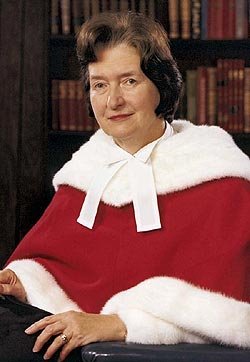
OK. Enough procrastination. I promised I would do a five-part blgoathon on the Singh decision (by which everyone means Madam Justice Wilson's reasons), and that means I'd better get busy.
The first order of business was to explain why the argument the literatus tells me the righties are fond of -- to wit, that the SCC ought never to have included refugee claimants among the persons owed rights under the Charter-- must be wrong. And I was to do it without engaging in politically correct balderdash, or using too much Latin.
The hard part is explaining how the process worked. Back in the day (pre-1985) refugee claimants were not automatically entitled to an oral hearing before the Immigration and Refugee Board. First, they had to appear before a federal government official, where they were asked questions under oath, and a transcript was taken. The transcript was then reviewed by a committee, which decided whether to grant the claimant permission to reside in Canada for the time it took, even in those relatively halcyon days, to get a refugee hearing done. If the committee said "no" (as it did to Mr. Singh), then there was an opportunity to apply in writing to have the Board reconsider the decision. But that application was in writing (i.e. just with the transcript) and the onus was on the claimant to show that he or she would more than likely prevail.
If you think that was complicated, you don't want to be practicing immigration law today.
Anyway, the SCC had to figure out whether this process was consistent with section 7 of the Charter (which Justice Scalia once explained to some law students, including me, was sufficiently "foofy" that any country stupid enough to put it in their constitution deserved the inevitable judicial tyranny that would follow):
Everyone has the right to life, liberty and security of the person and the right not to be deprived thereof except in accordance with the principles of fundamental justice.
(Actually, technically, the Court dodged this question, but let's leave that for another part of the blogathon.)
Lawyers love to divide simple sentences up into "tests" and "stages" and no lawyers liked to do that more than the 1980s SCC. So they started with who is included in "Everyone." According to the righties, this is where they went wrong. "Everyone" only means Canadians or maybe landed immigrants.
Sorry, but that cannot be right. Because when the Charter means citizens, it uses "citizen" (Section 3: Every citizen of Canada has the right to vote...), and when it means citizens and landed immigrants, it uses "citizen" and "person who has the status of a permanent resident of Canada" (Paragraph 6(2)(a): Every citizen of Canada and every person who has the status of a permanent resident of Canada has the right [...] to move to and take up residence in any province.).
So, when it says "everyone", it means "everyone" (bracketing controversies about fetuses, corporations, sentient robots and so on).
That doesn't mean that Wilson's at logical home plate yet. She's only gotten past one word: she still has to get through the rest of section 7, and then section 1. Each of the moves she makes on each of these points is one that a reasonable person could dispute, and, to give it its due, the DOJ did.
But before we get there, a theoretical intermission: the Pithlord is oddly comforted by his sense of certainty on even the first stage. Like most quibblers, he has had his dark nights of the soul when he doubted that the law really meant anything, other than what some damn fool judge preferred it to mean. Back in law school, he read the "Realists" who made an ideology of this doubt, and liked to argue their side when classroom participation marks were being dangled. But there is *something*, however underdetermining, to the technical canons of the profession. The DOJ didn't try to argue that Mr. Singh was outside the category of "Everyone" and Wilson dispensed with that issue in a paragraph, for reasons that I think almost all lawyers would agree with. In some ultimate sense, these certainties may be the folkways of the guild, but they are certainties nonetheless, and that they could be taken advantage of by somebody as far from the obvious sources of power as Mr. Singh gives the quibblers something to be proud of.
OK, the literatus reasonably, if impatiently objects, but it can hardly be possible that everyone in the world is owed the same concern and attention of the Canadian government as those here and paying taxes. How can "everyone" really mean everyone on Earth?
It works, but just so long as the Charter is a classically liberal document creating negative obligations on government. To make this doable, we need a strong act/omission distinction, and we have one in the Dolphin Delivery doctrine. All rights have correlative obligations, and, for the Charter those obligations are all on the government, and (although the SCC hasn't always been consistent here), they are all either negative or conditional obligations. The Charter is not violated when criminally-minded Canadians deprive others of their life or liberty, nor even when the state fails to effectively prevent this.
There are very few classically liberal ("libertarian") Canadians, thank God, and certainly none of those responsible for the Charter answered to that description. But, as I suggested previously, the Charter was intended to preserve that consensus between classical liberalism and social democracy. It allows, but does not require, affirmative action to redress social inequality. It allows, but does not lift a finger to defend, a free market economy based on private property and contractual freedom.
So, when it is said that "everyone" means everyone, no positive obligation has yet been created. The Canadian government cannot kill anyone, even a foreigner, without going through some more hurdles. But it need not save anyone's life. We expect it will do something for the literatus and myself when we are in trouble, but our basis for that expectation is a political one.
OK, but then how do we get to a positive and costly obligation to refugee claimants, which an oral hearing certainly is? Here Wilson makes a move that I must approve of in principle. She says that entry into the country is a pure Crown prerogative, but that the Crown and Parliament has substantively defined what a refugee is through the Executive's agreement to the relevant Convention and the latter's use of that definition in legislation. So while Canada had no constitutional obligation to do this, once it has created this substantive right, it has a constitutional obligation to have adequate procedures to determine whether the substantive right exists or not.
One possible response would be that if the federal government could, constitutionally, allow no refugee applicants at all, how can it be in trouble if it allows them, but doesn't give them all oral hearings? I'm not sure Wilson squarely addresses this thought, other than to say that such a privilege/right distinction was exactly the kind of thinking that made the Diefenbaker Bill of Rights such a joke.
The counter-argument that I think is right is that section 7 was intended to do something, and what it was intended to do was to allow the courts to look at procedures affecting people's vital interests and make sure those procedures were adequate. The framers of the Charter knew that section 7 was a bit "foofy" in its wording, but thought that the procedure/substance distinction would keep it under control. The evidence that this was what they intended is overwhelming: unfortunately, the SCC didn't listen.
But if they had listened, then this would have justified this part of Singh. Parliament would have free reign to decide what substantively constitutes a refugee, or whether we should even have such a category: the judges could then determine whether the procedures for assigning this status are fair. This division of labour -- which was genuinely intended -- would require the courts to take a look at procedures even where the status sought is, in some sense, a "privilege."
Defining procedures is a more modest task for courts, but it is the one that the authors of the Charter really did mean to give them. The Pithlord is OK with that, particularly since the political system has the notwithstanding clause -- and, more importantly in practice, the ability to bring social policy issues into play under section 1.
All of which just gets us to the legitimacy of the Court considering the real questions: Is an oral hearing required to determine fairly whether a person is truly a refugee? Is the extra stress on the immigration system of requiring such a thing really worth it? The actual consequences of the decision put the Court's judgment on these matters in doubt. But that's the subject of the next post.
Picture of Bertha Wilson from Supreme Court of Canada collection. Credit: Michael Bedford.
Singhing for my supper, Part Un

The Pithlord takes requests.
Oh, he'd rather not. But the Pithlord knows his low station in the blogosphere. Anonymous part-timers who refer to themselves in the third person, using Star Wars-inspired handles no less, cannot afford to be choosy. With a chosen area of interest of Canadian constitutional arcana, one cannot help be aware that one's social standing ranks below that of the Secretary-Treasurer of the Grade 10 Dungeons & Dragons Club.
The reader asks:
Been reading some righties who say the Singh decision was *textbook* [expletive deleted] judicial arrogation, expansion or power-grabbing bloat. That no real jurisprudentialist could interpret the Charter's "persons" to mean "all passersby, visitors and even petitioners are kidnapped into Canadianism and may at any time draw from the scanty, the limited, the put-upon public purse," into which the natives, I remind you, must tithe on pain of Kingston Pen.
I bet these ideologues are eliding some part of the Singh thing. Wanna give me a quick, non-goofy précis? Yes, you'll be marked. And Colby Cosh will give you a tentative little wave and try to approach you at parties, and you'll pretend you don't see him.
The Pithlord was raised to respect the social graces, and so wishes to preface his précisifying with thanks to the reader for his confidence in my eventual position in the Canblogger primate hierarchy, but most of all for braving the right-Canuckosphere to come back with such chilling reports. As Jack Pickersgill accurately, albeit arrogantly, noted, Tories are like mumps--you get them once a generation. Their time being the present, the Pithlord is glad to know a mump expert.
The furthest the Pithlord has yet ventured was into Andrew Coyne's comment threads. Unfortunately some minor electoral success had got the locals all riled up. The Timbits-treasuring Tories triumphalist denigration of adequately-caffienated beverages ("lattés are worse than capital gains taxes", "people who don't order double doubles should be disenfranchised", and similar drivel) annoyed the Pithlord. The election had already seriously divided Canadians on beverage-preference lines, and I was late for a same-sex wedding reception where I was to discuss with some top Grit bagpersons how we could blow Alberta's oil wealth on paving contracts in Shawinigan on our inevitable return to power, so perhaps my impending exposure to the work of Gloria Gaynor made me grumpy. In any event, I typed out "You can pry my no fat grande cappucino from my cold, dead fingers, so con" and pressed the Post button. Needless to say, it isn't just ethnic watering holes in the Dufferin-Bloor area where the Pithlord is unwelcome anymore.
But enough prefacing. Is the righties' critique of Singh on the money or not? At this point, the Pithlord needs to confess that he cannot live up to his name. On such a sensitive issue, it is better to be substantive than pithy. The reader has provoked me to a four-part blogathon (five parts, if you count this meandering preamble). The subsequent posts will attempt to show that:
1. The righties have unerringly picked the aspect of Wilson's judgment in Singh which is most undeniably beyond reproach. There really is no way to interpret "Everyone" in section 7 of the Charter such that it excludes applicants for refugee status. The other parts of Wilson's decision, although more open to reasonable dispute, do not contain an obvious logical flaw.
2. Nonetheless, Singh was a mistake, and has contributed to the clusterf**k that is our immigration policy.
3. The root of the problem was that Wilson (and Beetz too) acted too much like "real jurisprudentialists" and not enough like the cunning politicians that the Charter requires judges to be.
4. The whole thing could be sorted out by a federal government with the will to do so. In other words, the problem (at least here) isn't the Charter, so much as the political system's preference to have these hot potatoes dealt with by people in Santa Claus outfits.
Picture of Jon Cary as DJ taken by Nathaniel Meo of Utopium Photography, and donated into the public domain. Thanks, dudes. Pithlord biographical details may or may not be completely fictional.
Meaning -- Not in the Head; Constitutional Controversy -- Not About Meaning
Matthew Yglesias explains, to the Pithlord's satisfaction, why meaning isn't about the private intention of the speaker/author. Somebody in the comments thread points out that private meaning might be important in certain kinds of speech/writing. But it is beyond dispute that legal documents are not that kind of utterance.
This was all inspired by Stanley Fish's embrace of the "What would Madison do?" kind of originalism, which everybody in the legal world considered dead. In Canada, it is paradoxically even more silly than in the US with its long-dead framers, since the drafter of the Charter, Barry Strayer, is an intermediary appeal judge on the Federal Court. If the WWMD types were right, he would decide all his cases by trying to reminisce about what he would have done back when he was a wet-behind-the-ears DOJ hack, and once he introspected this, then his panel colleagues and the SCC would just have to do what he said.
If Constitutional adjudication were about meaning, then this would all be very important. But, at least most of the time, constitutional adjudication is *not* about the meaning of terms like "equality" or "liberty", but their application. Is a ban on Sunday shopping contrary to freedom of religion? You don't find out by asking English speakers what "freedom" and "religion" and "of" mean; you find out by inquiring as to the secular purposes of such legislation, its effect on religious minorities and so on.
The Pithlord is very sympathetic to the concern behind originalism. He worries about judicialization of decisions that ought to be decided democratically. But originalism isn't going to do anything about this concern. If it is of the WWMD type, it is absurd, and would require the kind of communing with the dead that has wisely not been part of the Canadian public policy process since King. If originalism is recast in more plausible form, then it doesn't actually do anything useful, at least not in the cases that people worry about.
This was all inspired by Stanley Fish's embrace of the "What would Madison do?" kind of originalism, which everybody in the legal world considered dead. In Canada, it is paradoxically even more silly than in the US with its long-dead framers, since the drafter of the Charter, Barry Strayer, is an intermediary appeal judge on the Federal Court. If the WWMD types were right, he would decide all his cases by trying to reminisce about what he would have done back when he was a wet-behind-the-ears DOJ hack, and once he introspected this, then his panel colleagues and the SCC would just have to do what he said.
If Constitutional adjudication were about meaning, then this would all be very important. But, at least most of the time, constitutional adjudication is *not* about the meaning of terms like "equality" or "liberty", but their application. Is a ban on Sunday shopping contrary to freedom of religion? You don't find out by asking English speakers what "freedom" and "religion" and "of" mean; you find out by inquiring as to the secular purposes of such legislation, its effect on religious minorities and so on.
The Pithlord is very sympathetic to the concern behind originalism. He worries about judicialization of decisions that ought to be decided democratically. But originalism isn't going to do anything about this concern. If it is of the WWMD type, it is absurd, and would require the kind of communing with the dead that has wisely not been part of the Canadian public policy process since King. If originalism is recast in more plausible form, then it doesn't actually do anything useful, at least not in the cases that people worry about.
Tuesday, April 11, 2006
When Neorealists Get Normative: Jacob Levy on Mearsheimer & Walt
Many, many stupid things have been said about Mearsheimer & Walt's piece on "The Israel Lobby", not all of them by Glenn Reynolds. Even though Dan Drezner avoided calling them anti-Semites, I didn't think his post warranted all the praise it got.
But Jacob Levy doesn't say stupid things. Read Multiculturalism of Fear if you want to understand Trudeau better than Trudeau did. Or read Loyalties of Federalism and Liberal Thought if you want to know how we ought to be responding to the separatist movement.
So Levy's post on M&W is, unsurprisingly, worth reading.
But Jacob Levy doesn't say stupid things. Read Multiculturalism of Fear if you want to understand Trudeau better than Trudeau did. Or read Loyalties of Federalism and Liberal Thought if you want to know how we ought to be responding to the separatist movement.
So Levy's post on M&W is, unsurprisingly, worth reading.
Generational Reflections of an Ex-Leftist
Publius has an interesting and moving account of attending the big pro-undocumented worker demonstration in Washington, D.C. and reflecting on his generational sense of belatedness/annoyance in relation to the sixties.
I think I'm a bit older than publius, but I know what he is talking about, so I posted this in his comments box:
Of course, then we get into a big Usenetty thing about libertarianism. But it was an interesting moment.
I think I'm a bit older than publius, but I know what he is talking about, so I posted this in his comments box:
I was born in 1970, so I know exactly what you mean about the feeling of belatedness. I remember the first Gulf War --after a few years of tiny demonstrations of Trotskyists and anarchists on every conceivable subject, we had thousands. And then it all dried up again a few weeks later when it was obvious that US military victory would be pretty easy.
We had a decade of stupid identity politics, and then in 1999, Seattle and the whole traveling anti-globalization stuff. By then, I had enough. I didn't sympathize with the cause, which seemed to be a generalized objection to international trade and governance per se, and I realized I didn't *want* to see another wave of leftist protestors.
Just like the sixties, the 1999 period was quickly followed by the triumph of right-wing ultra-nationalists who shared the hostility to international cooperation, but had the benefit of a realistic sense of how politics actually works. They took what the neoliberals had built in the 1990s and wrecked it out of a sort of Dionysian rage at the constraints of civilization.
Fighting for equality and dignity for the people who have worked and lived in your country is a real cause. Opposing another stupid war is a real cause. Good luck.
Of course, then we get into a big Usenetty thing about libertarianism. But it was an interesting moment.
Monday, April 10, 2006
Creation Science at SSHRC?
According to Panda's Thumb, Nature is reporting that SSHRC denied a research grant proposal on the grounds that "the committee felt there was inadequate justification for the assumption in the proposal that the theory of evolution, and not intelligent-design theory, was correct."
As I read this, I was immediately struck with panic. "But I thought Stockwell Day became Minister of Public Safety."
Sure enough, SSHRC apparently reports to the Minister of Industry, Maxime Bernier. Un avocat Québécois . So what's up with creationist infiltration of SSHRC?
As I read this, I was immediately struck with panic. "But I thought Stockwell Day became Minister of Public Safety."
Sure enough, SSHRC apparently reports to the Minister of Industry, Maxime Bernier. Un avocat Québécois . So what's up with creationist infiltration of SSHRC?
Bringing the Administration of Justice into Disrepute
I participate in an argument about the "exclusionary rule", i.e., whether it is a good idea to exclude probative but unconstitutionally-obtained evidence in criminal trials over at Lawyers, Guns and Money.
Bottom line: exclusionary remedies are a bad idea, but the kind of people who are most against them wouldn't like the alternative, making personal injury lawyers rich suing cops.
One of these days I will tell the story of how current Chief Justice of Ontario Roy McMurtry came up with the current s. 24(2) in an attempt to keep exclusionary remedies exceptional, how Lamer CJC overruled this relatively obvious intention, and what it means for the idea of original intent in Canada. But, today, I got work to do.
Update: I know, I know. The politically correct term is "original understanding", not "original intent." I was just being pejorative.
Update 2: Got an e-mail from the literatus complaining about all the typos on this site. I just fixed one on this post, but don't think I'm going to make a habit of it. I will be better about using the spell check, but I am not getting paid, unless you count $0.11 Canadian from Google Ads. If you want typos fixed, post a bleeding comment, and I'll fix them.
Bottom line: exclusionary remedies are a bad idea, but the kind of people who are most against them wouldn't like the alternative, making personal injury lawyers rich suing cops.
One of these days I will tell the story of how current Chief Justice of Ontario Roy McMurtry came up with the current s. 24(2) in an attempt to keep exclusionary remedies exceptional, how Lamer CJC overruled this relatively obvious intention, and what it means for the idea of original intent in Canada. But, today, I got work to do.
Update: I know, I know. The politically correct term is "original understanding", not "original intent." I was just being pejorative.
Update 2: Got an e-mail from the literatus complaining about all the typos on this site. I just fixed one on this post, but don't think I'm going to make a habit of it. I will be better about using the spell check, but I am not getting paid, unless you count $0.11 Canadian from Google Ads. If you want typos fixed, post a bleeding comment, and I'll fix them.
Sunday, April 09, 2006
We're # 4
Apparently, this site comes up in 4th place if you google "Pith" + "Substance". More remarkably, we're #1 for "Foucault"+"Trudeau".
Good work everybody, and bonuses all round.
Good work everybody, and bonuses all round.
Saturday, April 08, 2006
Insider/Outsider Trading and Property Rights
Stephen Bainbridge has a good post on how to analyze when trading on non-public information should be illegal and when it is just the market functioning as it should. The key is whether someone other than the trader should be considered to have a "property right" in the information.
I think this is right, but would add that this just pushes the analysis to the next stage: who has property rights in information? Where the information is received as a result of a fiduciary role (e.g., a lawyer knowing something from a client or a manager knowing something the firm has an interest in keeping secret), then it is pretty easy. But there will be border line cases.
I think this is right, but would add that this just pushes the analysis to the next stage: who has property rights in information? Where the information is received as a result of a fiduciary role (e.g., a lawyer knowing something from a client or a manager knowing something the firm has an interest in keeping secret), then it is pretty easy. But there will be border line cases.
Rights under the International Covenant on Economic, Social and Cultural Rights : Should They Be Read Into Canada's Constitution
Patrick Macklem argues "yes." He bemoans the relative absence of reference to ICESCR in Charter decisions.
The Pithlord is not a strict originalist, by any means. But he thinks both right and left need to accept that the 1982 deal bracketed the struggle between social democracy and classical liberalism. That is the real meaning of the absence of property rights or specific social guarantees in the Constitution. The Pithlord knows that it isn't too hard to come up with interpretive arguments incorporating either the principles of Alabaman laissez faire or Swedish welfare statism in sections 2, 7 or 15. But the courts shouldn't entertain them, no matter how ingenious. Social democracy needs to fight it out with libertarianism in the political sphere.
In a nutshell, that's why the majority was right in Gosselin and the minority was on the money in Chaoulli.
The Pithlord is not a strict originalist, by any means. But he thinks both right and left need to accept that the 1982 deal bracketed the struggle between social democracy and classical liberalism. That is the real meaning of the absence of property rights or specific social guarantees in the Constitution. The Pithlord knows that it isn't too hard to come up with interpretive arguments incorporating either the principles of Alabaman laissez faire or Swedish welfare statism in sections 2, 7 or 15. But the courts shouldn't entertain them, no matter how ingenious. Social democracy needs to fight it out with libertarianism in the political sphere.
In a nutshell, that's why the majority was right in Gosselin and the minority was on the money in Chaoulli.
Seymour Hersh: Bush Plans to NUKE Iran!
If it was anyone else, I'd dismiss it as crazy conspiracy crap. But Seymour Hersh has a pretty good track record. He claims that the Bush administration has plans to bomb Iran, including with tactical nuclear weapons.
Hersh reports:
According to Hersh, some members of the Joint Chiefs of Staff sought to have the nuclear option removed, including threats of resignation, without success.
The level of immorality and criminal stupidity involved in the first use of nuclear weapons far, far outweighs the Iraq war. If it happens, Canada must leave all its military alliances with the US immediately, including NORAD and NATO. If Harper refuses, then he must be brought down.
Sometimes hyper-ventilation is appropriate. An unprovoked first nuclear strike is one of those times.
Update: Matthew Yglesias wonders where the evidence is that sanctions inspire revolution. He is right, of course. They don't. Sanctions result from the famous syllogism:
1. Something must be done.
2. This is something.
3. Let's do it.
On the other hand, sanctions are way preferable to nuclear first-strikes.
Update, Part Deux: On Monday, Bush called Hersh's article "wild speculation." That is not a denial, and therefore, in the odd literalism of DC discourse, it is the next best thing to a confirmation. One with Nineveh and Tyre.
Hersh reports:
One of the military’s initial option plans, as presented to the White House by the Pentagon this winter, calls for the use of a bunker-buster tactical nuclear weapon, such as the B61-11, against underground nuclear sites. One target is Iran’s main centrifuge plant, at Natanz, nearly two hundred miles south of Tehran.
According to Hersh, some members of the Joint Chiefs of Staff sought to have the nuclear option removed, including threats of resignation, without success.
The level of immorality and criminal stupidity involved in the first use of nuclear weapons far, far outweighs the Iraq war. If it happens, Canada must leave all its military alliances with the US immediately, including NORAD and NATO. If Harper refuses, then he must be brought down.
Sometimes hyper-ventilation is appropriate. An unprovoked first nuclear strike is one of those times.
Update: Matthew Yglesias wonders where the evidence is that sanctions inspire revolution. He is right, of course. They don't. Sanctions result from the famous syllogism:
1. Something must be done.
2. This is something.
3. Let's do it.
On the other hand, sanctions are way preferable to nuclear first-strikes.
Update, Part Deux: On Monday, Bush called Hersh's article "wild speculation." That is not a denial, and therefore, in the odd literalism of DC discourse, it is the next best thing to a confirmation. One with Nineveh and Tyre.
Friday, April 07, 2006
Inside Stuff
I need a better nickname for the reader, since that was becoming confusing. I have hit upon the literatus. And so, congrats, to the literatus on a fine, published, piece of writing.
Surreal Moments in Blogging, Part I
Smarty-pants theocon Ross Douthat "fisks" the Gnostic Gospel of Judas.
According to technorati and Google Blogsearch, Judas has nothing to say in response to this devestating takedown at his own blog, 30piecesofsilver.blogspot.com.
According to technorati and Google Blogsearch, Judas has nothing to say in response to this devestating takedown at his own blog, 30piecesofsilver.blogspot.com.
Paging Dr. Zeno
The federal government has terminated an untendered contract to Marie-Joseée Lapointe, a well-connected Quebec Tory. The subject of the contract was the reform of the government's tendering process.
Naturally, it follows that the contract must now be tendered. But who will provide the evaluation of that competition? The Tories do not trust the public service, so it must be an outside consultant, who must, it follows, compete. And so on, and so on.
The impulse to respond to the violation of laws with new laws is the source of all bureaucracy. Discuss.
Naturally, it follows that the contract must now be tendered. But who will provide the evaluation of that competition? The Tories do not trust the public service, so it must be an outside consultant, who must, it follows, compete. And so on, and so on.
The impulse to respond to the violation of laws with new laws is the source of all bureaucracy. Discuss.
The Grand Unified Theory of Bushism & the British Constituion
Publius reflects on the recent Libby revelations by accurately summarizing the grand theory of Bushism: the Executive defines the limits of its own power. Not a good theory, and one with dreadful practical consequences for America and the world.
Unfortunately, many liberal Americans have thrown around the phrase "King George" or, on a more sophisticated level, emphasized the discontinuity between the British traditions of the royal prerogative and America's post-revolutionary constitution (Cass Sunstein, I'm looking at you).
These discontinuities exist. Clearly, there is a link between Article I's list of powers given to Congress, and Blackstone's list of the King's Prerogatives in relation to war and foreign affairs. The British Crown could (and can) declare war, issue letters of marque and reprisal and enter into treaties, and the framers thought the American President shouldn't be allowed to do these things (although in the 20th century, these restrictions have been honoured principally in the breach).
But, at a more basic level, the principle Yoo and Bush are asserting is an attack on the British Constitution as Blackstone would have understood it, and as Hamilton and Madison would certainly have wanted to preserve it. The Crown *does not* determine the limits of its own preorogative.
The key to the prerogative is that it is a matter of common law. Common law is defined by the courts, and subject to alteration by Parliament. Since the prerogative is a matter of common law, its existing limits are ultimately decided, not by the executive, but by the judiciary, and its limits can be restricted to any degree by Parliament.
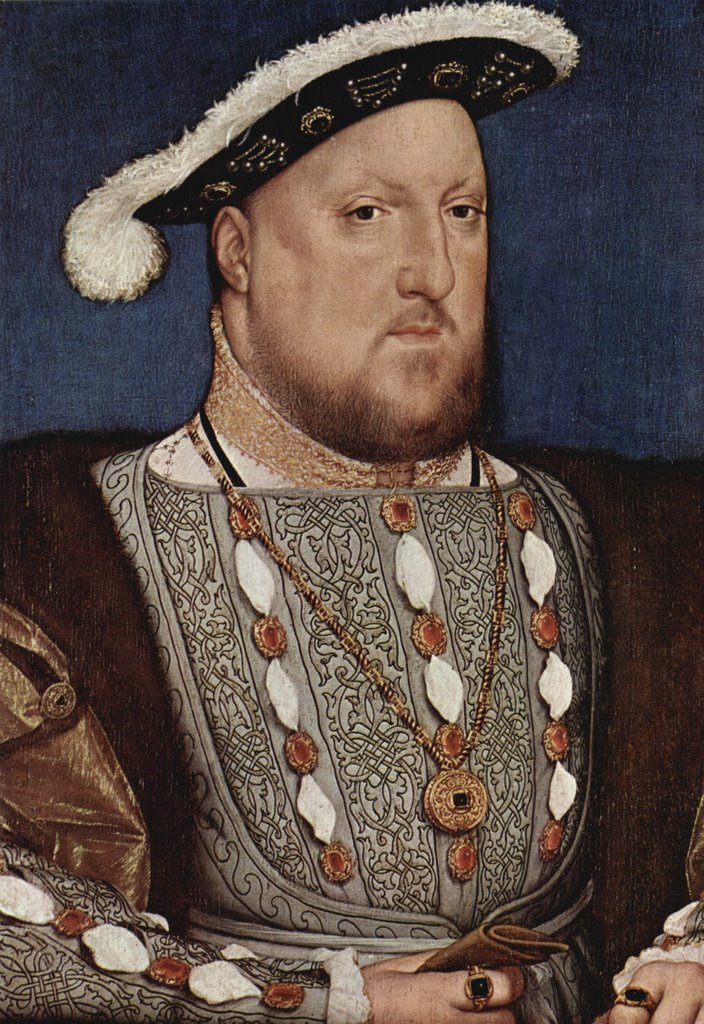
Amazingly, even Henry VIII accepted this principle: "We are at the height of our sovereignty when we act by and with the advice and consent of the Lords Spiritual and Temporal and the Commons." As a result, statutes were the Crown acting at the *height* of its sovereignty, while ordinary executive action were the Crown in a relatively subordinated position. There could therefore be no limit, in principle, to Parliament's ability to restrict executive power. By John Yoo's standards, Henry VIII was a wuss.
Thursday, April 06, 2006
Read this, Iggy
The Pithlord would be a lot happier about Ignatieff as Prime Minister if he would read some Jim Henley. Iggy would know a lot more about the DC Universe and why liberal imperialism doesn't work.
Here is Mr. Henley noting the odd American fixation on personality over structure.
I'm glad a Yank is bringing this up, because I was worried it might be impolite to mention how stupid this makes the US look. What *is* the deal with taking obscure Arab politicians and terrorists and making them into individual megastars when you have a whole mass movement that hates you, and can easily replace these individuals?
Here is Mr. Henley noting the odd American fixation on personality over structure.
I'm glad a Yank is bringing this up, because I was worried it might be impolite to mention how stupid this makes the US look. What *is* the deal with taking obscure Arab politicians and terrorists and making them into individual megastars when you have a whole mass movement that hates you, and can easily replace these individuals?
Wednesday, April 05, 2006
Rae Joins the Liberals

Bob Rae has come home again.
Some see the fiscal and uber-PC train wreck he led in Ontario a while back as a major obstacle to Rae making it to 24 Sussex. The Pithlord disagrees. He would rather not recall what he did and believed in the early nineties, and would be pleased to see a PM in the same position.
Freedom's just another word for limitation period expiry.
Image of toothy ex-premier subject to Crown copyright. Reproduction for non-commercial purposes licensed.
Tuesday, April 04, 2006
Will the American left finally embrace federalism?
I had an argument a few months ago with Scott Lemieux about whether the left should be so centralist on federalism issues. For a while, I have thought that the US left could do well to refocus its energies at the state level, and to start defending some constitutional autonomy for states in court. As far as I can see, if the American left is going to have any forward momentum in the next generation, it is going to be in the states.
Well, Massachusetts is now poised to become the first state to offer universal health care. More would follow, and would have done so earlier, were it not for the Court's imposed restrictions on residency requirements for state social programs.
Update: Sensible man-of-the-left Kevin Drum complains about the "kludges" in the Massachusetts plan. The Pithlord is no helath economics wonk, but counters that this misses the bigger point. Once the principle of universality is conceded, it is always possible to come up with more efficient ways of delivering it, since there will be no lack of pressures to do so. Its the principle itself that matters. Massachusetts, then Hawaii, then NY and CA. LBJ ain't coming back, so there's no point pining after Washington any more.
Well, Massachusetts is now poised to become the first state to offer universal health care. More would follow, and would have done so earlier, were it not for the Court's imposed restrictions on residency requirements for state social programs.
Update: Sensible man-of-the-left Kevin Drum complains about the "kludges" in the Massachusetts plan. The Pithlord is no helath economics wonk, but counters that this misses the bigger point. Once the principle of universality is conceded, it is always possible to come up with more efficient ways of delivering it, since there will be no lack of pressures to do so. Its the principle itself that matters. Massachusetts, then Hawaii, then NY and CA. LBJ ain't coming back, so there's no point pining after Washington any more.
Treaties to be ratified in Parliament
Not much surprising in the throne speech. I already mentioned the misguided commitment to democratize the Senate.
Everyone has already noticed that the déséquilibre fiscal is the doozie.
But I hadn't noticed the "Significant treaties will be submitted for a vote in Parliament" promise before. As it currently stands, signature and even ratification of a treaty are exercises of the Crown prerogative, but legislation is necessary to make a treaty effective as a matter of domestic law. (Very different from the US system.) What changes does the government have in mind?
Everyone has already noticed that the déséquilibre fiscal is the doozie.
But I hadn't noticed the "Significant treaties will be submitted for a vote in Parliament" promise before. As it currently stands, signature and even ratification of a treaty are exercises of the Crown prerogative, but legislation is necessary to make a treaty effective as a matter of domestic law. (Very different from the US system.) What changes does the government have in mind?
Stephen, Don't Say I Didn't Warn You
If the Pithlord could abolish the Senate, he would. If that is impossible, then we should just make the best of a bad situation, and leave the status quo in place. There is no way to rework the Senate without it descending into zero-sum regional competition. Triple-E means that Quebec is outnumbere 9-1. Rep-by-pop duplicates the House. The current distribution makes BC livid.
All of which is just a mildly annoying grievance as long as the Senate is unelected and therefore without the legitimacy to exercise its constitutional powers. But you add election to the mix, and you have just what we don't need -- raw regional power struggle.
So, naturally, our Prime Minister wants to get the party started now.
All of which is just a mildly annoying grievance as long as the Senate is unelected and therefore without the legitimacy to exercise its constitutional powers. But you add election to the mix, and you have just what we don't need -- raw regional power struggle.
So, naturally, our Prime Minister wants to get the party started now.
Monday, April 03, 2006
Lawyer Guild Privileges: The Next Unwritten Principle?
Through the lawless device of striking down legislation on the basis of "unwritten constitutional principles", the legal profession has obtained tax free status in British Columbia. But if you want to see where the game will be played next, it is wise to look at the law reviews.
In "Unwritten Constitutional Principles and the Enforceability of the Indpendence of the Independence of the Bar" (2005), 30 SCLR (2d) 463, Blakes associate and former clerk to Chief Justice McLachlin Roy Millen calls on the Court to establish "the independence of the bar" as the latest unwritten principle.
Shaw pointed out that all professions are conspiracies against the laity. For the most part, they are effective enough that few governments do much about them. But occasionally, the public may demand some constraint on the interests of a profession. If the Court takes up Millen's proposal, then lawyers will still be able to lobby politicians to avoid regulatory scrutiny, as pipefitters and doctors do, but will be able to ask the highest lawyers in the land to reverse any lack of success.
The Pithlord recognizes that there are some reasons for the guild privileges of lawyers, and that these need to be balanced against the benefits of external regulation. But he thinks the legal profession is strong enough to take its lumps in the political arena. The profession's guild privileges are based on the premise that lawyers are genuinely willing to uphold the rule of law. If the Dominion's barristers and solicitors are prepared to throw out hundreds of years of British/Canadian constitutional law to win perquisites for themselves, then the Pithlord is going to have to learn some lawyer jokes.
In "Unwritten Constitutional Principles and the Enforceability of the Indpendence of the Independence of the Bar" (2005), 30 SCLR (2d) 463, Blakes associate and former clerk to Chief Justice McLachlin Roy Millen calls on the Court to establish "the independence of the bar" as the latest unwritten principle.
Shaw pointed out that all professions are conspiracies against the laity. For the most part, they are effective enough that few governments do much about them. But occasionally, the public may demand some constraint on the interests of a profession. If the Court takes up Millen's proposal, then lawyers will still be able to lobby politicians to avoid regulatory scrutiny, as pipefitters and doctors do, but will be able to ask the highest lawyers in the land to reverse any lack of success.
The Pithlord recognizes that there are some reasons for the guild privileges of lawyers, and that these need to be balanced against the benefits of external regulation. But he thinks the legal profession is strong enough to take its lumps in the political arena. The profession's guild privileges are based on the premise that lawyers are genuinely willing to uphold the rule of law. If the Dominion's barristers and solicitors are prepared to throw out hundreds of years of British/Canadian constitutional law to win perquisites for themselves, then the Pithlord is going to have to learn some lawyer jokes.
Sunday, April 02, 2006
McCain: Warmonger, but, other than that, a great guy
Publius argues, from a centrist Democratic perspective, and much to the disgust of his commentariat, that John McCain might not be so bad after all, except that he "never met a war he didn't like."
It seems to me like an exception that swallows the rule. I suppose as an American, publius is entitled to care about the domestic policies of a possible Presidential contender. But, from my perspective, the worst possible Republican nominee would be (a) more militaristic than Bush and (b) not tied in the public mind with Bush's Iraq policy. At least a dyed-in-the-wool Bushie would have trouble using the whole "Weapons of Mass Destruction" line again. And a conservative isolationist like Hagel might actually have a rational foreing policy. So McCain seems like the worst of all worlds.
It seems to me like an exception that swallows the rule. I suppose as an American, publius is entitled to care about the domestic policies of a possible Presidential contender. But, from my perspective, the worst possible Republican nominee would be (a) more militaristic than Bush and (b) not tied in the public mind with Bush's Iraq policy. At least a dyed-in-the-wool Bushie would have trouble using the whole "Weapons of Mass Destruction" line again. And a conservative isolationist like Hagel might actually have a rational foreing policy. So McCain seems like the worst of all worlds.
Friday, March 31, 2006
Iggy Speaks
All the cool kids are talking about Micheal Ignatieff's speech at the U of O yesterday.
At the most obvious level, he's going to try to lead my party. That means I'm going to have to read some of his stuff.
As to the speech, it starts with the obligatory praise of the land, with examples chosen carefully from each time zone, and then segues into the archetypical immigrant experience of Tsarist nobility marrying into the Ontarian haute bourgeoisie. [/unfair and hypocritical snark]
Overall, I liked the domestic part of the speech, but the international stuff makes me nervous.
The most problematic theme is the one Ignatieff starts with: "ask not what you can do for your country; ask what your country can do for the world." It is especially troubling from Ignatieff. As a journalist/professor, his theme was always that the "West" should use its infinite power to rescue everyone from the consequences of the conflicts endemic to the human condition. He ignored completely the limits of the "West's" power, limits that Canada faces in spades. His lack of sympathy for particularism led him to ignore what armies, and military force, are made from.
Ignatieff shows a lot of finesse on Quebec. He is dead right that the real asymmetry that needs to be conceded is an asymmetry of sentiment. Quebec will mean something to Quebecois that Ontario will never mean to Ontarians, whether or not the Quebec government has any powers that the Ontario government does not.
There are a few false notes. He talks about Quebec being part of the Canadian solution "from the Quiet Revolution onwards." The implicit denigration of traditional Quebec is gratting. In fact, Quebec needs to rethink some of the legacies of the Quiet Revolution, particularly the way it created an interlocking state-labour-capital anti-competitive elite, and there is some evidence that it is starting to do so. The embarrassment a single generation had for Quebec prior to 1962 should not deprive an entire people of its heritage.
And then there is the obligatory reference to Quebec not assenting to the constitutional deal in 1981, although each individual part of that deal turns out to be as popular in Quebec as anywhere else. Iggy is well-placed to point out that we expect the Tutsis and Hutus to "get over" a massive genocide in 1994, so harping on the non-unanimous resolution of a many-year constitutional negotiation a generation ago is just demeaning.
Ignatieff emphasizes exactly the right things on the role of the federal government, and he has made some progress over traditional Liberal dogma just by recognizing that that role is a limited one.
A common border, a common market and a common citizenship.
The common border is a crucial one, and the harder-headed American milieu may make Ignatieff improve on traditional Liberalism here.
Personally, I don't think direct federal regulation of securities, for example, is necessary. But there should be federal laws requiring each provincial security regulator to respect the certification provided by the others (and similar laws for professional qualifications, pensions, etc., etc.) We can have the benefits of regulatory competition and inter-operability.
He makes good sense on equalization. It needs to be simplified, and it needs to be based on population.
Rhetorically, I think it is wrong to equate the situation of aboriginal Canadians, and the mutual obligations we need to work through, with the issues facing voluntary "visible minority" immigrants.
Finally, I don't think you can overestimate the importance of experience. Ignatieff is obviously a talented, charismatic guy, but there is still some dues-paying that has to be done.
Update:Red Tory defends Ignatieff from the charge of being more ex-pat than man.
At the most obvious level, he's going to try to lead my party. That means I'm going to have to read some of his stuff.
As to the speech, it starts with the obligatory praise of the land, with examples chosen carefully from each time zone, and then segues into the archetypical immigrant experience of Tsarist nobility marrying into the Ontarian haute bourgeoisie. [/unfair and hypocritical snark]
Overall, I liked the domestic part of the speech, but the international stuff makes me nervous.
The most problematic theme is the one Ignatieff starts with: "ask not what you can do for your country; ask what your country can do for the world." It is especially troubling from Ignatieff. As a journalist/professor, his theme was always that the "West" should use its infinite power to rescue everyone from the consequences of the conflicts endemic to the human condition. He ignored completely the limits of the "West's" power, limits that Canada faces in spades. His lack of sympathy for particularism led him to ignore what armies, and military force, are made from.
Ignatieff shows a lot of finesse on Quebec. He is dead right that the real asymmetry that needs to be conceded is an asymmetry of sentiment. Quebec will mean something to Quebecois that Ontario will never mean to Ontarians, whether or not the Quebec government has any powers that the Ontario government does not.
There are a few false notes. He talks about Quebec being part of the Canadian solution "from the Quiet Revolution onwards." The implicit denigration of traditional Quebec is gratting. In fact, Quebec needs to rethink some of the legacies of the Quiet Revolution, particularly the way it created an interlocking state-labour-capital anti-competitive elite, and there is some evidence that it is starting to do so. The embarrassment a single generation had for Quebec prior to 1962 should not deprive an entire people of its heritage.
And then there is the obligatory reference to Quebec not assenting to the constitutional deal in 1981, although each individual part of that deal turns out to be as popular in Quebec as anywhere else. Iggy is well-placed to point out that we expect the Tutsis and Hutus to "get over" a massive genocide in 1994, so harping on the non-unanimous resolution of a many-year constitutional negotiation a generation ago is just demeaning.
Ignatieff emphasizes exactly the right things on the role of the federal government, and he has made some progress over traditional Liberal dogma just by recognizing that that role is a limited one.
[The federal government] is charged with the defense of the country, the protection of its borders , the development of national infrastructure and a national economic market, as well as safeguarding the rights of citizenship. That all Canadians hold in common. Without respect for these federal domains, we cannot have a country.
A common border, a common market and a common citizenship.
The common border is a crucial one, and the harder-headed American milieu may make Ignatieff improve on traditional Liberalism here.
Personally, I don't think direct federal regulation of securities, for example, is necessary. But there should be federal laws requiring each provincial security regulator to respect the certification provided by the others (and similar laws for professional qualifications, pensions, etc., etc.) We can have the benefits of regulatory competition and inter-operability.
He makes good sense on equalization. It needs to be simplified, and it needs to be based on population.
Rhetorically, I think it is wrong to equate the situation of aboriginal Canadians, and the mutual obligations we need to work through, with the issues facing voluntary "visible minority" immigrants.
Finally, I don't think you can overestimate the importance of experience. Ignatieff is obviously a talented, charismatic guy, but there is still some dues-paying that has to be done.
Update:Red Tory defends Ignatieff from the charge of being more ex-pat than man.
Matthew Yglesias's Homage to Asymmetric Federalism (in Catalonia)
Wonk Wunderkind Matthew Yglesias notes, in regard to Spain's devolution of power to the Catalan government, that running multi-ethnic federations is hard.
The Pithlord is new to the ways of the blogosphere, and so is unsure whether that deserves a "Heh" or an "Indeed." Probably both.
Update: While in Europe, Yglesias also found out what they call a Quarter Pounder with Cheese. I'm afraid we've all been misled.
The Pithlord is new to the ways of the blogosphere, and so is unsure whether that deserves a "Heh" or an "Indeed." Probably both.
Update: While in Europe, Yglesias also found out what they call a Quarter Pounder with Cheese. I'm afraid we've all been misled.
SCC to Criminals: Go with the low-risk investment portfolio
The SCC has ruled, sensibly enough, that you don't get your fine reduced if you blow your proceeds of crime.
Tuesday, March 28, 2006
We Get Mail

I received an e-mail from a reader of this site (OK, the reader of this site) who objected to my reliance on Foucault in trying to define our place among the nations. Sadly, despite its kind words about my prose style and its author's own way with the mot juste, it was too suffused with philistine anti-intellectualism and hurtful Francophobia to be quoted at any length here. The Pithlord does not want to risk his new relationship with Google Ads through a sentimental attachment to old friendships!
But (and you will have to trust me on this) the e-mail raised a few interesting points. First, when speaking of British North America's expectations about the biological assimilation of the French and aboriginal peoples, it is important not to forget how damn sexy the Victorian Brits thought most of the people they were colonizing were. (In my defence, I did allude to the Northern European view that miscegenation with Indians was distinctly unhorrible.)
Second, my correspondent suggests Old Doug Johnson may be a bit of a sloganeering chump, which seems to be true. Although I do confess to a soft spot for the bats**t crazy unreconstructed 68ers, that would really go away if they kill Aldo Moro or Pierre Laporte again.
But my correspondent's most important point was to question Foucault's S&M assumption that the relationship between a People and its Others has to be one of sumbission and domination. Why can't our relationship with the Other be one of polite interest, or exotic fascination or even pure indifference? My correspondent suspects that Foucault was being a Euro-weenie. We can have a strong sense of who we are without harbouring ill will against anyone else. (My correspondent went on to say that Canadians do have a strong sense of who we are, which, since it goes against common sense and conventional wisdom, is probably true.)
I'm not a remedial writing instructor to the post-structuralists, so I'm not going to guess what Foucault would have said in response, but I will hazard my own attempt, which I think he'd agree with.
It may or may not be true that a distinct people can happily subsist without threatening or feeling threatened, just as feminine hygeine products may not really be necessary. But just as the manufacturer of the deodorant needs the "not quite fresh feeling", so too a biopolitical state needs the people to face an existential threat. The state, like the capitalist, has something to sell. It needs to make you realize you had needs you didn't realize you had.
And Foucault actually gives the biopolitical state some credit: it emerged when the scientific revolution showed that some pretty concrete threats could be dealt with: enclosed sewers, vaccination, actuarially-assessed insurance, and the Queen's Navy all really worked to allow non-Malthusian population growth. And they all worked by defining a threat, and finding a science-based solution.
And by the time of the Great War, each of the major biopolitical states represented quite genuine threats to the others. And each found a science-based solution to the threat, and the rest was the catastrophe that nearly brought down the first, great bourgeois civilization. It certainly brought down the British Empire, and with it British North America, even though they hobbled along for a few more decades.
Now, it may be said that Foucault, in his snobby Nietzschean way, fails to credit this development with its great achievement in allowing uncounted ordinary lives to unfold without the pre-industrial Malthusian horrorshow. Certainly, Foucault is uninterested in pointing out how this all could have worked out better. That would be some pretty uncool reformism, and uncool reformism just was not his bag.
But pointing out paradoxes was. And Foucault pointed out the paradox that the modern state has become increasingly squeamish about executing even serial killers, while being invested in a military strategy of massive retaliation against civilian populations, which would have horrified the Rennaissance Popes. Both developments fit with the idea that the state's job is to nurture the growth and survival of a people, seen a bit like a slightly delicate houseplant.
For the English Canadian "people", the threat the state has tended to emphasize is a particulalry ethereal threat, the threat to "identity." The threat is particulalry insidious, in that the identity has never (or at least not since the collapse of the Imperial ideal -- and we certainly don't want to go back to that) been securely established in the first place.
Promotional image of Canada Post truck copyright Canada Post Corporation. It is believed that use on this site is fair use under copyright law of Canada and the United States of America.
Monday, March 27, 2006
A Conservative Intellectual's Temptations

In my search for something high-falutin' to say about our current Canadian dilemmas, I have been re-reading George Grant. He doesn't disappoint, and is high-falutin enough on the subject to turn me off it for a while. But before I get into that, I had a thought about conservative intellectuals generally.
Conservatives rightly (and we now know, scientifically) think of human nature as essentially fixed through time. And they also (again I think rightly) think of the good as eternal and trans-historical. Finally, they understand that part of any plausible idea of the good is loyalty to one's own. A person whose virtues could all be deduced from utilitarian principle couldn't even be normal, let alone good.
The trouble is that one's own is inherently fleeting, and bound by time and space. The temptation is to try to grab hold of something --Platonic philosophy, patristic Christianity -- that can plausibly be both one's own and eternal.
Neoconservatives must mean many things by "cultural relativism." Some of those things are indeed shallow or nihilistic. But the basic recognition that what is one's own can never be absolute, which is perfectly compatible with love for it anyway, is wise. Ratzinger, a very subtle man, seems to think that the choice is between nihilism and the identification of one tradition as the tradition of the absolute. But the absolute relativizes everything, even its own traditions.
One of the good things about Canada is that it is a bit difficult to take seriously, let alone identify with the absolute.
Saturday, March 25, 2006
Sounds of Silence: "Unwritten Constitutional Principles" and Value for Law Degrees
Ah, the federal election of 2006. Bliss it was to be a political junkie, but to be a law geek was the very heaven.
From an ordinary poli-junkie's perspective, it was a great election, what with the multi-party alliances of convenience, the self-immolation of the Earnscliffe gang and the return of a national party. But for a con-law geek in the midst of ordinary politicos, it was even better. Should we get rid of the notwithstanding clause? Entrench property rights? Abolish the Senate? The law geek could pontificate with an air of professional authority, and, it must be confessed, the Pithlord did not always pass up the opportunity.
Of course, to cultivate the air of a true cognoscentus, it was important to say that all of these debates missed the real point, and that moves had been made in the game of judicial power that could not be undone by the remedies of the politicians. And, best of all, in the winter of 2005, it was true.

A few days before Christmas, the British Columbia Court of Appeal ruled that the Social Services Tax could not apply to legal bills. Over the dissent of the fearsome Mary Southin, three members of the Court decided that taxes on legal bills offended an unwritten constitutional right to legal representation. The majority discerned from the sounds of constitutional silence the command that all the world might be taxed, but not the transactions between a lawyer and her client.
No one likes taxes, and we have gotten used to courts striking down legislation, but the grounds used in Christie should still cause a self-governing people a bit of concern. Striking down a tax on legal services is not going to benefit the poor: on the contrary, it shifts taxes elsewhere, which will inevitably be regressive. Unwritten principles have unwritten boundaries. The Charter may not constrain the courts very much, but at least they have to go through the motions of an interpretative exercise, and the ability of the government to put forward evidence under section 1, and ultimately to override under section 33, keep judicial review a subordinate part of our governing structure.
The BC Court relied on the precedent of one of the Lamer SCC's most questionable decisions, the Provincial Court Judges' Reference. There, for the first time in 130 years, a Canadian court struck down a statute on the basis that it conflicted with "unwritten constitutional principles," and required the legislatures' to engage in a kind of interest arbitration for the compensation of provincial judges.
It would be a mistake to attack this decision on the basis that there are no unwritten principles in the Canadian constitution. There clearly are. But the highest of these principles is that Parliament is supreme, and while the English courts could review executive action to make sure it complies with the common law and statutory authority, they could not do the same for legislation. If an Act of Parliament was properly passed, then the courts had to give effect to it.
In his dissent in the Judge's Reference, Gerard La Forest had a great deal of fun with Lamer's ahistorical conception of judicial independence. He also pointed out that judges deciding on their colleagues' compensation were in causa sui. But the biggest problem with the decision is that it leaves a hole in the Constitution wide enough to force any judicial agenda through.
The BC Courts are still working out the consequences of the decision, and it will likely go to the Supreme Court of Canada. My general impression of the McLachlin court is that it wants to consolidate the craziness of the Lamer era, but, obviously, the surprising intervention into health policy last year stands as a counter-example. As the CBC likes to say, what the impact will be on democracy and the rule of law in Canada, "remains to be seen."
What cannot help but give public choice theorists aid and comfort, though, is that in 140 years, two decisions invoke an "unwritten" constitutional principle to strike down legislation, and both of them directly improve the incomes of persons with law degrees.
Copyright of image of cover to "Simon and Garfunkel's Greatest Hits" belongs to The Sony Corporation. Low resolution reproduction for parody purposes is believed to be fair use under Canadian and U.S. Copyright law.
From an ordinary poli-junkie's perspective, it was a great election, what with the multi-party alliances of convenience, the self-immolation of the Earnscliffe gang and the return of a national party. But for a con-law geek in the midst of ordinary politicos, it was even better. Should we get rid of the notwithstanding clause? Entrench property rights? Abolish the Senate? The law geek could pontificate with an air of professional authority, and, it must be confessed, the Pithlord did not always pass up the opportunity.
Of course, to cultivate the air of a true cognoscentus, it was important to say that all of these debates missed the real point, and that moves had been made in the game of judicial power that could not be undone by the remedies of the politicians. And, best of all, in the winter of 2005, it was true.

A few days before Christmas, the British Columbia Court of Appeal ruled that the Social Services Tax could not apply to legal bills. Over the dissent of the fearsome Mary Southin, three members of the Court decided that taxes on legal bills offended an unwritten constitutional right to legal representation. The majority discerned from the sounds of constitutional silence the command that all the world might be taxed, but not the transactions between a lawyer and her client.
No one likes taxes, and we have gotten used to courts striking down legislation, but the grounds used in Christie should still cause a self-governing people a bit of concern. Striking down a tax on legal services is not going to benefit the poor: on the contrary, it shifts taxes elsewhere, which will inevitably be regressive. Unwritten principles have unwritten boundaries. The Charter may not constrain the courts very much, but at least they have to go through the motions of an interpretative exercise, and the ability of the government to put forward evidence under section 1, and ultimately to override under section 33, keep judicial review a subordinate part of our governing structure.
The BC Court relied on the precedent of one of the Lamer SCC's most questionable decisions, the Provincial Court Judges' Reference. There, for the first time in 130 years, a Canadian court struck down a statute on the basis that it conflicted with "unwritten constitutional principles," and required the legislatures' to engage in a kind of interest arbitration for the compensation of provincial judges.
It would be a mistake to attack this decision on the basis that there are no unwritten principles in the Canadian constitution. There clearly are. But the highest of these principles is that Parliament is supreme, and while the English courts could review executive action to make sure it complies with the common law and statutory authority, they could not do the same for legislation. If an Act of Parliament was properly passed, then the courts had to give effect to it.
In his dissent in the Judge's Reference, Gerard La Forest had a great deal of fun with Lamer's ahistorical conception of judicial independence. He also pointed out that judges deciding on their colleagues' compensation were in causa sui. But the biggest problem with the decision is that it leaves a hole in the Constitution wide enough to force any judicial agenda through.
The BC Courts are still working out the consequences of the decision, and it will likely go to the Supreme Court of Canada. My general impression of the McLachlin court is that it wants to consolidate the craziness of the Lamer era, but, obviously, the surprising intervention into health policy last year stands as a counter-example. As the CBC likes to say, what the impact will be on democracy and the rule of law in Canada, "remains to be seen."
What cannot help but give public choice theorists aid and comfort, though, is that in 140 years, two decisions invoke an "unwritten" constitutional principle to strike down legislation, and both of them directly improve the incomes of persons with law degrees.
Copyright of image of cover to "Simon and Garfunkel's Greatest Hits" belongs to The Sony Corporation. Low resolution reproduction for parody purposes is believed to be fair use under Canadian and U.S. Copyright law.
Tuesday, March 21, 2006
Opinions That I Had But Never Inflicted on the Anonymous Internet Until Now
I voted Liberal, but I'm glad to see Martin go. What a terrible campaign.
I can see why people are mad at Emerson, but there is no legal remedy and shouldn't be.
I'm leaning to Bob Rae for leader. It would be good to have somebody who learned something the hard way.
The Rothstein hearings went well. This is long overdue. The opposition parties and the CBA embarrassed themselves.
The SCC was right about swinger clubs, but wrong about the Arbutus train right-of-way.
I didn't see Brokeback Mountain, but no significance should be attached to this, since I doubt I will be able to see any movie that is neither animated nor stars Hillary Duff for some time.
Liberal bloggers' collective love affair with the word "wanker" is going to end badly.
I can see why people are mad at Emerson, but there is no legal remedy and shouldn't be.
I'm leaning to Bob Rae for leader. It would be good to have somebody who learned something the hard way.
The Rothstein hearings went well. This is long overdue. The opposition parties and the CBA embarrassed themselves.
The SCC was right about swinger clubs, but wrong about the Arbutus train right-of-way.
I didn't see Brokeback Mountain, but no significance should be attached to this, since I doubt I will be able to see any movie that is neither animated nor stars Hillary Duff for some time.
Liberal bloggers' collective love affair with the word "wanker" is going to end badly.
Foucault, Trudeau and the Complexity of Canadian Biopolitics

"Old Doug Johnson" has some interesting thoughts about religious wars, the inherent racism of the modern nation state and everyone's favourite Ayatollah-loving S&M post-modernist.
Foucault is often remembered as one of a wave of fashionable Parisian maitre-penseurs,* but as Old Doug reminds me, he had some smart cookie moments. In particular, his discussion of "biopolitics" in History of Sexuality, vol. 1 (I never read the other piece Old Doug refers to) is well worth the time of anyone who wants to come to grips with our contemporary Canadian dilemma.
Basically, Foucault's story is that the modern territorial nation-state is inevitably "racial" in that it must define and protect the health and unity of its "people" against external and internal threats (what Carl Schmitt would call the "foe"). In this light, fascism, eugenics and all the other horrors of twentieth century illiberalism are just an extreme version of what every immigration and public health official is always up to.
A full-blooded "biopolitics" is what American paleoconservatives admire about Europe. To be French, or English, is not to have a particular ideology, but to be a particular type of person, bred as such over centuries by the institutions that do that sort of thing.
Against this, I suspect somebody like Old Doug is going to rely on St. Paul's supersession of biological categories (Jew and Greek; male and female) in favour of a militant ideology (Christianity, Islam, Communism, maybe neo-conservatism). Of course, there are problems with this solution too: it doesn't divide Jews from Greeks, but it sure divides sheep from goats, and sometimes pretty bloodily. Lineage and particularist culture no longer matter, but propositions sure do.
Old Doug specifically included Canada among the inherently racist secular states, and someone in the comments thread rises to its defence. The defence is a bit simple minded ("we're not racist, we're multicultural"), but appreciated.
But what is the Canadian state's relationship to biopolitics? As Chief Justice Lamer asked, "Are Canadians a people?"
The original concept was an unequal accommodation between two races/peoples. The other peoples inhabiting the territorial space were to be subject to a short period of wardship, and then assimilated both biologically and culturally (for whatever reason, northern Europeans never had the fear of miscegenation with Indians that they did with blacks). Each people would control its own matters of private and local interest, and have its own private law, but it would be under the British Crown.
So the two levels of government were both biopolitical, but in the case of Quebec, there was to be a (subordinate) state that could favour the (subordinate, but still accommodated) race. The other states would play their role within the larger British empire of promoting Britishness as a global master race, no longer confined to a rainy island.
Imperial institutions would make sure that the British Canadians didn't abuse the French Canadians, just as Dominion institutions were supposed to make sure that settlers didn't treat the natives too egregiously. The Judicial Committe played this role pretty well, forging a genuinely federal multi-ethnic state in the process.
Of course, non-British ethnic elements came into the country, particularly in the West. Some of them -- Protestant Northern Europeans -- were expected to assimilate biologically and culturally into the predominately British population. Others were not, but as long as the British Empire was around, there could easily be a multi-racial order that nonetheless had a clear hierarchy.
Canada's biopolitical problem -- still not solved -- emerged when the British Empire left the picture. The sentimental tie became more and more annoying to the canadiens, especially when they were expected to die for it, and after World War II, it no longer had much purchase with English-speakers either. And then the Empire collapsed. So we are left with modern state institutions without their original biopolitical mission.
Except for Quebec, of course, the biopolitical mission was more obvious than ever. The path to creating a "normal state" which would protect the now Quebecois people from internal and external threats, understood in classically epidemiological terms, was open. Simultaneously, Catholicism lost its purchase. Language and nation were all that was left.
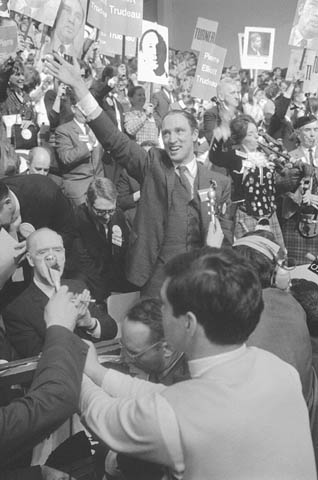
So what about Trudeau? Did he really come up with a post-biopolitical strategy for giving the nation state a mission? I would say "no", but the biopolitics are a bit more complicated.
Trudeau offered British Canada (including those lineages that had more or less assimilated into it) a deal. Part of it was a propositional, rather than ethnic identity (hence the Charter), but this propositional identity was pretty weak tea by St. Paul or Lenin's standards. The liberal propositionalism would cohere loosely with ethnic brokerage, mediated by the Liberal Party of Canada. In return, Trudeau would be firm in suppressing the straightforward biopolitics of Quebec.
Not that this model means leaving biopolitics altogether. The state still decides what minorities to cultivate, and tries to choose what Amy Chua calls "market-dominant minorities." There are lots of them around the world, and Trudeau-era immigration policy was designed to seek them out.
At this point, it is hard not to get normative. If biopolitics is the kind of thing whose ultimate expression is fascist, then propositionalism would seem to be the better bet. But the ultimate expression of propositionalism is the Inquisition or maybe the Khmer Rouge, so it might just be more important to keep our heads and our sense of moral limits wherever we go.
We remember Parizeau's drunken Kinsley-style gaffe about "money and the ethnic vote." But we forget Trudeau's "Where's Biafra?" quip, his willingness to sacrifice an entire ethnic group to the need of a multi-ethnic state to stay together. There is something about Trudeau's militant cosmopolitanism that grates, even a generation later.
But if we accept that Canada is necessarily multi-racial (in all senses of the word), then are we stuck? Not necessarily propositionalism, but propositionalism if necessary?
Diagram of Panopticon in public domain. Picture of Trudeau at the 1968 Liberal convention copyright National Archives of Canada
*I can't get HTML to do the French accent things.
Monday, March 20, 2006
Stand on Guard For We? International Ethnic Solidarity and Canadian Foreign Policy
Dan Drezner and Scott Lemieux both discuss IR hotshots John Mearsheimer and Stephen Walt's article in the London Review of Books about the Israel Lobby , and how it has diverted America from the foreign policy path Realists would expect.
Or to put it more bluntly, the Jews got Bush to do stuff that helps Israel, but hurts America.
As Drezner notes, this is the kind of subject that makes students tense. But, of course, it is pretty much received wisdom in most of the world, so it hardly makes sense for Americans to duck the issue on political correctness grounds.
If we look at the "Israel Lobby" as an example of a broader species of international ethnic solidarity and its influence on the foreign policy of multiethnic states, we at least achieve a more comfortable level of abstraction. Strict IR Realism, by employing the reification of "state interests," rules out the possibility that the ethnic mix of a country might influence its foreign relations.
According to Edwin O'Connor's mayor in The Last Hurrah, there were only two things an aspiring municipal politician in mid-century Boston needed to know: first, that Trieste belongs to Italy, and second, that all Ireland must be free.
Clearly, Canada, viewed as a unit, got itself into lots of conflicts that make no sense from a Realist perspective because of the ethnic loyalties of its British population. The canadiens understandably objected to this. Since the natural federal allies of canadien nationalists tended to be reactionary old stock Brits, this repeatedly led to the breakdown of the federal blue coalition. This might happen again over Afghanistan.
Of course, to Anglos at the time of the Boer war, it made no sense to talk about Canada's international interests as distinct from the Empire's as a whole. Arguably, it still doesn't make sense to pro-American Canadians today. Even anti-American Canadians tend to define their international views as if they were part of a domestic opposition in the US. Canadians are most comfortable talking about "our" interests in trade disputes, where it is, however, least appropriate: American home buyers ought to like $0.25 per metre stumpage rates, and BC taxpayers ought to dislike them.
Realism has an undeserved reputation for mental toughness, but it depends on a pretty sentimental vision of a common national interest. It's good to see that Mearshmier and Walt are beginning to think about this, although maybe they should have taken a wider perspective.
Added: thanks to Scott Lemieux for the link. Blogging is a lot harder than being a pest in somebody else's comment box.
Or to put it more bluntly, the Jews got Bush to do stuff that helps Israel, but hurts America.
As Drezner notes, this is the kind of subject that makes students tense. But, of course, it is pretty much received wisdom in most of the world, so it hardly makes sense for Americans to duck the issue on political correctness grounds.
If we look at the "Israel Lobby" as an example of a broader species of international ethnic solidarity and its influence on the foreign policy of multiethnic states, we at least achieve a more comfortable level of abstraction. Strict IR Realism, by employing the reification of "state interests," rules out the possibility that the ethnic mix of a country might influence its foreign relations.
According to Edwin O'Connor's mayor in The Last Hurrah, there were only two things an aspiring municipal politician in mid-century Boston needed to know: first, that Trieste belongs to Italy, and second, that all Ireland must be free.
Clearly, Canada, viewed as a unit, got itself into lots of conflicts that make no sense from a Realist perspective because of the ethnic loyalties of its British population. The canadiens understandably objected to this. Since the natural federal allies of canadien nationalists tended to be reactionary old stock Brits, this repeatedly led to the breakdown of the federal blue coalition. This might happen again over Afghanistan.
Of course, to Anglos at the time of the Boer war, it made no sense to talk about Canada's international interests as distinct from the Empire's as a whole. Arguably, it still doesn't make sense to pro-American Canadians today. Even anti-American Canadians tend to define their international views as if they were part of a domestic opposition in the US. Canadians are most comfortable talking about "our" interests in trade disputes, where it is, however, least appropriate: American home buyers ought to like $0.25 per metre stumpage rates, and BC taxpayers ought to dislike them.
Realism has an undeserved reputation for mental toughness, but it depends on a pretty sentimental vision of a common national interest. It's good to see that Mearshmier and Walt are beginning to think about this, although maybe they should have taken a wider perspective.
Added: thanks to Scott Lemieux for the link. Blogging is a lot harder than being a pest in somebody else's comment box.
SCC: Don't Mess with the Three Part Tests
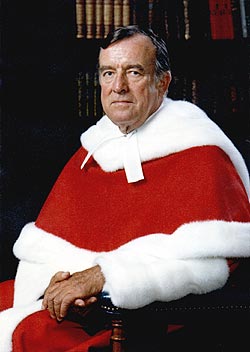
The good news is that the SCC revived the crucial ratio/obiter distinction.
Still, with the Court nothing is simple. Binnie still insists that "much of the Court’s work (particularly under the Charter) required the development of a general analytical framework which necessarily went beyond what was essential for the disposition of the particular case. In those circumstances, the Court nevertheless intended that effect be given to the broader analysis."
Binnie gives the example of Chief Justice Dickson (photograph from Supreme Court of Canada collection, credit to Michael Bedford)'s decision in R. v. Oakes. Oakes set out the "test" for a "reasonable limit" under section 1 of the Charter.
Narrowly,Oakes decided that the government could not require somebody found with a large amount of drugs to prove that they weren't intending to traffick. But the larger doctrine Dickson lays down is about the hoops the government has to go through once somebody shows a presumptive violation of a Charter right. First, it has to show that the law it enacted fulfilled a "pressing and substantial objective." Second, it has to show that the law is "rationally connected" to the objective. Third (and this is where the action almost always is), the government has to show that it "minimally impaired" the right, i.e., it couldn't have achieved what it was trying to do in a way less costly to the applicant's Charter rights. Finally, it has to show proportionality between the beneficial and detrimental effects of the regulation.
Because Dickson loved three-part tests, he divides his test into two stages, with the second one consisting of three parts. You had to be there.
Lawyers are familiar with a number of other "general analytical framework" cases. There is the two part Anns test for negligence, the three part (by Dickson) Pettkus test for unjust enrichment, and the godawful "pragmatic and functional" test for judicial review of administrative decision making (man, if you gotta ask, you don't want to know).
Binnie doesn't want lower courts ignoring this broad, analytical statements. At their best, these tests are just directions to lower courts to balance interests. Sometimes, they create endless verbal formulae without making the law any more determinate. But they actually do positive damage when they are held up as "new law", which overturns the previous "categorical" approach. Typically, this proves to be destabilizing and unworkable, and the Court eventually releases a judgment saying they didn't mean to overturn existing law: for the Anns test, see Cooper v. Hobart; for Pettkus, see Peel. But the Court keeps purporting to overrule all the old, "categorical" cases in particular areas of the law, most recently and importantly on hearsay and statutory interpretation.
To return to Oakes, the reality is that Dickson's statements in the original case give a distorted sense of what the actual law of section 1 really is. For instance, Dickson claimed that the government would have to come up with "clear and convincing" proof (a standard between the normal civil balance of probabilities and criminal reasonable doubt) about both its objective and whether it met the minimal impairment test. However, since then, hardly any "objectives" set out by the government have been rejected, and in most policy areas, the courts recognize the reality that social science doesn't deliver the sort of proof Dickson seemed to be calling for. There are lots of reasons to criticize the Oakes test, which seems to me like a simplistic form of cost-benefit analysis. The reality, though, is that it is sufficiently flexible that it neither poses much of a problem for further development, nor provides much guidance.
Stare decisis should be limited to the actual decisions. Courts that think they have found a unifying principle typically have to retreat later on, and have abandoned the relatively firm ground of case-by-case adjudication for abstract quasi-statutory language.
Obiter Dicta: They're Back
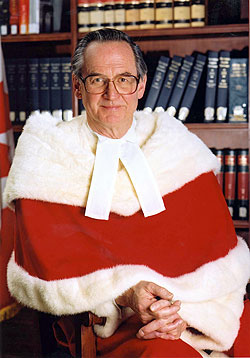
My initial intention with this blog was to comment on obscure legal arcana. So I'm pleased on a number of levels that the Supreme Court of Canada in December released its decision in R. v. Henry.
In the broader public sphere, there is a lot of talk about judicial activism, and excessive judicial power. I think the last election shows that the public is worried about too much power in the hands of judges, despite the overwhelming support Canadians have for the Charter.
Not suprisingly, there is relatively little talk about the ways the legal process can confine the power of judges. The issues are a bit technical for a general audience, and the legal profession is highly invested in expanding judicial power. But a number of traditional process doctrines about standing, pleadings, evidence and the scope of appellate review helped confine what judges could do.
The problem is that the contours of these doctrines are in the hands of the judiciary itself. That isn't to say that every judge in every case wanted to expand the scope of judicial power: it is easy to come up with counter-examples. But the pressure on the judicial system to take over more and more of social life has been pretty relentless since the 1970s, and there is still relatively little in the way of organized counter-pressure.
Anyway, one of the powerful constraints on judicial power, particularly the power of final appellate bodies, was the old distinction between the holding (ratio decedendi) and the comments (obiter dicta) in the case. The holding consists of the minimum necessary norms to decide the issue between the parties, while the dicta are all the other things a judge may be minded to say.
Traditionally, just because the majority of a court said something didn't make it law. Only the holding/ratio was binding on future judges. Although this sounds incredibly boring and technical, along with standing rules, and being confined to pleadings and evidence, it held judicial tyranny at bay. A majority of judges (or their clerks) couldn't make a proposition the law just by saying it -- it had to be necessary to decide a real case between real people. It also fit with what we know about the cognitive structure of normative intuition -- people are much better at knowing what should be done in a particular case then in theorizing why.
The holding/obiter distinction was apparently buried in R. v. Sellars, [1980] 1 SCR 527. The headnote said that lower courts now had to follow anything higher courts said. This was just before the Charter era began, and soon we had an orgy of undigested political theory and advocacy-based "legal scholarship" in Supreme Court of Canada judgments.
The good news is that Henry has revived the distinction. I'll get to the bad news in another post.
Picture of Mr. Justice Binnie from Supreme Court of Canada collection. Credit Phillipe Landreville
Never Start a Land War in Asia. But If You Do, Don't Define Exit as Defeat
Unlike Iraq, I supported the war in Afghanistan and Canada's participation in it. The main difference was that the Taliban really was providing state support to Al Qaeda. The secondary difference was that it was perfectly reasonable to put Western technology in the balance between the Northern Alliance and the Taliban.
Over the past 4 years, much like almost everyone else, I stopped paying much attention to Afghanistan, even though it is easily Canada's most important overseas military commitment since Korea.
Since I supported the intervention in the first place, I am not particularly sympathetic to the NDP/BQ's current opposition. I'm more sympathetic to the Liberals' disarray and confusion on the subject. Certainly our men and women over there need better moral and material support from us latte-swilling urbanites.
Harper deserves credit for giving this issue high priority, and good on him for going. But I want to register some concern about his rhetoric, which is (consciously) modelled on Bush's "stay the course" rhetoric about Iraq.
Harper's response to NDP calls for a debate -- that it would give aid and comfort to the enemy -- was unacceptable in a democracy. But it is the phrase "cut and run" that really makes me worry. The right way to fight one of these wars is to define limited objectives, and to define exit as victory. After all, the Taliban are no longer in power. If they get into power again, we can always overthrow them again. We are not going to be providing order in Afghanistan in the long term.
For a Canadian PM to define leaving as cutting and running is to cretate precisely the hostage to fortune Bush has given in Iraq.
Over the past 4 years, much like almost everyone else, I stopped paying much attention to Afghanistan, even though it is easily Canada's most important overseas military commitment since Korea.
Since I supported the intervention in the first place, I am not particularly sympathetic to the NDP/BQ's current opposition. I'm more sympathetic to the Liberals' disarray and confusion on the subject. Certainly our men and women over there need better moral and material support from us latte-swilling urbanites.
Harper deserves credit for giving this issue high priority, and good on him for going. But I want to register some concern about his rhetoric, which is (consciously) modelled on Bush's "stay the course" rhetoric about Iraq.
Harper's response to NDP calls for a debate -- that it would give aid and comfort to the enemy -- was unacceptable in a democracy. But it is the phrase "cut and run" that really makes me worry. The right way to fight one of these wars is to define limited objectives, and to define exit as victory. After all, the Taliban are no longer in power. If they get into power again, we can always overthrow them again. We are not going to be providing order in Afghanistan in the long term.
For a Canadian PM to define leaving as cutting and running is to cretate precisely the hostage to fortune Bush has given in Iraq.
Tuesday, November 22, 2005
You can take the Shachtmanite out of the Third Camp
But you can't take the Third Camp away from the Shachtmanite.
Tuesday, October 25, 2005
Playing Constitutional Law
I left a comment over here that I like more than most. Publius at Law and Politics was making the claim that constitutional principles are just a thinly disguised form of politics. Here's my take:
"It all depends on the level of abstraction you are dealing with.
Obviously, at some level of abstraction, people pick their process principles based on consequences. If I disagree with what you say, but will defend to the death your right to say it, I probably think that, in the long run, freedom of speech leads to a better society than censorship.
So why don't I just say, "I will defend your right to say it, just so long as your saying it will cause less harm than your not being allowed to say it"?
I don't use that more "pragmatic" rule because it isn't a rule at all, and I figure in the human tendency to want to stop people saying things they don't like.
On the other hand, unless I'm a doctrinaire nutbar, I will eventually come across a situation where I am not going to defend your right to say "it", if "it" is a ransom demand, or shouting fire in a crowded theater or whatever.
How does this apply to constitutional law? Well, we have to factor in the fact that judges, being human, are going to look more unkindly at statutes they disagree with. No principles of constitutional interpretation are gonna change that. At the same time, judges, to retain an ounce of self-respect, have to come up with some principle other than it's unconstitutional if I don't like it. And those of us who aren't judges have to try to hold them to some principle other than it's unconstitutional if they don't like it, particularly if we like different things than they do.
I'm not saying that this principle has to be originalism, or deference to elected branches. It could be representation reinforcement. It could be revealed natural law. But if you don't have some principle other than it gets struck down if I don't like it, you are not playing constitutional law."
"It all depends on the level of abstraction you are dealing with.
Obviously, at some level of abstraction, people pick their process principles based on consequences. If I disagree with what you say, but will defend to the death your right to say it, I probably think that, in the long run, freedom of speech leads to a better society than censorship.
So why don't I just say, "I will defend your right to say it, just so long as your saying it will cause less harm than your not being allowed to say it"?
I don't use that more "pragmatic" rule because it isn't a rule at all, and I figure in the human tendency to want to stop people saying things they don't like.
On the other hand, unless I'm a doctrinaire nutbar, I will eventually come across a situation where I am not going to defend your right to say "it", if "it" is a ransom demand, or shouting fire in a crowded theater or whatever.
How does this apply to constitutional law? Well, we have to factor in the fact that judges, being human, are going to look more unkindly at statutes they disagree with. No principles of constitutional interpretation are gonna change that. At the same time, judges, to retain an ounce of self-respect, have to come up with some principle other than it's unconstitutional if I don't like it. And those of us who aren't judges have to try to hold them to some principle other than it's unconstitutional if they don't like it, particularly if we like different things than they do.
I'm not saying that this principle has to be originalism, or deference to elected branches. It could be representation reinforcement. It could be revealed natural law. But if you don't have some principle other than it gets struck down if I don't like it, you are not playing constitutional law."
Saturday, October 22, 2005
Why Joe Clark was wrong
Quebeckers would split almost evenly on the 1995 referendum question, but would overwhelmingly reject secession honestly described: according to an October 2005 Gregg poll .
Reasonable Canadians accept that Francophone Quebecois will always consider Quebec their homeland and the source of their primary loyalty. Reasonable Quebecois recognize that secession has far more costs than benefits. We can both live with that, as long as we can speak frankly.
Subscribe to:
Posts (Atom)
