Monday, March 12, 2007

Slobbiness as Fairness?

It is a fact* that women do more domestic work in heterosexual couples than their menfolk. Matthew Yglesias argues -- rather dangerously -- that this is not just exploitation: much of the effect can be explained by male tolerance for living in filth.

The result here actually shows that there are two different things happening here. One is that men and women have different ex ante levels of cleanliness. Single women do 10 hours of housework, whereas single men only do seven. A perfectly equitable division of labor, should result in a couple doing a combined seventeen hours and then splitting it evenly -- 8.5 hours each.

That, however, doesn't happen. Instead, you see male shirking to the tune of 3.5 hours -- cutting the male second shift down to five hours a week, and boosting the woman's up to 12 hours. But then women put three more hours of housework in per week. The effect of those three additional hours is to raise the couples' cleanliness standard up to the 10 hours per week per person maintained by single women.


Scott Lemieux puts an ostensibly feminist spin on this ancient male argument:

I continue to disagree with the implied solution of creating equality within domestic work norms that are an unholy marriage of 1)patriarchy, 2)the related assumption of one partner devoted full-time to domestic work, and 3)general cultural assumptions that unstructured leisure time is somehow immoral, and instead think that it makes more sense to try to achieve equality within a more rational allocation of priorities that doesn't take 50s-bourgeois standards of tedious domestic busywork as a given. An additional advantage of my idea is that I think gender equality will be much more viable if the total work is reduced.


I'd like to show some gender solidarity here, but I am afraid that I can't agree with the implicit normative premises either Matthew or Scott employs. If the position of our sex is to be vindicated at all, it must be on some other grounds.

I'll start with Scott's assertion that modal female norms of cleanliness are the product of patriarchal indoctrination. Now, the Pithlord is not in principle opposed to all arguments that depend on endogeneity of preferences or false consciousness. But I agree with Karl Popper and Jon Elster that such arguments require microfoundations. If the patriarchy acts, it acts through agents. And in my household, the only plausible agent of the patriarchy is me.

Now, in seven years of cohabitation/marriage, I can count the number of times I was the first to say, "Jeez, we'd better do something about the [vacuuming/ hamster cage/ bathroom." And even when I add the number of times my lovely wife said, "Let's leave that for now" I still get a number that children are expected to know if they want to graduate from kindergarten without being diagnosed with learning disabilities. On the other hand, if I add all the times that I have suggested that a lower standard might be appropriate to the complaints about our squalid living conditions from my life partner, I would get a number that would make Roger Penrose nervous.

So if average cleanliness (which we have occasionally achieved) is a patriarchal norm, it is being enforced by the feminist grad student and not the cranky Red Tory male lawyer.

Personally, I prefer a pop evolutionary psychology explanation to a social constructionist one. I think there's general agreement that in the Environment of Evolutionary Adaptation, women spent more time in high density settlements (at least by the standards of the day) and with poopy babies than did their more nomadic menfolk. Ceteis paribus, infectious disease was a bigger problem for women than for men. It is a quick theoretical line to the funky smell of the contemporary frathouse.

The best argument for a social constructionist approach is that the capacity of women of Scott and my generation (let alone Yglesias's) would cause their grandmothers heart attacks. (The same could be said of our grandfathers if they knew how bad we males are at fixing things.) No one keeps house like they used to. Two points. First, behaviour isn't just about preference -- its also about costs, including opportunity costs. The opportunity cost of time for women in our generation and social class is quite a bit higher than it was fifty years ago.

To the extent not only cost but preference has changed, I would say that this can be consistent with sociobiological theory. Our minds tend to define things relatively, not absolutely. It could always be the case that the average women would prefer a cleaner world, while learning to accept that it isn't going to be much cleaner than it is.

Further, and in any event, even if Scott is right that female preference for cleaner living conditions is the result of socialization by a sexist society, I don't think this has the normative implication that a greater degree of slovenliness than current heterosexual couples achieve would be more rational. On a purely instrumental view of reason -- which eschews evaluation of ends as opposed to cost-effectiveness of means -- each gender's preference is as rational as the other. As far as justice is concerned, preferences that derive from socialization are entitled to as much respect as those that come from biology. On a more pre-modern view of reason as encompassing pursuit of the Beautiful, the True and the Good, the estrogen-laden position seems to win on the first count.

It's true that a just solution might involve bargaining to a less clean solution than the female partner would prefer. But the disutility that creates for her should count in the balance just as much as the pain of extra work or lost leisure time.

Yglesias makes a still-more-subtle error. He tacitly takes it as just if the relationship leaves the woman no worse off than she would have been without it. If it would be OK with Pareto, it's OK with Matt. The trouble is he doesn't take into acount relational contract theory. Paretian optimality works as a criterion of justice for a one-off transaction: if both parties are better off and no one else is worse off, then we have as much justice as we're going to get in this vale of tears. But as Oliver Williamson or Dr. Phil could tell you, a relational contract involves investment in relationship-specific human capital. The mere fact that a party to such a contract would be better off sticking with it then exiting doesn't show that the contract is fair. So even if a woman would do about the same amount of housework if she were single, there is still the possibility of injustice if the male partner takes most of the economic surplus created by the relationship, even if there is sufficient surplus left over such that exit is not rational.

So just doing less housework or comparing women in couples to single women won't solve the problem of justice. But it could still be the case that at least some relationships in which women do more housework are just. Let us grant -- as I think Yglesias and Lemieux would in other contexts -- that a division of labour is not in itself unjust. The real issue is not whether each party gets the same specific benefits and burdens out of a relational contract (indeed, if that were the case, it is unlikely that the relational contract would exist in the first place), but that the sums of benefits and burdens be approximately equal. A traditional division of labour -- with the man in the coal mine and the woman doing domestic drudgery -- might fit the bill. The problem is the unequal distribution of unpaid labour when there are similar expectations of paid labour. (Even if there is fairness in the relationship, there may be unfairness in relationship breakdown if -- as is often the case -- the woman has paid for domestic work and childrearing by lost ability to earn income).

The trouble is distinguishing between division-of-labour as increasing the overall wellbeing of both parties and acting as a rationale for male exploitation. I don't have a solution to this, but I'm pretty sure putting women in charge of quality control is welfare-enhancing.


*The empirical facts in this post, such as they are, are British, but I'm sure that a bit of googling would show the same in Canada or the US. But I have to change the baby.

Thursday, March 08, 2007

Spencer -- Thumbs Up


There is a fundamental contradiction embedded in Canadian criminal law. Even before the Charter, a confession was supposed to be excluded from evidence unless the Crown could prove it was voluntary. And, at least in theory, a statement was only voluntary if it was made without any threat or inducement.

However, the dirty truth is that the whole criminal justice system is premised on getting admissions of guilt in return for stuff. The vast majority of charges never go to trial, and the only reason is because a guilty verdict after trial is worse news than a plea. If it weren't for this theoretically illegitimate expected risk/reward structure, the system would collapse.

So criminal law doctrine prohibits precisely what the crime control system is structured around.

In R. v. Spencer, the Supreme Court had to deal with this contradiction in the context of a confession provided by the accused with the hope of getting someone else out of trouble. Spencer and (perhaps) his lady friend were allegedly involved in a number of robberies on the West Coast. Spencer said he would confess if his inamorata was spared. The investigating officer promised nothing. Spencer confessed anyway. The trial judge let the confession in, resulting in a conviction. This was overturned on intermediate appeal.

The majority comes to the sensible conclusion that the confession should be allowed. I can't say they improve the doctrinal muddle, though.

Case Comment for R. v. Spencer, 2006 SCC 11

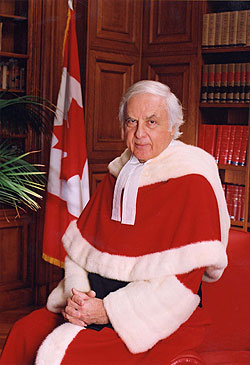
Photo credit Phillip Landreville, Supreme Court of Canada collection

Adventures in Narrowcasting: Gossip Blog About U. of T. law school

For those who care. Apparently, there has been a spot of nastiness at the legal clinic.

(Declaration of interest - one of the people involved provided me with all the Antonio Lamer anecdotes in my possession. They're pretty good, by the way.)

Tuesday, March 06, 2007

No new ideas, or too many bad ideas?

Partisans of both left and right have a tendency to complain that their opponents have "no new ideas. " (For an example from the right, look here. ) Editorials advise parties out of office to develop these new ideas, and political consultants promise to help in exchange for a modest fee.

But why are new ideas desirable in politics? There's nothing new about free markets, the protection of private property or traditional morality, and not much new about broad social insurance schemes, risk regulation, social liberalism, or aggregate demand management to ameliorate the inequalities caused by markets. Some combination of these things could easily characterize any position one would like to take on the domestic political spectrum. Combine like the median voter, and you have a winning politial coalition; combine like no one else, and you can be a contrarian social critic. No need for new ideas.

There might be some room for ingenuity in the detailed technocratic design, but that's never what the proponents of "new ideas" have in mind. In the end, we just get something vacuous like "the Third Way" or the "politics of meaning".

Genuinely new and non-vacuous ideas tend to be bad ideas.

For example, the Ackermans' proposal to give every high school graduate a "capital grant" of $80,000 for existing is a new idea, or at least was when they proposed it about ten years ago as a centrepiece for a new progressive agenda. The trouble is -- as anyone with an ounce of common sense could see -- it is a really, really bad idea. The Pithlord was a cautious teenager, as these things go, and yet it would have been a bad idea to give his pimply former self 80 grand. The Ackermans -- who are legalists -- could have talked to any estates and trusts lawyer to find out that what they were proposing is precisely what their sub-profession exists to avoid.

As it happens, in Canada, we have run this experiment a bit on resource-rich reserves. The results haven't been good.

And yet the very smart people at Crooked Timber manage to take this idea very, very seriously. Conservative anti-illectualism has its limits (certainly tested and exceeded with the Bush administration), but the whole thing does make me appreciate William F. Buckley's preference for being governed by the first 100 names in the Boston phone book than by the Harvard faculty.

I recall another "new idea" in 2003, involving junking international law and coercively promoting democracy everywhere. I wonder what happened to that.

Politicians generally are -- and should be -- extorverts in the seventh or eighth decile of intelligence. They should be devoting these talents to understanding and explaining old ideas, not thinking up new ones.

Update: Akrasia, despite a weakness for liberal political theory, applies the very conservative "better to be derivative and good than original and crap" principle to music.

As a Genertation Xer and the father of a nine-year-old girl, I can't say I'm familiar with any of the second-generation bands Akrasia cites. I haven't experienced new music on my own motion for a decade. What I do get exposure to in the family vehicle -- mostly Justin Timberlake and Fergie -- is simultaneously derivative andcrap. Oh well, every generation has its own disease.

Monday, March 05, 2007

Over 10,000 Served

We passed a meaningless milestone today. 10,000 visits since I installed Site Meter.

Hislop Again

When I wrote about Hislop, I failed to address the obvious argument for a retroactive remedy. If it violates the constitutional rights of same-sex couples to deny them survivorship pensions now, then presumably it violated them as soon as those rights existed (in Canada's case, in 1985). So why shouldn't people whose rights were violated get relief? Isn't it just unfair? Ubi jus ibi remedium. And if that costs a bit, so what? Fiat justitia ruat caelum!

As the Haligonian put it in the comments to this post:

One critical factor in this is that people are forced to make CPP contributions. It is not like a private plan that can be opted out of or at least can factor into an individual's employment choices. Gay people in 1985 simply had to make CPP contributions and they had no way of ensuring that the pension could be passed on to their partner.

If this is wrong today, which I think it is, then why wasn't it also a problem back in 1985? The people who lost out because of that are still alive in many cases and should be compensated because they had no alternatives.


Since my preferred rule would be to give the legislature a lot of leeway in relation to the transitional issues involved in implementing a constitutional decision, I have to answer this point. (So does the Court, which took the view that Parliament deserved no deference, but they should be able to determine the transitional issues on the basis of unworkable doctrine.)

The Haligonian's argument is seductive. Gays and lesbians contributed to CPP, so why shouldn't they get their money back?

Unfortunately, it is inherent in social insurance (and even private defined benefit or insurance schemes) that there is no direct relation between contribution and what you get back. If you want this, you end up with a Bush-style defined contribution scheme and -- ultimately -- libertarianism. CPP developed survivorship pensions because of modal heterosexual divisions of paid and unpaid work -- to protect women. Overall, it is not clear that same sex couples lost out financially for being treated as two individuals by the tax and transfer system. The reason for addressing the differential legal treatment between same sex and heterosexual couples was not that same-sex couples were disadvantaged financially. They weren't. The reason was that there was an obvious social message implied by the differential treatment, one that goes back to Judeo-Christian and perhaps naturally evolved attitudes that caused and cause grief for gays and lesbians.

So a retroactive remedy might well be unfair unless a lot of interconnected things were undone simulatenously. And doing that in regard to past transactions could cause a lot of unforseen hardship.

Presumably, these considerations were why the courts tended to suspend their declarations of invalidity when the original victories were won for same-sex couples.

There are other implications of prospective remedies:

--Precisely because they are less disruptive to society, they might encourage a more activist approach by the courts. On a traditional view of remedies, the constitution always said what it says now, and so governments ought to be able to anticipate an unfavourable ruling. Legislation is prospective because it is supposed to be about change and "progress". If judicial remedies are prospective, judicial thinking may become more legislative. I think that's what Andy was trying to get at here.

So from a judicial point-of-view, prospective remedies might mean more change through constitutional litigation.

--On the other hand, retroactive remedies create more incentives for clients and lawyers to engage in constitutional litigation. Kingstreet is going to mean a lot more constitutional tax cases. If Hislop had been an uncomplicated victory for the plaintiffs, then their lawyers would have become rich. And rich lawyers get imitated.

Underlapping Consensus

Matt McIntosh, libertarian, writes:

Value pluralism is a brute fact that any serious ethical theory has to deal with somehow, and so far as I can tell there are only three ways to do so:

1. Subjective values are are all there is, and there is no objective fact of the matter about what’s good or bad.

2. There really is only one true Good, and when people pursue anything else it’s simply due to error.

3. There are lots of things that are good and bad, and these things aren’t reducible to a single underlying variable.


Position (1) is usually taken by libertarians of an economistic bent, but is unsatisfactory when we consider meddlesome preferences because it doesn’t allow us any basis on which to discuss and evaluate states of affairs: I want this and you want that, and where these conflict we have to hash it out either by votes or violence. Position (2) is the one taken by members of various One Big Thing schools of thought, like utilitarianism and Objectivism, but runs into epistemological difficulties.


So far, all I can add is amen and hallelujah (although I'd say there are better arguments against Position 1 and maybe Position 2). But then we get this:

Position (3) appears to be Will [Wilkinson]’s, and strongly informs his contractarian reasoning: if there’s no consensus on value, the best we can do is to build a neutral framework in which people’s pursuit of multifarious values can be accomodated to the maximum extent possible.


If this is a fair statement of what WIlkinson is arguing, the fallacy is obvious. It starts by saying there is no summum bonum, no meta-value, and then it turns around and makes consent the meta-value.

Once you accept value pluralism, then you have to accept that any argument about how we should order our affairs has to be specific to the situation we find ourselves in. You might as well abandon hypothetical consent, and accept that actual consent is usually going to have to give way to something else. In fact, you ought to abandon "political philosophy" in the sense of designing trans-historical principles to evaluate societies by.

(To be fair, McIntosh says he is going to distance himself from this position later.)

Friday, March 02, 2007

Serbia Genocide Decision

Link here.. I am posting it because it took a bit of work to find. I will try to comment later.

Thursday, March 01, 2007

Hislop & Kingstreet -- Thumbs Down -- Two Contradictory Decisions in Six Weeks

When a court decides that an ordinary law is contrary to the Constitution, when should this determination come into effect?

There are basically three options:

1. On the basis that the constitution was always the higher law, and therefore the statute was always unauthorized, the decision could be retroactive -- everyone should be treated as if it had never been enacted.

2. On the basis that constitutional jurisprudence is really a different form of legislation, and legislation should usually be prospective (so as not to overturn reasonable reliance and other rule-of-law values), then the decision could be prospective. Past transactions would be left undisturbed, and the new constitutional rule would take effect after the decision.

3. The courts could recognize that the legislatures are better able to make this transitional determination, and give them room to decide in most cases.

The Supreme Court of Canada has not been good at coming up with a coherent answer as to which option should be chosen. In theory, #1 is the default rule for constitutional remedies. However, most cases with bigger social implications have, in fact, been given a suspended declaration of invalidity -- which doesn't take effect until sometime after the decision, and which would seemingly be inconsistent with retroactivity.

In addition, there is a doctrine against actions for damages on the basis of acts which were subsequently declared unconstitutional. Until recently, the same applied to actions for restitution.

The Pithlord will declare a preference for Option #3. Let the legislatures decide how they want to deal with the temporal issues of unconstitutionality (within reason, of course). Unfortunately, here we come up against the attitude of judicial supremacy.

Option #3 does require a default rule in the event that the legislatures don't act. Here, I would say that the best rule is retroactivity subject to ordinary limitation statutes.

2007 has seen two cases on the issue of the temporal effect of unconstitutionality. I hate to say it, but all the Court seems to have accomplished is to compound the confusion.

In Kingstreet, the issue was whether a provincial tax found to be "indirect" (and therefore unconstitutional) should be returned. In Canadian constitutional law, only the federal government can levy indirect taxes, which are defined as those for which the incidence falls on somebody other than the legal payor. (A difficulty with this test is that modern economic thought tells us that this applies to all taxes. Not surprisingly, the case law is therefore a bit confused.) Back in the seventies, the Court held that provincial laws preventing civil suits for unconstitutional taxes were unconstitutional. In the eighties, noting the potential fiscal difficulties, it then created a common law rule that unconstitutional taxes could not be recovered. In 2007, it now abolished both rules, leaving only the limitation period as a limit on recovery.

So far, this might be seen as an implementation of the Pithlord's preferred option. The retroactive effect of a declaration that a tax is unconsitutional will be up to the legislature, with a default rule of retroactivity.

Hislop involved a class action by survivors of same-sex couples claiming survivorship benefits under the Canada Pension Plan. The background is that the Supreme Court of Canada narrowly upheld different treatment of same-sex and heterosexual common law couples in federal pension plans in 1995. Then, in 1999, another Court decision convinced governments that they were going to lose if they continued to distinguish between heterosexual and same-sex couples. The federal government enacted specific transition provisions to determine both the earliest date of death for eligibility, and when the payments would start.

In Hislop, the Court gave with one hand and took away with the other. The Court struck down the legislated transitional provisions, but simultaneously decided that its prior ruling would not be retroactive. The general discussion of remedy is quite confused -- the general rule is supposedly retroactivity of remedy, but the prospectivity exception swallows it. There is some quite open discussion of the law-making function of judges in the Charter era:

In substance, the position of the appellants is predicated on the traditional – often called Blackstonian – view that judges never make law, but merely discover it. In this perspective, the courts are said to apply the law as it really was or has been rediscovered. As a consequence of the declaration of nullity, the appellants claim that they are entitled to the full benefits of the law, in conformity with an understanding of the Constitution, which is deemed to have never changed.

When the Court is declaring the law as it has existed, then the Blackstonian approach is appropriate and retroactive relief should be granted. On the other hand, when a court is developing new law within the broad confines of the Constitution, it may be appropriate to limit the retroactive effect of its judgment.


This is highly confused. Any court ruling creates new law in the sense that it can be used as an authoritative statement of positive law in the future. And courts may apply old constitutional principles to new situations. But the principles themselves are not supposed to change.

In any event, and however you try to address the counter-majoritiarian difficulty inherent in judicial review, the distinction between "declaring the law as it has existed" and "developing new law" will be impossible to draw. And making remedies -- which, after all, are the only things litigants care about -- depend on such philosophical considerations is madness.

Obviously, we are going to see a lot more on this as the lower courts try to figure out what they're supposed to do.

Case Comment of Kingstreet Investments Ltd. v. New Brunswick, 2007 SCC 1 and Canada (Attorney General) v. Hislop, 2007 SCC 10

Monday, February 26, 2007

Everyone's an intuitive lawyer

Or so argues John Mikhail.

Not everyone would take that as a compliment.

But what Mikhail means is that humans have a native jurisprudence module in their minds, strictly analogous to Noam Chomsky's universal grammar module.

The interesting thing from a lawyer's point-of-view is that -- if Mikhail is right -- legal codes could turn out to be a source of understanding of the human mind. We're not just quibbling over our client's liability -- we're on the forefront of neuroscience!

Sunday, February 25, 2007

Charkaoui -- Thumbs Up

Since I started the Supreme Court of Canada case comment feature, the Court has done distressingly little in the way of far-reaching controversial "judicial activism." Between May and December 2006, there didn't seem to be any headline shakers, no Morgentalers or Delgamuukws or Chaoullis. True, there were some fundamental shifts in mining hedging tax transaction treatment, pension windup and airline insolvency. But somehow the Pithlord's brilliant thoughts on these exciting developments failed to register an increased hit count. I suggest you speak to the Sitemeter technical staff about it. Anyhoo, it makes a nice change to be blogging about a case that really is firing up the blood pressure on talk radio.

On Friday, the Supreme Court of Canada allowed the appeals of three men -- Adil Charakaoui, Hassan Almrei, and Mohamed Harkat -- all of whom are believed by the federal government to be connected to jihadist terrorism, and none of whom is a Canadian citizen -- challenging sections of the Federal Immigration and Refugee Protection Act relating to the issuance of "certificates of inadmissibility" by the Ministers of Citizenship/Immigration and of Public Safety. A certificate of inadmissibility results in immediate detention and (ultimately) in deportation.

The decision was a good one on a number of grounds. It struck down the right parts of the law: the ability of the judge to rely on information never disclosed to the subject of the certificate to uphold the detention/deportation without further safeguards and the lengthy period of unreviewed detention for foreign nationals without permanent residence status. It also rejected a number of bad arguments -- that difference in treatment of deportation of citizens and non-citizens is contrary to equlaity guarantees, or that the possibility of long detention while fighting deportation is "cruel and unusual punishment." And the remedy of suspended declaration of invalidity (the law dies a year from now if Parliament doesn't fix it), while overused in general, was the right one here.

To prove a case under section 7, our alleged terrorists have to show two things: first, that their liberty or security of the person is at stake and, second, that they have been treated contrary to "the principles of fundamental justice." If they do this, then the government can still get the law upheld by proving it is a reasonable limit on rights in a free and democratic society. This third move is analyzed via the Oakes test, target of some gentle mockery here, but, in essence, about whether there is a Paretian alternative that meets the government's needs just as well, but does not damage the right so much.

The first part -- whether Messrs. Charakaoui, Almrei and Harkat's liberty and security of the person was on the table -- is a pretty easy. A controversial line of cases -- Singh, Burns & Rafay and Suresh -- tells us that Canada violates the security of a person by not acting to keep them from being tortured or executed (say by deportation of a non-Canadian). I find this line troubling, but even if we reject it, in this case Canada is itself detaining and labelling a person a terrorist. I wouldn't consider pure executive discretion to decide a foreign national should leave the country without cause unconstitutional, but matters are different when we jail somebody first and send them home with "al Qaeda" stamped on their forehead.

"Principles of fundamental justice" means, at least, due process. In fact, it ought to just be about due process, but that's an argument for another day. No one doubts that one part of due process is knowing the case against you. Ideally, everyone would have a right to all the information in the possession of the state in relation to the case. Even in ordinary criminal trials, this ideal has to be compromised somewhat. If I give the police some information about the Hell's Angels, the Crown isn't obliged to pass my identity or information on, unless they want to use my testimony to convict. In ordinary criminal law, the Crown can't keep the evidence it is going to convict with a secret from the accused. But the inadmissibility certificate system does let the government both keep sensitive stuff from the subject of the certificate AND use that stuff to justify the certificate. It's hard to see how you can have a fair trial in those circumstances.

Of course, the problem is that much of what governments know about really bad guys they are presumably not at liberty to discuss openly.

The Court made two moves here, both of which I approve of. The first is to kick the discussion of the security rationale down to the section 1 analysis. Convicting on evidence the accused doesn't even get to hear is a sufficiently big departure from English-speaking traditions that it should be up to the government to show the necessity. The second move is to suggest other options that meet the government's stated concern -- in this case, the use of special counsel who can be expected to keep the stuff secret. (Note that this is the solution the court rejected in the solicitor-client privilege case last year.)

The Pithlord bitches about judicial review from time-to-time, but this is it at its best. The Court encouraged a more moderate response to a serious problem, one that has the potential to reduce miscarriages of justice.

Case Comment of Charkaoui v. Canada (Citizenship and Immigration), 2007 SCC 9

Israel Needs Mearsheimers and Walts

Condolezza Rice tells Israel it can't further its security by talking to Syria.

I fully expect the "friends of Israel" to defend Israel's sovereignty, and tell Ms. Rice to buzz off. Otherwise, we might think they put their ideology above their loyalty to any place in particular.

Thursday, February 22, 2007

Stranger Brews: An Idiosyncratic List of Great Canadian Movies

The Pith-household has yet to see Bon Cop, Bad Cop, but I hope to remedy this in light of Jacob Levy's enthusiastic recommendation:

To my American friends who still think Strange Brew (or "Blame Canada," or worst of all Canadian Bacon) is the ultimate cinematic expression of Canadianness, I highy recommend that you put this onto your Netflix queues. It's the funniest movie about federalism you're likely to see; the best (and most violent) action movie about language and translation problems; and the most politically and socially engaged movie about hockey. It's a real gem that as far as I can tell no one in the U.S. has heard of at all.


I have to agree with the Professor here. "Blame Canada" is a great musical number, but what hath Trey Parker to do with the land of Macdonald and Laurier? I haven't seen Canadian Bacon, thank God. I will hear nothing said against the Mackenzie brothers, SCTV's answer to Trudeau-era Canadian content rules, but Strange Brew was not their best work. Buy the albums - Geddy Lee's vocal on "Take Off (to the Great White North)" makes it all worth it.

But even those who take a more favourable view of SB than I do (e.g. the good people of Prince George) will admit that it doesn't exhaust the heavily-suibsidised Canadian film oeuvre.

I love On the Road. The DVD has a wonderful interview of the director by an improbably-dressed Pierre Berton, a reminder of a time when patriots -- while not required to lay down their lives -- were at least expected to pretend that Harold Innis was a genius.

My favourite Quebec film is Robert Lepage's Confessional. Arcand has redeemed himself after Jesus of Montreal with Les Invasions Barbares.

From Egoyan, I would endorse The Sweet Hereafter, Exotica and The Adjuster. I I like Bruce MacDonald's Highway 61 best, although Hard Core Logo is a better movie.

But the genius of Canadian cinema, in my humble opinion, hails from Winnipeg. Guy Maddin's Saddest Music in the World is the definitive statement on cold-weather multiculturalism. (His Tales from the Gimli Hospital is not a fair representation of our medical system. There is actually surprisingly little necrophilia and cannabilism. )

Wednesday, February 21, 2007

Canadian Constitutional Revolutions

Brad DeLong lists 10 constitutional revolutions in American history. I'd quibble with some of his inclusions (only an economist would think the Bork-Posner inspired change in interpretation of competition law equals the Warren Court or the "Switch in time that saved nine"), at least one exclusion (the post-civil war cases that gutted the newly enacted Fourteenth Amendment other than the due process clause) and a bunch of the normative valuations (DeLong tries to persuade us that reading the "interstate commerce clause" as if it is a grant of full sovereign power over everything is being faithful to the text).

But, more importantly, I read it is as a challenge. What are the "revolutions" in Canadian constitutional law -- in addition to the formal ones on July 1, 1867 and April 2, 1982? Can I come up with a list? (I am going to avoid normativity here. Some of these revolutions are approved of by the Pithlord; others not so much.)

1881 Parsons gave the provinces something to do. Reasoning that the grant of power over "Property and Civil Rights" was intended to give Quebec a different system of private law, and that regulating an industry like insurance is really about modifying the common law or civil law of contract, the JCPC cut back on the federal government's "Trade and Commerce" power. Good move, if you ask me.

Late nineteenth century -- culminating in The Liquidators of the Maritime Bank of Canada v. The Receiver-General of New Brunswick, [1892] A.C. 437 -- the Privy Council confirms Oliver Mowat's vision of a genuine federation with co-equal levels of government at the expense of John A. Macdonald's imperial vision.

1945-50. The spending power revolution, and deposition of the Privy Council in the Immediate post-WWII period. Basically, the Anglo governments just ignored the New Deal cases saying that the federal government cannot spend unless it legislates, and therefore cannot spend in areas of provincial jurisdiction. Tax-and-spend with conditionality basically permits the feds to enter any area of policy, although sometimes with an inefficient policy instrument.

1985 Court imports "substantive due process" into Canada under section 7 against the explicit wishes of all the politicians involved in negotiating the Charter three or four years earlier. Logically, no limit to judicial power. The consummation of the revolution doesn't occur until 2005's Chaoulli decision, when the Court decides it would like to dictate health policy.

1989 Court decides that "every individual has the right to equal protection and equal benefit of the law" means only an individual in a list of protected groups we make up has equality rights, and these rights can mysteriously be invoked even where there is equal treatment under the law. In Law, the Court made equality rights even more subjective by saying they could only be invoked when judges think "human dignity" is involved. This means nothing other than "when we say so."

1990 Court invokes dubious regulation/extinction distinction to overturn compromise in aboriginal rights provision of 1982 Constitution. In 1981, Lougheed (and a stunned Bennett) agreed to section 35 as a standstill clause -- governments would not be permitted to take away aboriginal rights they had already recognized. That was the purpose of adding the word "existing". Sparrow and Delgamuukw took away any meaning to that word. There was a poision pill for aboriginals too, though, since new restrictions on aboriginal rights became acceptable provided the courts thought they were for a good cause.

1997 On its own motion, Court decides -- contrary to 400 years of precedent -- that it can strike down duly-enacted laws without reference to written constitutional provisions.

Also in 1997, the Court gave the federal government virtually unlimited ability to regulate under the criminal law power. Now, the feds aren't even limited in their policy instrument.

That makes seven. I am not counting a number of failed revolutions -- the attempt by part of the Court between the thirties and fifties to create an implied bill of rights, or Laskin's attempt to formally overturn the Privy Council's subsidiarity-based federalism jurisprudence.

Thursday, February 15, 2007

Harper Needs New Constitutional Lawyers

So the House passes a bill requiring Canada to meet the unmeetable Kyoto targets. The Environment Minister initially says the government will just ignore the law (which would be totally unconstitutional, needless to say). Harper now has some gobbledygook about how he will -- on the one hand -- respect it, but -- on the other hand -- it doesn't mean anything.

The Government has an alternative. It can instruct the Governor General not to give royal assent to the bill in the event it passes the Senate. It's been done.

Of course, it would make a perfectly legitimate confidence issue if the opposition parties want to go that way.

Update: Matthew Shugart has a good post on the constitutional position.

Tuesday, February 13, 2007

Why Homphobia?

You hear much talk about the causes of homosexuality and the extent to which they are rooted in biology, but there is far less on the causes of hostility to gays and lesbians. This is a bit odd in a society which has decided that the latter, and not the former, is a problem.

The "Man Who is Thursday" gives it a shot here. It's an important question, but I think there are some flaws in the reasoning.

Thursday notes that the derogatory use of "fag" continues among male heterosexual high school students even in a place as self-consciously egalitarian as Toronto. He speculates that this contempt may have deeper roots than ideological indoctrination. If he's right, then we should figure out what it is if we want to effectively combat a form of hostility that can be violent at wrost and discourages males to adopt civilized tastes that seem too femmy.

So far, I am in complete agreement. But I have trouble with Thursday's ateiology. He says:

My own theory of male homophobia is that it is rather easily explainable in Darwinian terms. The human male is almost always pretty obsessed with having sex with human females. However, the one thing in the universe that most resembles a human female is, of course, a human male. Therefore, without some intervening factor, there is the significant possibility that many men would end up obtaining sexual release with other (very horny) men instead of trying to persuade (sometimes reluctant) women.


What Thursday is talking about is "opportunistic homosexual behaviour." It is just not the case that this is universally disdained or considered unmanly in human cultures. As Richard Posner points out in Sex and Reason, societies without companionate marriage between men and women are pretty relaxed about men who substitute male sex objects for women when women are unavailable, at least as long as those men take the active role in anal intercourse and the passive role in oral sex. A man who takes the converse roles may be considered contemptible, but not evil or threatening. A few cultures -- Periclean Athens and tradtional warrior Pushtun culture -- create a system of socially-approved pederasty, in which a younger male can be penetrated with only minimal loss of status and no loss on the older, active male's part.

As Posner also points out, Puritan-Protestant cultures which valued companionate marriage are more anxious about opportunistic homosexuality, and so created even more extreme penalties for sodomy in the case of the active partner. This is perhaps because opportunistic homosexuality is a bigger threat to companionate marriage.

At the more theoretical level, the trouble with Thursday's hypothesis is that it posits male sexual activity as being highly costly in evolutionary terms. But the premise of evolutionary psychology is that male sexual activity is extremely cheap (if not perhaps costless). Men are capable of several orders of magnitude more sexual experiences than offspring. As many animals show, as long as there is a heterosexual preference, there is no great evolutionary cost to homosexual acts.

Even if there were such a cost, it would explain only why (most) males are averse to engaging in homosexual acts themselves, not why they have a problem with other males doing so. Naively, we would expect males to want other malest to be homosexual, since it reduces intra-gender competition.

A better explanation comes from the modularity of the mind. In order to reduce infectious disease, we became programmed with a sense of disgust at unhygenic acts. The "disgust" module will be overriden by the "sexual desire" module. But if we don't feel the sexual desire, then disgust will return. This explains both the reaction of heterosexual males to depictions or even references to gay sex, and also the symmetrical view of many gay males about heterosexual acts. (Read Dan Savage.)

But I don't think this is the full explanation of why Thursday's students talk and act as they do. Why is it so important not to be thought a "fag"?

I thnk one obstacle to thinking this through right is that we tend to imagine that the only biological purpose of sex is procreation. It is obviously correct that desire for sex exists most fundamentally because a sexually-reproducing organism that did't have such a desire wouldn't be any of our ancestors. But there is no reason that sex can't play other functions as well. It can build up relationships of common action (which are obviously evolutionarily useful) and it can express status hierarchies (which also have straightforward evolutionary explanations).

In every culture, a penetrated male is reduced in status. I suggest that the median male heterosexual brain has in it a module for homosexual sex which is all about status hierarchies. Calling someone a fag (and therefore penetrated) is an assertion of dominance over them. To be confused with a "fag" is to lose status, especially where social egalitarianism prevails, eliminating the countervailing sense that cultural accomplishment grants status.

What is to be done? I'm not sure. I think we have to recognize that homophobia (I have concentrated on male hostility to male homosexuality) is part of the nature we are put on this earth to rise above. It won't wither away after the revolution, but liberal North America has obviously done a good job in socializing its boys to affirm that such discrimination is inappropriate. Of course, this has not prevented them/us from being anxious about being thought to be homosexual. That anxiety is sometimes comic, but it has unfortunate results.

Anyway, to my readers of all sexual orientations, Happy Valentine's Day!

Thursday, February 08, 2007

Saturday, February 03, 2007

Hiatus Update

I expect to be back to normal posting after February 22. I even hope to do some or all of the SCC cases decided since I announced a hiatus at the beginning of December, since there have been a number of interesting ones. In the meantime, just ill-formed theological thoughts and attacks on cartoon dragons.

Wednesday, January 31, 2007

The Reverse Nixon

Anti-Iraq-war realist types are often accused of being negative all the time. We hear it all the time: where's your alternative to belligerent neo-con/neo-lib moralizing? It seems it's not enough any more just to avoid doing stupid things.*

The Pithlord was delighted, therefore, to see Daniel Larison* arguing for a new grand strategic alliance of the US, Russia and India to counter-balance China. A component of this new axis-of-lesser-evil would be rapprochment with Iran (presumably on a normalization-in-return-for-not-going-nuclear deal), which is pally with Moscow and New Dehli (and, of course, our friends in Baghdad -- but why get into that sore point). Larison doesn't mention it, but, in addition to stragic rivalry with China, the West has some possible future issues with Pakistan that Russia and India might be able to sympathize with.

This would, of course, invert the Nixonian strategy of linking up with China (via Pakistan) to counterbalance the Soviets (then, as now, friendly with India). But it would be an application of the old bastard's way of approaching things to present-day circumstances.

The danger, as always, would be Cold War nostalgists turning these sensible alignments of interest into some Manichean death match with the panda. It doesn't have to be that way -- Nixon was able to combine strategic rivalry with Moscow with significant progress in advancing US interests where Brezhnev could see a non-zero-sum solution.

It's perfectly true that behind most of the West's security problems lies a Chinese client. But in addition to the obvious economic interdependence, we could do a number of deals along the lines of SALT and the ABM treaty. The West's primary interest has to be saving the non-proliferation treaty. Banning anti-satellite weapons has obtained a new urgency. And replacing Kim Jong Il with a saner Stalinist puppet of Beijing would be lovely. We have to recognize both that China is a threat, and that it has legitimate interests, which lead it to be a pain.

There will be much bitching about disappeared journalists and Chechnya if we follow down this path. What this misses is that societies tend to imitate what they perceive as success: right now -- and at least in part as a direct result of the insane Wilsonianism periodically followed by Clinton and wholeheartedly endorsed by the Cheney administration -- China is widely seen as more successful and more stabilizing that the US. I think this perception is wrong, but it does a lot more damage to the prospects for human rights and free markets than a realist foreign policy would.


*Although the Pithlord has increasingly come to the cranky old-fashioned conservative view that just such prudent inaction constitutes 90% of the art of promoting peace, order and good government.

**Larison claims to be taking a break from blogging on the unlikely basis that he is human and needs to devote time to his professional responsibilities and sleep.

Update: Ross Douthat makes the interesting observation that while the Iraq war is unlikely to have any impact on the hubristic Wilsonianism of baby boomer political elites, it is having a big impact on his own under-30 generation. More sympathy for "isolationism" and "realism" on the right, and for what he calls McGovernism on the left. Makes a grizzled 36-year-old optimistic. The kids are alright.

Tuesday, January 23, 2007

Osgoode launches SCC review website

The lonely world of Canadian law blogging has a new, institutionally-backed entrant. Readers into that sort of thing are advised to check it out.

Sunday, January 21, 2007

Who Designed the Blind Watchmaker? Does He Mind the Watches?

Last week, Harry Brighouse of Crooked Timber sparked an interesting discussion when he reviewed Phillip Kitcher's new book on the theological implications of Darwin.

Harry says Kitcher shows that Darwinism - while consistent with a strictly "spiritual" belief in God - is a threat to "providentialism", the view that "the universe was created by a Being who has a great design, a Being who cares for his creatures, who observes the fall of every sparrow and is especially concerned for humanity. "

I haven't read Kitcher's new book (I found his 1980s attack on sociobiology convincing when I read it fifteen years ago, but it has not held up well. ) But my amateur take is that his argument is wrong. Darwinism wouldn't have bothered Augustine or Aquinas, who were clearly providentialists by the above definition.

Aquinas believed that the ultimate cause for everything that happened was divine will (the "universal cause"). But the divinity normally wills that events should follow each other in accordance with regular laws of nature (the "particular cause"_- laws subsequent scientific inquiry has shown have a startlingly simple and symmetrical mathematical structure: ST, Q.22, Art. 2

What Darwin and his successors showed is that biological "design" can be accounted for by the mechanistic process of natural selction acting on many generations of entities replicating with significant but not perfect fidelity and with differing success. The insect eye and the human brain are "designed" by this purely impersonal process.

Darwinism is critical to the reduction of biology to chemistry and physics. But natural selection relies on the fact that physical laws are reliable (if, perhaps, fundamentally statistical) and intelligible. Otherwise, DNA couldn't replicate, and no feature would provide a selection advantage over any other.

As Dawkins and Dennett both concede, what Darwin showed was that - under certain conditions - order generates design. He didn't explain the origin of order.

For Aquinas, this would be enough to get his proofs off the ground. If the world has an intelligible structure, then the principle ultimately responsible for it must, in some sense, be intelligent. Why else does math - which appears to be a product of intellect, although independent of any individual intellect - describe the universe?

There is obviously a gap between a principle that is "intelligent" (in a sense somehow analogous to the way in which we are intelligent) and a providential intelligence that cares about sparrows. After all, Darwin shows that the sparrow came to be because of the winnowing of lineages, not because a particular intellect thought through sparrow design.

But if Aquinas had been familiar with his Darwin, he wouldn't be fazed. Perhaps the standard model of particle physics (or whatever model Lee Smolin's students ultimately come up with) and appropriate initial conditions amount to a more economical way of making sparrows (and all other creatures great and small) than individualized special creation. Who are we to argue? Where wast thou when He laid the foundations of the earth?

Maybe Kitcher objects that, however economical, natural selection is a cruel way of meta-designing sparrows and people. Natural selection gave us pain. It gave us desires we cannot satisfy, or can only satisfy at other people's expense. It made us selfish unhappy bastards, and we are lucky among animals. Whether or not Aquinas has a good answer to this objection, he hardly needed Darwin to be aware of it. It is just the problem of evil, and it is an existential rather than intellectual problem. Shall he that contendeth with the Almighty instruct him?

What Darwin might help us see is that there is no way for creatures like us to exist (because we wouldn't be us if we weren't animals evolved through natural selection) without both natural and moral evil. Neither type of evil can exist without evolution - there is no pain and no deceit on Mars. Differential reproduction creates - even among bacteria - an entity with interests. At some point a niche develops in which a central nervous system with the possibility of pain becomes more helpful than not in defending these interests. At a later point, both the ability to appeal to moral norms and the propensity to violate them also pass the benefit/cost threshold. That's when we appear -- perhaps the moment the Standard Model was designed to bring about. Man is born to trouble, as the sparks fly upward.

Lee Smolin's The Trouble with Physics

My brother gave me Lee Smolin's polemic against string theory for Christmas. I now have to read in 2 minute bursts, but I finally finished it.

Smolin's basic point is that string theory has predicted no experimental result, and on its own account it is a highly incomplete precursor to a deeper "M theory" that no one has actually formulated. He makes a good case that its continued domination of theoretical physics is because of the political economy of the university, not its promise as a research program.

Obviously, I can say no more than that the man sounds plausible. If I can get more out of it than that, it is on points he raises in passing. For instance, à propos the Summers controversy, he testifies that in his experience, gender and racial biases are common in hiring decisions in physics.

He doesn't like the Copenhagen interpretation of quantum mechanics which so intimidated we philosophy students who couldn't understand it when I was a lad, and it is from him that I learned von Neumann's supposed proof that no hidden deterministic variables could explain quantum results was disproved by David Bohm.

Most interesting to me is his discussion of the "anthropic principle". As it has become clearer that string theory leads to a "landscape" of possible universes, the idea that the basic physical structure of the world can be explained on the basis that otherwise our existence would be impossible has become highly respectable.

The anthropic principle lends itself to at least two metaphysical interpretations. One is that God so ordered things because embodied intelligence was part of his plan. The other is that there is an infinitude of universes with other structures beyond the possibility of causal interaction with us, but we only observe one in which we could exist. These alternatives would have been familiar to the ancients. It seems clear that no experiment could decide between them - that the choice is one of preference and speculative argument - and therefore beyond science.

Smolin deplores the explanatory use of the anthropic principle, and I think he is right to do so. Whatever we use to explain is itself unexplained. If science gets to the point where it takes our existence as the explanans, rather than the explanandum, it is conceding a rather major defeat. Why should it do so unless it has absolutely no other choice? I agree with Smolin that positing an infinitude of causally-isolated worlds -- while perhaps true -- isn't science, because in principle no experiment could shed light on it one way or the other.

The best objection to Intelligent Design theory is similar to Smolin's objection to the anthropic principle. An intelligent (but inscrutable) designer explains everything and therefore nothing. No experiments are suggested: as John Derbyshire pointed out, it can't discover anything, Neither are science -- both are statements that science can't do something when we don't really know until it tries. Since science has discovered lots of stuff in the past, and shows no sign of slowing down, this seems like unwise defeatism. Smolin's plea to put resources behind other approaches that do not need the anthropic crutch therefore seems like a sensible one. (Perhaps a version of string theory can be developed that won't need it either.)

Of course, Smolin admits that his expectation that a theory in which our world comes out of the math, and not out of our (unexplained) presence will be developed is a matter of faith. It is perfectly possible that no such theory exists, or that it will never be discovered by human beings. But he'd say his faith is a healthy one for the scientific community, while a belief in string theory willing to sacrifice basic scientific method is an unhealthy faith.

Viewed as a philosophical proposition, rather than a rival scientific theory (as Daniel Larison wishes it would be), Intelligent Design does well especially if Smolin's faith is ultimately found to be justified. For if the world comes right out of the math, then we still have the mystery of how the physical can be so amazingly described by an intellectual construct like math. The unexplained fact is that facts can be explained, that they manifest an intelligible order. Here's a mystery that I doubt science could ever explain.

Saturday, January 13, 2007

The Folkways of the Pathan, Law and Humanitarioimperialism

The Economist publishes two thick issues at the end of each December. "The World in ---- [next year]" invariably sucks. But the Christmas double issue is snooty English journalism at its best.

This year, they had a must-read article (subscribers only) on the customary law of the Pushtuns (formerly Pathans), the largest ethnic group in Afghanistan, and the source of the Taliban.

Why is it a must-read? Well, I have some legal positivist readers (BKN and Fred S.) who think that law is the command of the sovereign, and it would be good for their souls to read about a longstanding legal system that functions without any sovereign at all. I don't want to spoil the ending, but customary arbitration can be pretty hardcore.

Not to say that all is well. Any paleo-anarcho-libertarian readers would also benefit from reading about how the Pathan clans resolve their disputes -- first by killing each other in nasty ways and, once they have tired of that, by trading their women.

But the most important audience would be the naive democracy promoters. I, for one, would be happy to have the Pathans continue in their folkways. Those folkways are the main obstacle (and main target) of the legalistic and textual Talibs. But those folkways are obviously a million miles from our ideas of human rights. The Taliban, unlike the tribes, are connected into an international jihadist network that would like to kill you and me, gentle reader, so I see some point in fighting them. But we shouldn't get all moralistic about it. The society they are reacting against is just as foreign to us as they are.

A Disgrace

The US government appears to be asking clients of firms that represent Guantanomo detainees to pressure those firms to drop their representation.

Conservative lawyers in particular have a duty to protest this.

Thursday, January 11, 2007

Fan Linking

This Daniel Davies post on why he hates progressives is positively brill.

Wednesday, January 10, 2007

I am Clark, Scourge of Tigray, Hammer of the Oromo


Canadian public policy circles tend to discuss African politics as a backdrop to a familiar argument about a proposed "Duty to Protect". "Internationalists" are all telling us that state sovereignty is completely outmoded and that if Canadians weren't such sorry selfish wusses, we would be spending half the GDP on invading various impoverished places and sorting out their governance and identity issues. Africa is a handy example for them to use, because it indeed has and has had serious problems of predatory states and ethnic-based slaughter.

But what few of us talk about is that Canada's historic role in Africa has frequently been to actively promote predatory states and ethnic-based slaughter. It's at least arguable that the real lesson should be "first, do no harm."

Trudeau and his foreign minister Mitchell Sharp strongly supported the federal government in Nigeria when it starved and bombed Biafra, homeland of the Igbo (the "Jews of Africa"), into submission. Trudeau and Sharp saw the situation in Nigeria as analogous to Quebec secession, and they were prepared to countenance a bit of ethnic massacre to prevent a bad precedent. (Another possibile motive is raised by this report from the BBC. Apparently, the Biafran conflict was an Franco-British proxy conflict, even though such things were no longer supposed to be going on in 1970. Trudeau in 1970 saw France as Canada's major foreign antagonist.)

The Progressive Conservative and NDP opposition protested Trudeau's stand in Biafra. But the most shameful episode was tripartisan. In the mid-eighties, the military-communist government of Ethiopia repeated Stalin's forced collectivization experiment in 1930s Ukraine, with similar results. The Reagan administration was mildly critical. The Trudeau and Mulroney governments -- for different reasons -- saw their African policy as a way of distinguishing themselves from the US.

This led Canada to knowingly finance forced resettlement programs. Disfavoured ethnic groups -- the Oromos in particular (since the Tigrayans and Eritreans could defend themselves) -- were dumped Soviet-style far from their homes with generous assistance from the Canadian taxpayer. Much well-meaning rhetoric about "overpopulated areas" was forthcoming, on the theory that Canadian bureaucrats know better than Ethiopian peasants about what land is overpopulated.

Biafra and the mid-eighties famine in Ethiopia are hardly minor black spots in the recent history of Africa (and our intevention in Somalia didn't work out perfectly either). In both cases, we did something in Africa for reasons that have more to do with our own obsessions than what was going on there. But it will always be thus. Canadian politicians react to Canadian political realities. Even if an intellectual could design the ideal humanitarian intervention in her head, it would never be what was in fact delivered.

Monday, January 08, 2007

Ethioblogging -- A few things I know about the current crisis

I'm not the first to observe it, but there is something liberating about the ignorance on display on the Internet. I don't really know much about the Horn of Africa, for instance: I visited Ethiopia for ten days once, and I know people (both Ethiopian and ex-pat) who know a lot about that country. Which certainly should not be confused with real knowledge. As Sidney and Beatrice Webb demonstrated, no one is as ignorant as the tourist. All I can say for sure from that experience is that the Ethiopian Federal Police look scary and Addis Abbaba has traffic problems that make Istanbul look like Reykjavik. And I wouldn't claim that my more knowledgeable informants are exemplars of dispassionate objectivity.

But in the blogosphere, all expertise is relative. Not everyone willing to share their opinion could distinguish Eritrea from Madagascar. So I feel emboldened. Here are a few points I think are worth bearing in mind.

1. Ethiopia is, at bottom, an old-time Communist country, an ethnic-Leninist party-state.

This isn't something you hear much on the right-wing blogs cheerleading Meles Zenawi, and it is subject to a few caveats, but it's true and important.

The caveats are that the current gang (really the Tigrean People's Liberation Front (TPLF), but more politely known as the Ethiopian People's Revolutionary Democratic Front (EPRDF)) got rid of a worse bunch of reds, Mengistu's Derg (in 1991), and that they have ruled ever since with a patina of market economics, elections, free expression, federalism and an independent judiciary. At least in the past, there have even been elements of reality to each of these things. But they were always subordinate to the reality of state ownership of land and a democratic-centralist Tigrayan party that would interfere with markets, federalism, judges or elections when it suited them. And since the elections of 2005 -- which the ruling party clearly lost -- there has been a lot less velvet glove and a lot more iron fist.

The best thing that can be said of Meles and his crew is that (at least until recently) they have been nowhere near as bad as a reasonable observer would have expected them to be.

As readers of Lenin and viewers of The Life of Brian will hardly need reminding, communists can be a fractious lot. The Derg (1974-1991) were plain old Brezhnevite commies. As Robert Kaplan (before he went completely nuts) pointed out, they were the first serious commies to take power in Africa. The famine that inspired Band Aid and Live Aid and so on was an exact replica of Lenin and Stalin's politically-induced famines. It was part deliberate civil war tactic and part inevitable consequence of ideolgically-driven collectivization.

The Derg were also Amhara-dominated. The Amhara are an aristocratic-looking people of ancient Christian heritage from the highlands who believe they conquered the other races of Ethiopia fair and square. Their cousins the Tigrayans also think of themselves as born to rule. Marxists Tigrayans (and Eritreans) couldn't look to Moscow for guidance because the Soviets were supporting their Amhara enemies. They also had a falling out with China. So they adopted Enver Hoxha's Albania as the sole socialist motherland. Not encouraging.

However, the TPLF took power in 1991 at a low point for communism of any stripe. Ever since, they have tried (and for the most part succeeded) in being ideal Anglo-American clients. They also realized that the promise of ethnically-based federalism was a good was a good way to get support from all the ethnic groups that hated the Amhara but were suspicious of the similarly Semitic-speaking highlander Tigrayans.

Fortunately for the TPLF, Lenin himself provided a bit of a solution to the trick of being on the Anglo-American good boy list, while remaining red. As all good Trotskyist boys and girls are taught, prior to 1917, Lenin did not think that Russia was ripe for socialist revolution. The next stage had to be a "democratic" revolution getting rid of Tsarism, but leaving capitalism intact. But unlike the more orthodox Mensheviks, he also didn't think that Russian liberal democrats were up to doing this. So he called for a "democratic dictatorship of the proletariat and peasantry" under the firm guidance of a "democratic centralist" Leninist party. The dictatorship would be "democratic" -- not in the conventional sense of being subject to removal by popular vote -- but in its historic tasks of getting rid of the monarchy, landlords and promoting industrial development.

In 1991, Meles figured that Lenin's formula made sense for Ethiopia. Western development experts and Arab, Western and Chinese investment were welcomed. But in all the critical ways, the country remained communist. The neighbourhood cell structure and the Leninst party remained. In contrast to China, land -- obviously the most critical asset in an overwhelmingly agrarian country -- stayed nationalized. But Lenin's formula could be consistent with being buddies with the USA and Britain. Which leads to the next point...

2. Western leaders have an unfortunate need to have African friends.

In terms of pure power, Meles has nothing compared to Bush and Blair. But there is a strong psychological need to think that some African leaders are good guys. Blair needed a leader of a regional African power on his commission, and he'd pissed off Mbeki. And Bush wants to think there are good Third Worlders fighting Islamofascism with him. So we have the US military stregnthening the already fearsome Ethiopian military.

As Wikipedia points out, Meles doesn't lack for "international accolades".

3. The TPLF/EPRDF is past its "best before" date.

You can get somewhere in life being better than your predecessors. And the TPLF/EPRDF were not quite as evil and extreme a bunch as the Derg they got rid of. And even if you dislike them and they are keeping your country poor, it's hard to get rid of well-organized Leninists with a solid base of support among their co-ethnics.

In 2005, the opposition (fractured, naturally, on ethnic lines) got itself together and won the May elections. But the TPLF/EPRDF figured that they came to power through insurrection and civil war, and they were damned if they were going to give that up just because somebody else one an election. So they stole the election, massacred hundreds of unarmed demonstrators and shut down the Amhara opposition press (the English business-orinted media is still allowed polite criticism of the government).

Meles isn't an idiot, and realizes how fractured his country is. He has had to have some continued negotiations with the opposition. But the present situation can't go on forever. Either a full-scale dictatorship is set up, or the opposition (with the support of the diaspora) comes to power.

One thing that could prolong the TPLF/EPRDF's rule would be a security crisis. Widespread jihadi terrorism in the country would be bad for the country, but not necessarily for the regime.

4. Somalis don't like Ethiopians or jihadis

The liberal media is correct that Somalis resent Ethiopia. In the late nineteenth century, Menelik II kicked some Somali butt and many ethnic Somalis live within the borders of Ethiopia. When Haile Selaissie fell to the Derg, Somalia unsuccessfully tried to take advantage of the confusion to win this territory back. The prospect of a Greater Somalia is remote, given the ovewhelming military superiority of Ethiopia. But Somalis don't like highland Semitic-speaking Christian types one bit.

What the last couple weeks revealed is that they may dislike madrassa students even more.


So where does this leave us?

First, the Ethiopian intervention was unjust. International law may permit crossing borders to help the "legitimate" government, even when it has no de facto authority, but any sensible just war theory will reject this legalism. Ethiopia was not aggressed against, and so it had no right to interfere in what type of awful regime Somalia should have.

Second, America's interests (and by extension those of the bourgeois West in general) may or may not be served. The Islamic Courts government might have accepted a deal in which it would keep al Qaeda types out of the country in return for not experiencing what just happened. A chaotic ineffective Somali pseudo-state doesn't have the power to deliver a deal like that.

Third, Meles is a clear winner. He has a more decisive military triumph than he could possibly manage against Eritrea. He has a security rationale for internal crackdown. He has the secure backing of the US.

Fourth, since Meles is a clear winner, the people of Ethiopia are the losers.

Somalis avoid religious tyranny. But they get continued chaos.

Update January 15, 2007: Via Matt Yglesias, I see that the Weekly Standard wants to overthrow the government of Eritrea. Wonderful.

Wednesday, January 03, 2007

Federalism and Uniformity: Feature <> Bug

Matt Yglesias complains that federalism doesn't always lead to policy diversity: as he points out, in their remaining areas of jurisdiction, American states often do the same stuff as other American states.

Yglesias's commenters point out that he leaves out a lot of important counter-examples -- the death penalty comes to mind.

But the bigger point is that policy uniformity in matters of provincial/state jurisdiction is the system working as it should. On a lot of issues, the preferences of the median voter will be the same everywhere. On other issues, there are market pressures to do things the way the others do. What Yglesias's point shows is that even when the benefits of uniformity outweigh the benefits of diversity, the lower-level units are likely to deliver it. As a result, one of the main arguments against federalism/for high degrees of centralization is wrong.

The phenomenon of policy convergence demonstrates one of the fallacies of asymmetrical federalism fans. They correctly point out that Quebec is different from the English Canadian provinces in more ways than they are different from each other. But this doesn't mean Quebec needs different powers, just that it is likely to use the same powers differently.

Tuesday, January 02, 2007

Very Silly Person Watch

The intelligent libertarian bloggers have correctly determined that Ann Althouse is a very silly person, and very much not worth talking to.

Pith & Substance has already been on the case, although I can't claim to have devoted as much time to it as these people.

I Blame Peter, Paul and Mary

When you have small children, you enter a different culture. One of the features of this culture that seems worse this time around is the plethora of cutesy dragons. Maybe it is specific to boys -- their pajamas seem to have nothing else.

The old fart in me wonders how this generation is going to be able to have the same reaction I did when I first read The Hobbit and the fearsome Smaug finally appeared. Dragons are supposed to be scary, but I can't imagine that popular culture has created a sinister dragon since 1959.

It was their scariness -- and therefore misunderstood "otherness" -- that made sense of the friendly dragon theme in the first place. But the self-reflexive parasitical nature of this kind of counter-culture ultimately undermines itself, just like Cardinal Ratzinger said it would. Who's scared of dragons now?

Friday, December 08, 2006

Hiatus

The Pithlord is delighted to announce that he will have new parental responsibilities in the very near future.

Great news, but it means changes around here.

In order to avoid contributing to Canada's burgeoning divorce rate, I'm going to put the blog on hold for a little while.

I'm not going to post at all until at least the New Year. After that, I will see what level of posting I can reasonably keep up.

I appreciate all the support and links, particularly from Matthew Shugart, Scott Lemieux, Daniel Larison and Andy the Ectomorph (a diverse bunch!). Thanks also to Phillipe Landreville, Supreme Court of Canada portrait photographer, for most of the site's visual content.

Google Ad revenues are in the high one figures!

Thursday, December 07, 2006

Why should he sell your wheat?


Dion is going to bring back the Wheat Board monopoly if and to the extent the Tories undermine it.

One annoying thing about this debate is the presumption that only producers have a legitimate stake in it. Not all wheat is exported, and higher prices for staples is pretty regressive.

It's probably good politics for Dion, though. Liberal support among wheat farmers is zero plus or minus 4% nineteen times out of twenty. However support for the monopoly lines up, getting those votes is still an improvement for the Libs on the status quo.

Wednesday, December 06, 2006

You Can't Say That on Pith & Substance

OK, for the first time, I decided to censor a comment. We have a bit of a free-wheeling discussion here about race, ethnicity and culture -- all hot button issues. I felt a comment went over the line, but I guess that compels me to try to state better where the line is.

The accusation of "racism" or "anti-Semitism" has frequently been used to prevent discussion of things Candians need to discuss. At the same time, taboos exist for a reason and on a private site, even the strongest libertarian would accept I can enforce what I think are necessary taboos.

I am willing to hear arguments that some cultures have strengths and weaknesses that others do not. It is possible that various genetically-based traits are differently distributed among different human populations. Not all religions can be true.

However, I expect people not to engage in setting up their own ethnic group as morally and intrinsically superior to everyone else. I am not going to listen to tales of collective guilt. Ethnic slurs (and other incivilities) are verboten.

As I have previously indicated, this site is not a democracy and there is no right of appeal.

Tuesday, December 05, 2006

Hindsight, Part II

Fred S. reminds me of this unprescient statement by a certain pseudonymous Canadian lawyer:

Well, the purpose of bringing in a francophone has generally been to win francophone votes. Since Dion is more unpopular in Quebec than either Rae or Ignatieff, I don't think he is going to get it. I think he's the sentimental favourite, but sentimental favourites don't win.


Oops. Still two (as yet) unfalsified predictions in that post.

Dion Won't Give Up Dual Citizenship

A bit late, the Toronto Star reports that Dion is a dual French/Canadian citizen, and intends to stay that way.

This actually might change my vote. The citizenship relationship ought to be a big deal. The Canadian government has an obligation to protect Canadian citizens, and I think Canadian citizens have correlative obligations of loyalty to the Canadian state. Same with French citizens to the French state (and the French are more serious about this than we are.) Since you can't have dual loyalties, we shouldn't permit dual citizenship.

It's bad enough that we have so many dual citizens in the ordinary population. To have one of them seek to be Prime Minister is too much.

Update: Andy suggests handing Dion over to the French authorities for treason against the Fifth Republic.

Monday, December 04, 2006

Hindsight

Andy inspires me to a familiar argument:

If you're wondering why we're in Afghanistan or why we (Canadians) should be in Iraq, it is more than anything because we need to counter the notion that all this is feeding on...that the West will risk nothing in defence of its supposed "ideals". Even if one were to concede (in hindsight) that the Iraq invasion wasn't the best thing to do in 2003, it is crucial not to give up now. The establishment, there and in Afghanistan, of moderate, prosperous and democratic Islamic societies is still possible, and one of our last best hopes for a "sustainable" world.


My first complaint is about the parenthetical to the subjunctive concession. Whatever the epistemic benefits of hindsight, they are unnecessary for the conclusion that there exists at least one possible world in which the benefit/cost ratio of the invasion of Iraq, net of opportunity costs, is less than unity. What we know now, we could have known then.

The Pithlord wasted a good deal of time in '02-'03 arguing with Iraq War supporters, so everything about that era -- its music, its fashions and its bar debates -- remains impressed on my memory. Two things stand out in particular:

1. Everybody in the whole world (except the Anglophone centre and right) predicted disaster, more-or-less of the kind that occurred. Hippies did. Gaullists did. Andean peasants, Buchananite reactionaries, John Paul II, Al Gore, the career US military, pulp novelists, realist IR professors and pissy arts students all saw this one coming. I know it's kind of embarrassing for the English-speaking right to admit that they didn't have the foreign policy chops of the Berkeley Women Studies' department, but them's the facts.

2. When one argued with Anglophone righties back in the day, one could almost see them twitch with anticipation of being proven right against all of the persons mentioned in point #1 above. Their narratives of Churchill and Reagan were not really attempts to understand the present in light of the past, but the sweet anticipation of being a vindicated minority (albeit one in possession of the world's only military superpower). If Afghanistan's #1 problem right now was a sense of bourgeois ennui, I can't imagine them taking well to talk of "hindsight being 20/20." No, they would demand nothing less than acknowlegment that History had proven them right.

OK, on to less petty points. Andy's claim is that (a) demography is (if present trends continue) going to deal enormous power to the Islamic world that it currently doesn't have, and therefore (b) it is worth taking risks now so that they will be boring pacifists in fifty years.

Point (a) is impossible to refute altogether. But I doubt that we will see an Islamic ascendancy. If you want to worry about civilizational challenges to the West, I'd still bet on China. Having lots of people -- divided by country, confession and ethnicity -- is not power in the contemporary world.

True, you don't need to be a rival civilization to explode a nuclear device in a major Western city. But you don't need a demographic boom to do that either.

Moderate, prosperous and democratic Islamic societies would be nice. Domesticating Islam -- making it more liberal and bourgeois (which, for now, conflicts with making it more democratic) -- is a good thing. But conservatives are supposed to be the people who ask not whether a project is well-intentioned, but whether it will work. Reducing poverty among the working poor is a good thing -- but the minimum wage might not be. Best alternative technology standards for auto emissions may have negative effects if they price out new cars. Could it be possible that ill-thought out attempts to "democratize" a culture North Americans see no reason to try to learn the first thing about could have even worse effects?

To the extent anyone can make anyone else more bourgeois, it is by doing business with them. If we occupy and militarize, then we give power to precisely the undemocratic, extremists forces of anti-prosperity.

Those were just arguments three years ago. Now they are experience.

As for our reputation for the future, every power in the world suffers defeats. Better to suffer smaller ones than bigger ones, so it is better to cut losses now than later. We should fulfill our commitments in Afghanistan. The US should make sure that the Kurds' security is guranteed (it has no other real allies in Iraq). But we should get clarity about what we are fighting for, and what we are not.

Update: Here is a September 2002 paid announcement in the New York Times setting out the realist case against the war. The key bullet point is, "Even if we win easily, we have no plausible exit strategy. Iraq is a deeply divided society that the United States would have to occupy and police for many years to create a viable state."

Best Federal Program Ever -- Axed

BKN opines:

Seriously though, I'm provisionally impressed by the fact that Dion, unlike his fellow policy-wonk counterpart on the other side of the aisle, seems to believe (as I do) that the state has functions beyond spewing jeep exhaust at brown-skinned foreigners and devising ways to wring a few more drops of vengeance from convicts.


I'm a bit of a law-and-order type myself, and I think populist complaints of an erratic and overly-lenient sentencing system are vindicated by sound empirical work. But I have to raise an objection to the cancellation of a program giving federal inmates free tatoos. Personally, I can't think of a better investment of public money than providing some easy feature for shaky prosectuion visual ID witnesses.

Dion -- Things Could Definitely Be Worse

I am nervous about parties that pick a candidate because he doesn't have the negatives of two more plausible candidates. No doubt the Alberta Tories will survive such things, but the federal Liberals have to exist in a multi-party democracy. We know Dion is a political science professor, has a thin skin, makes Stephen Harper seem like a man of the people, is hard to understand in English and has taken positions that annoy the majority of francophones.

But he got this far. And he has a history of being right (unlike Rae or Ignatieff). I am cautiously optimistic, which is the only kind of optimistic anyone should ever be.

Saturday, December 02, 2006

None of these teams can win

My slightly unfair précis of John Ibbitson's reaction to the Liberal leadership campaign's first ballot results. Somehow, though, somebody has to win.

Note that the calculation of the total number of votes required to win is off. The Liberal Party of Canada can't seem to divide by two. Maybe they are subtly trying to set up an Adscam defence -- no corruption, just bad math skills!

Thursday, November 30, 2006

2004: When Iggy was young and foolish, Iggy was young and foolish

Antiwar.com reminds us of this charming quote from Michael Ignatieff in 2004:

To defeat evil, we may have to traffic in evils: indefinite detention of suspects, coercive interrogations, targeted assassinations, even pre-emptive war.


Or as Trotsky put it,

As for us, we were never concerned with the Kantian-priestly and vegetarian-Quaker prattle about the 'sacredness of human life.'


Vegetarians, Kantians, priests and Quakers are advised to vote for Rae or Dion.

My kind of redneck

Jim Webb. Bush's lucky Webb didn't wrestle him to the ground.

Update: I sort of meant this as a joke, but via Daniel McCarthy, I see that a source for The Hill is saying Webb actually confessed to a desire to "slug" the Commander in Chief. All I can say is I admire that man's anger management skills.

Update: Scott McConnell has an interesting article about Webb in The American Conservative.

Daniel Davies: Why Investing in a Reputation as an Idiot Isn't Worth It

Basically, because after you have committed moral crimes, killed or injured your soldiers and blown billions of dollars, all you have is a reputation as an idiot.

Here. (Warning: Game Theory)

Wednesday, November 29, 2006

The Revenge of the 401 Refugee

In response to Jim Henley's thoughtful post, I reminisce about a visit by Amy Chua, author of World on Fire, to the U. of Toronto law school back in the day:

I remember Amy Chua (before she was famous) giving her lecture on market-dominant minorities and populist backlash at the University of Toronto law school. She didn’t mention Quebec, and during the question period, she disclaimed any knowledge. It didn’t matter — the effect of her speech was absolutely electric.

What you have to realize is that a huge part of English Canada’s elite are Hwy 401 refugees. Exiled in their own country. Je me souviens aussi.


It would be too bad if the trip down the 401 leads to a completely deracinated liberalism.

Tuesday, November 28, 2006

The Other Shoe: Recognizing Anglos as a nation within a united Canada

Read Andy the Ectomorph on the next step in our dialectic. If the Québécois are a nation, and Acadians are a nation, and the Métis are a nation and (of course), the First Nations are nations, then what does that make the remainder? A nation!

That's fine with me. I don't cry for the loss of Andrew Coyne's dream state. I don't want the homogeneous (although supposedly diverse), post-national liberal "civic nationalist" polity which there are only individuals and governments. (And by governments, he means the Federal government, with the judiciary at the apex.) Yuck.

The trouble is not with the Québécois (OK, there are troubles there -- an overweening state, an excessive reaction to a Catholic past, but the point is, those are NOT OUR TROUBLES). The trouble is us, our inability to reestablish an identity when the British Empire passed away, other than the identity of consumers and rights holders.

Update: You should read "gabriel"'s thoughts on the Commons resolution. There's a good discussion starting in response to Reihan Salaam's post at the American Scene.

Late Night Update After Finishing Very Technical Legal Submission: I realize there are deeper objections to Coyne's worldview, but I do sort of wonder at the idea that recognizing obviously true things constitutes suicide. Water is wet, Ottawa is cold in December, poutine's bad for the arteries, the Pope's Catholic and bears defecate in the woods. If the Qu´eb´ecois aren't a nation, who is?

Further Update: It is probably silly to link to someone a lot more famous than oneself, but I like Cosh's take. On Pith & Substance, of course, every day is Dominion Day.

Sunday, November 26, 2006

Democratic Imperialism: Once again on why it is a bad idea

I know many of you like to see bloody-minded arguifying. The Pithlord has been busy for personal and work reasons, but the Pithlord understands. So I point you to a fight I get into with ex-pat philosopher "Akrasia" on the subject of whether Canada's foreign policy should involve "democracy promotion".

Asymmetrical Thoughts on Quebec and the Constitution, Part I

Let's suppose there was a change X to the Constitution that a plurality of English Canadians disliked intensely, but would prefer to secession. And let's suppose that the median resident of Quebec would oppose secession if X became part of the Constitution, but not otherwise. Will X get enacted?

No. Secession will happen or the status quo, but not X.

But why? Wouldn't it be the most efficient result? What about Ronald Coase?

There are many reasons, all of them I suppose subsumable under the term "transaction costs". Too many veto points is one answer. But another is that the implicit deal "Enact X and we won't separate" is unenforceable. The ROC could agree to X, and Quebec could still have another referndum in a few years.

ROCkers may be unfashionable, but they are not stupid. So, X is not going to happen.

The only possible way out of this is if Quebec would agree, in exchange for X, to an explicit supermajority requirement for an independence referendum in the constitution. If the Constitution said, "A province may leave Canada, if, and only if, 2/3 of the electors in a province-wide referendum vote 'Yes' to the question, "Should [your province] leave Canada and become an independent state?", then I bet you could get ROCkers to agree to a lot in exchange.

The thing is that there is no X such that Quebec would give up the ability to leave on a 50% plus one vote in exchange. It doesn't exist. So it is secession or the status quo.

Thursday, November 23, 2006

R. v. Déry


The Supreme Court of Canada ruled today that you can't attempt to conspire to commit a crime. It takes more work than that.

Apparently, the accused in this case thought about stealing some booze, discussed it with another member of the lumpenproletariat, but never actually got to the point of agreeing on a positive course of action. Everyone's been at meetings like that.

Justice Fish noted that no one has ever been convicted of attempting to conspire before, and didn't see any reason to start now.

From a crime control perspective, the major downside with this case will likely be the free pass it gives persons who think they are conspiring with a confederate who is in fact in the employ of Her Majesty. Parliament might want to fix that one.

Case Comment of R. v. Déry, 2006 SCC 53